
Pulp Fiction, 1916 · page 176 of 228
Adventure Magazine, March 1916 — page 176: what you’re looking at
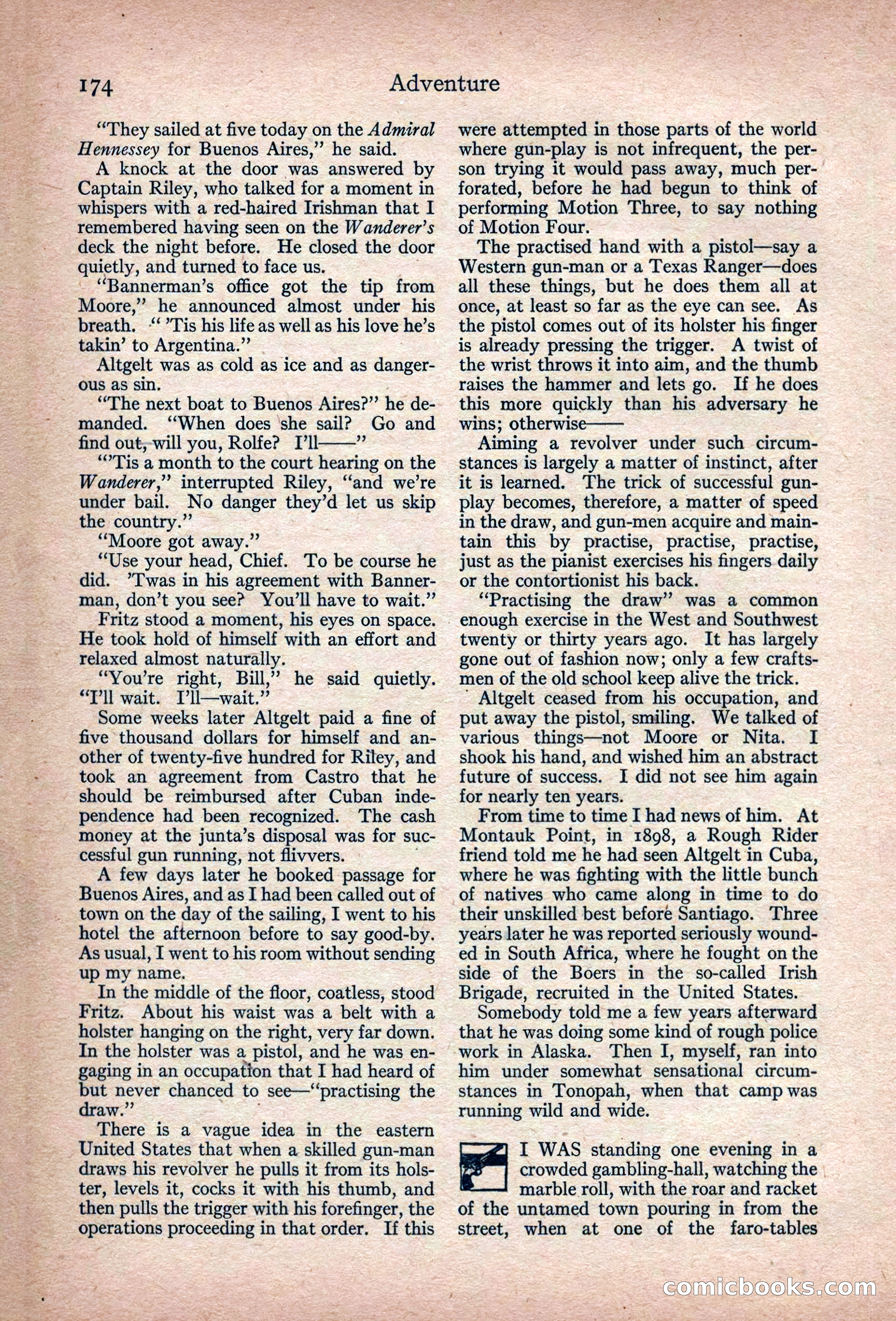
A restored page from Pulp Fiction, 1916. Page through the whole issue in the reader above.
📄 Transcribed text from this page (OCR, searchable)
Machine-transcribed from the original scan — historical spelling and the odd misread are preserved.
174 “They sailed at five today on the Admiral Hennessey for Buenos Aires,’’ he said. A knock at the door was answered by ~ Captain Riley, who talked for a moment in whispers with a red-haired Irishman that I remembered having seen on the Wanderer’s deck the night before. He closed the door quietly, and turned to face us. - “Bannerman’s office got the tip from Moore,” he announced almost under his breath. “‘’Tis his life as well as his love he’s takin’ to Argentina.” Altgelt was as cold as ice and as danger- ous as sin. “The next boat to Buenos Aires?” he de- manded. ‘“‘When does she sail? Go and find out;-will you, Rolfe? T’Il——” “Tis a month to the court hearing on the Wanderer,’ interrupted Riley, ‘“‘and we’re under bail. No danger they’d let us skip the country.” “Moore got away.” “Use your head, Chief. To be course he did. *I'was in his agreement with Banner- man, don’t you see? You'll have to wait.” Fritz stood a moment, his eyes on space. He took hold of himself with an effort and relaxed almost naturally. “You’re right, Bill,” he said quietly. “Tl wait. T’ll—wait.” Some weeks later Altgelt paid a fine of five thousand dollars for himself and an- other of twenty-five hundred for Riley, and took an agreement from Castro that he should be reimbursed after Cuban inde- pendence had been recognized. The cash money at the junta’s disposal was for suc- cessful gun running, not flivvers. A few days later he booked passage for Buenos Aires, and as I had been called out of town on the day of the sailing, I went to his hotel the afternoon before to say good-by. As usual, I went to his room without sending up my name. In the middle of the floor, coatless, stood Fritz. About his waist was a belt with a holster hanging on the right, very far down. In the holster was a pistol, and he was en- gaging in an occupation that I had heard of but never chanced to see—‘practising the draw.” There is a vague idea in the eastern United States that when a skilled gun-man draws his revolver he pulls it from its hols- ter, levels it, cocks it with his thumb, and then pulls the trigger with his forefinger, the operations proceeding in that order. If this Adventure were attempted in those parts of the world © where gun-play is not infrequent, the per- son trying it would pass away, much per- forated, before he had begun to think of performing Motion Three, to say nothing of Motion Four. The practised hand with a pistol—say a Western gun-man or a Texas Ranger—does all these things, but he does them all at once, at least so far as the eye can see. As the pistol comes out of its holster his finger is already pressing the trigger. A twist of the wrist throws it into aim, and the thumb raises the hammer and lets go. If he does this more quickly than his adversary he wins; otherwise—— Aiming a revolver under such circum- stances is largely a matter of instinct, after it is learned. The trick of successful gun- play becomes, therefore, a matter of speed in the draw, and gun-men acquire and main- tain this by practise, practise, practise, just as the pianist exercises his fingers daily or the contortionist his back. “Practising the draw” was a common - enough exercise in the West and Southwest twenty or thirty years ago. It has largely gone out of fashion now; only a few crafts- men of the old school keep alive the trick. - Altgelt ceased from his occupation, and put away the pistol, smiling. We talked of various things—not Moore or Nita. I shook his hand, and wished him an abstract future of success. I did not see him again for nearly ten years. From time to time I had news of him. At Montauk Point, in 1898, a Rough Rider friend told me he had seen Altgelt in Cuba, where he was fighting with the little bunch of natives who came along in time to do their unskilled best before Santiago. Three years later he was reported seriously wound- ed in South Aftica, where he fought on the side of the Boers in the so-called Irish Brigade, recruited in the United States. Somebody told me a few years afterward that he was doing some kind of rough police work in Alaska. Then I, myself, ran into him under somewhat sensational circum- stances in Tonopah, when that camp was running wild and wide. ———) I WAS standing one evening in a a crowded gambling-hall, watching the | marble roll, with the roar and racket of the untamed town pouring in from the street, when at one of the faro-tables JOO (ECON AIC cS (EO)