
Pulp Fiction, 1916 · page 172 of 228
Adventure Magazine, March 1916 — page 172: what you’re looking at
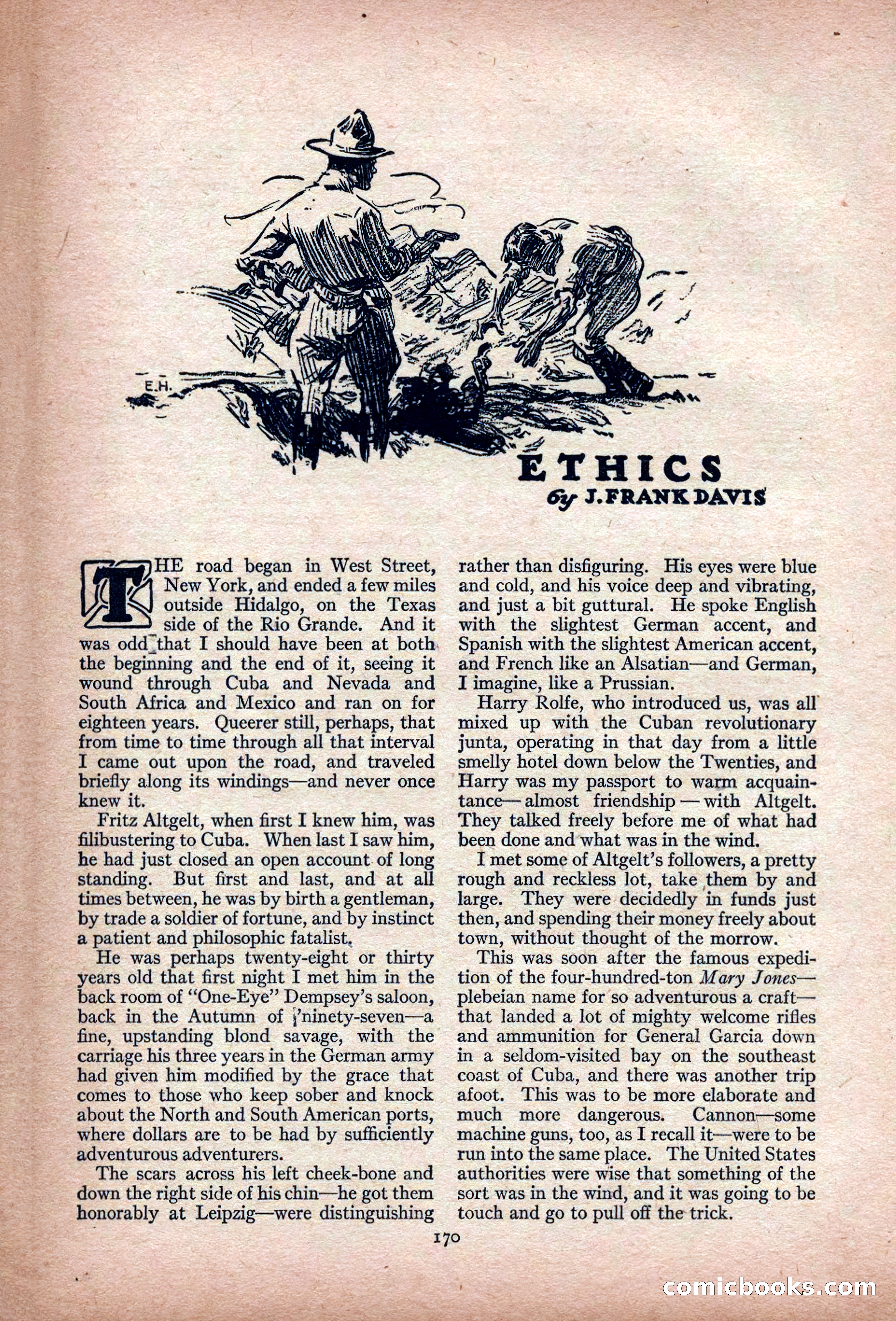
A restored page from Pulp Fiction, 1916. Page through the whole issue in the reader above.
📄 Transcribed text from this page (OCR, searchable)
Machine-transcribed from the original scan — historical spelling and the odd misread are preserved.
w SS oa LoD Oy a Ze a4 = ‘ » ea ee meg) HE road began in West Street, ( | New York, and ended a few miles outside Hidalgo, on the Texas side of the Rio Grande. And it _ Wy was odd _that I should have been at both. the beginning and the end of it, seeing it wound through Cuba and Nevada and South Africa and Mexico and ran on for eighteen years. Queerer still, perhaps, that from time to time through all that interval I came out upon the road, and traveled briefly along its windings—and never once knew it. Fritz Altgelt, when first I knew him, was filibustering to Cuba. When last I saw him, he had just closed an open account. of long standing. But first and last, and at all times between, he was by birth a gentleman, by trade a soldier of fortune, and by instinct a patient and philosophic fatalist, He was perhaps twenty-eight or thirty years old that first night I met him in the back room of “One-Eye”’ Dempsey’ s saloon, back in the Autumn of j’ninety-seven—a fine, upstanding blond savage, with the carriage his three years in the German army had given him modified by the grace that comes to those who keep sober and knock about the North and South American ports, where dollars are to be had by sufficiently adventurous adventurers. The scars across his left cheek-bone and down the right side of his chin—he got them honorably at Leipzig—were distinguishing 6y J.FRANK DAVIS rather than disfiguring. His eyes were blue and cold, and his voice deep and vibrating, and just a bit guttural. He spoke English with the slightest German accent, and Spanish with the slightest American accent, and French like an Alsatian—and German, I imagine, like a Prussian. Harry Rolfe, who introduced us, was all mixed up with the Cuban revolutionary junta, operating in that day from a little smelly hotel down below the Twenties, and Harry was my passport to warm acquain- tance— almost friendship —with Altgelt. They talked freely before me of what had been done and what was in the wind. I met some of Altgelt’s followers, a pretty rough and reckless lot, take them by and large. They were decidedly ‘i in funds just then, and spending their money freely about town, without thought of the morrow. This was soon after the famous expedi- tion of the four-hundred-ton Mary Jones— plebeian name for so adventurous a craft— that landed a lot of mighty welcome rifles and ammunition for General Garcia down in a seldom-visited bay on the southeast coast of Cuba, and there was another trip afoot. This was to be more elaborate and much more dangerous. Cannon—some machine guns, too, as I recall it—were to be run into the same place. The United States authorities were wise that something of the sort was in the wind, and it was going to be touch and go to pull off the trick. 170 co | comicbooks