
Pulp Fiction, 1916 · page 134 of 228
Adventure Magazine, March 1916 — page 134: what you’re looking at
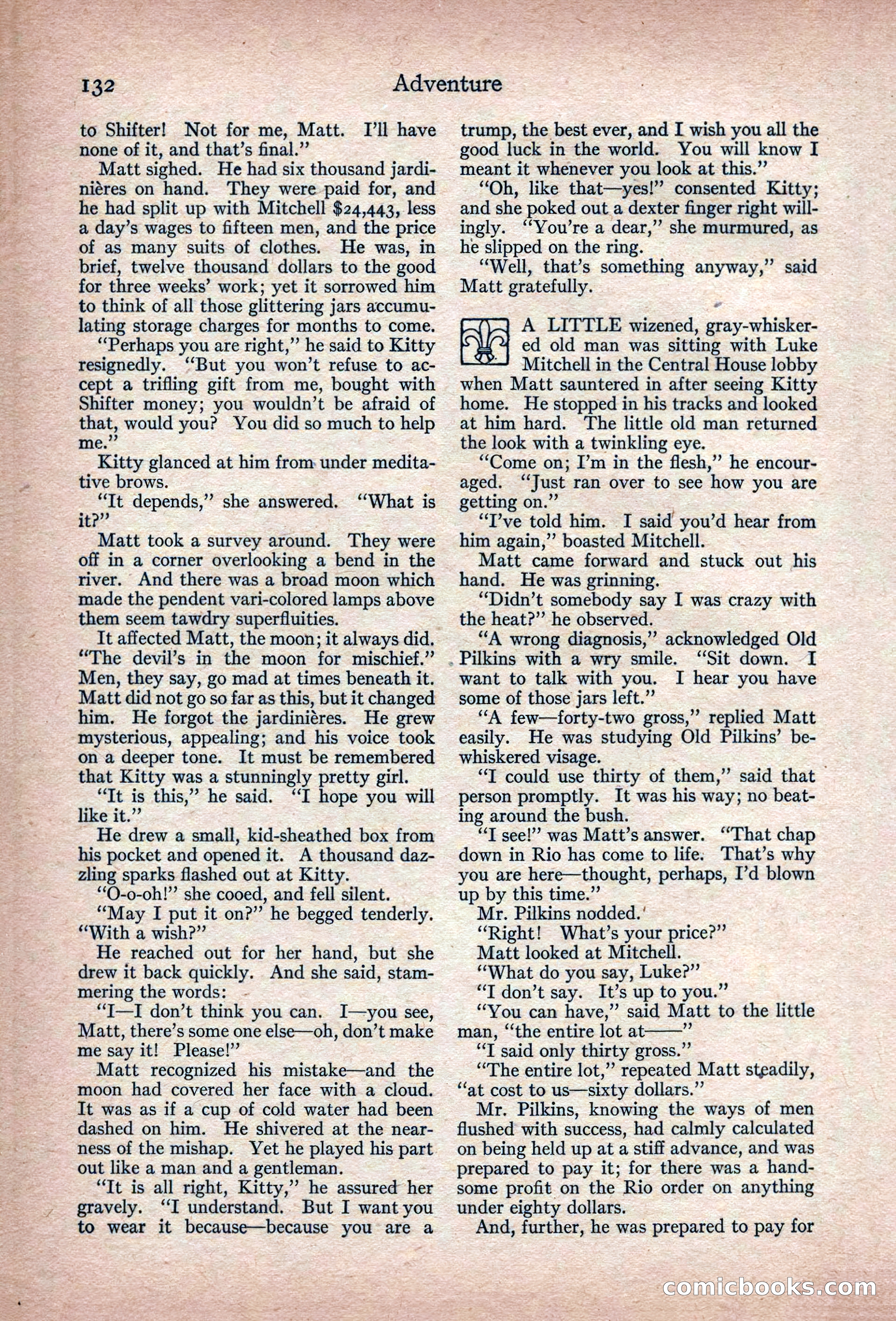
A restored page from Pulp Fiction, 1916. Page through the whole issue in the reader above.
📄 Transcribed text from this page (OCR, searchable)
Machine-transcribed from the original scan — historical spelling and the odd misread are preserved.
Awe Yrs 132 to Shifter! Not for me, Matt. I’ll have none of it, and that’s final.”’ Matt sighed. He had six thousand jardi- niéres on hand. They were paid for, and he had split up with Mitchell $24,443, less a day’s wages to fifteen men, and the price of as many suits of clothes. He was, in brief, twelve thousand dollars to the good for three weeks’ work; yet it sorrowed him to think of all those glittering jars accumu- lating storage charges for months to come. “Perhaps you are right,” he said to Kitty resignedly. ‘“But you won’t refuse to ac- cept a trifling gift from me, bought with Shifter money; you wouldn’t be afraid of that, would you? You did so much to help me.” Kitty glanced at him from under medita- tive brows. “Tt depends,” she answered. ‘‘What is it?” | Matt took a survey around. They were off in a corner overlooking a bend in the river. And there was a broad moon which made the pendent vari-colored lamps above them seem tawdry superfluities. It affected Matt, the moon; it always did. “The devil’s in the moon for mischief.” Men, they say, go mad at times beneath it. Matt did not go so far as this, but it changed him. He forgot the jardiniéres. He grew mysterious, appealing; and his voice took on a deeper tone. It must be remembered that Kitty was a stunningly pretty girl. “Tt is this,” he said. “I hope you will like it.” He drew a small, kid-sheathed box from his pocket and opened it. A thousand daz- zling sparks flashed out at Kitty. ““Q-o-oh!”’ she cooed, and fell silent. “May I put it on?” he begged tenderly. “With a wish?” He reached out for her hand, but she drew it back quickly. And she said, stam- mering the words: “T—I don’t think you can. I—you see, Matt, there’s some one else—oh, don’t make me say it! Please!” Matt recognized his mistake—and the moon had covered her face with a cloud. It was as if a cup of cold water had been dashed on him. He shivered at the near- ness of the mishap. Yet he played his part out like a man and a gentleman. “Tt is all right, Kitty,’ he assured her gravely. “I understand. But I want you to wear it because—because you are a . Pilkins with a wry smile. Adventure trump, the best ever, and I wish you all the — good luck in the world. You will know I meant it whenever you look at this.” “Oh, like that—yes!” consented Kitty; and she poked out a dexter finger right will- ingly. “You’re a dear,’ she murmured, as he slipped on the ring. “Well, that’s something anyway,” said Matt gratefully. AR A LITTLE wizened, gray-whisker- a'¢ ed old man was sitting with Luke <I Mitchell in the Central House lobby when Matt sauntered in after seeing Kitty home. He stopped in his tracks and looked at him hard. The little old man returned the look with a twinkling eye. “‘Come on; I’m in the flesh,” he encour- aged. “Just ran over to see how you are getting on.” “T’ve told him. I said you’d hear from him again,” boasted Mitchell. Matt came forward and stuck out his hand. He was grinning. “Didn’t somebody say I was crazy with the heat?” he observed. “A wrong diagnosis,’ acknowledged Old “Sit down. I want to talk with you. I hear you have some of those jars left.” “A few—forty-two gross,” replied Matt easily. He was studying Old Pilkins’ be- whiskered visage. “T could use thirty of them,’’ said that — person promptly. It was his way; no beat- ing around the bush. “T see!” was Matt’s answer. “That chap down in Rio has come to life: That’s why you are here—thought, perhaps, I’d blown up by this time.” Mr. Pilkins nodded. ' “Right! What’s your price?” Matt looked at Mitchell. “What do you say, Luke?” “T don’t say. It’s up to you.” “Vou can have,’ said Matt to the little man, “‘the entire lot at = “T said only thirty gross.” “The entire lot,’’ repeated Matt steadily, “at cost to us—sixty dollars.” Mr. Pilkins, knowing the ways of men flushed with success, had calmly calculated on being held up at a stiff advance, and was prepared to pay it; for there was a hand- some profit on the Rio order on anything under eighty dollars. And, further, he was prepared to pay for ‘;comicbooks con