
Pulp Fiction, 1916 · page 130 of 228
Adventure Magazine, March 1916 — page 130: what you’re looking at
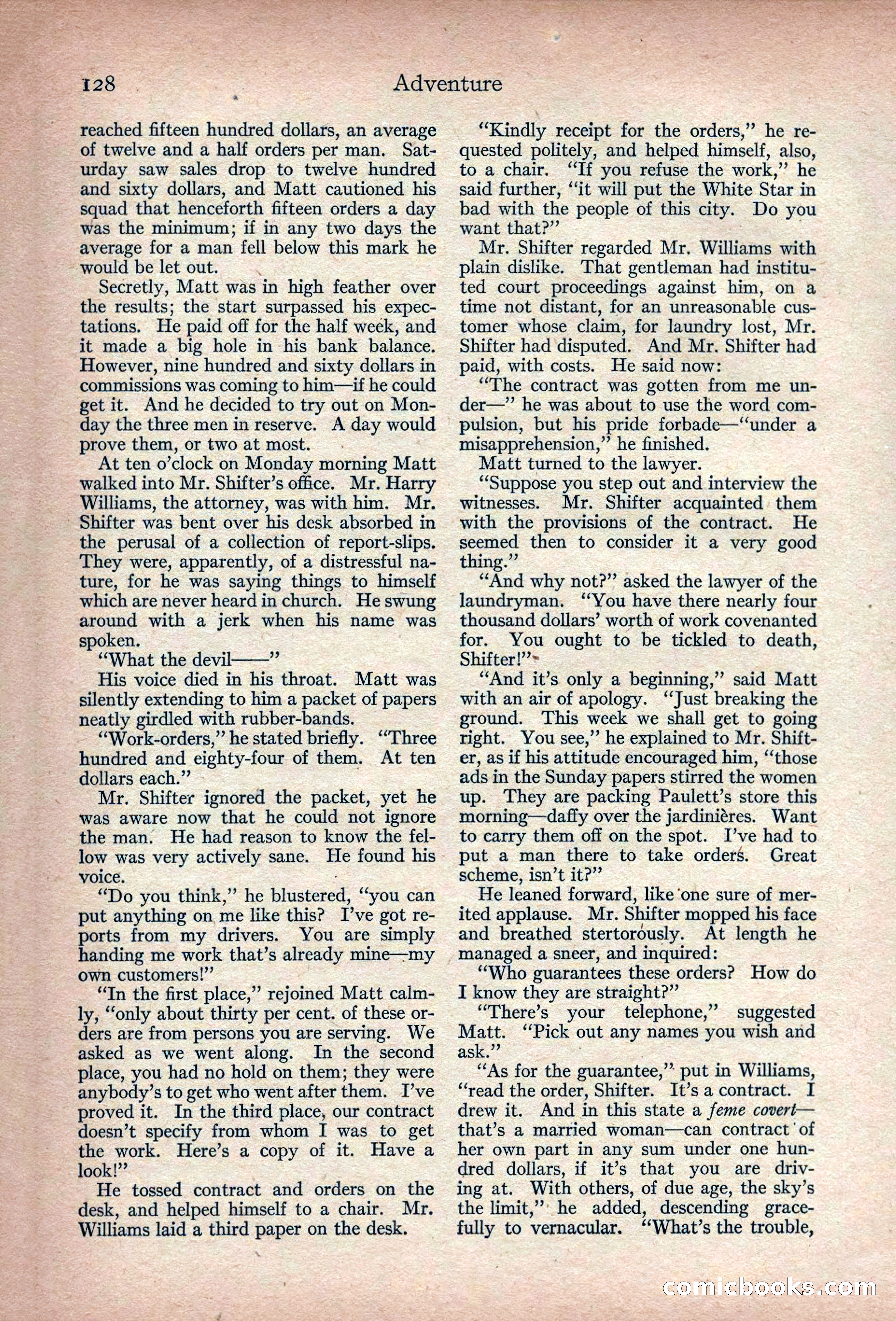
A restored page from Pulp Fiction, 1916. Page through the whole issue in the reader above.
📄 Transcribed text from this page (OCR, searchable)
Machine-transcribed from the original scan — historical spelling and the odd misread are preserved.
{28 reached fifteen hundred dollars, an average of twelve and a half orders per man. Sat- urday saw sales drop to twelve hundred and sixty dollars, and Matt cautioned his squad that henceforth fifteen orders a day was the minimum; if in any two days the average for a man fell below this mark he would be let out. Secretly, Matt was in high feather over the results; the start surpassed his expec- tations. He paid off for the half week, and it made a big hole in his bank balance. However, nine hundred and sixty dollars in commissions was coming to him—if he could get it. And he decided to try out on Mon- day the three men in reserve. A day would prove them, or two at most. At ten o’clock on Monday morning Matt walked into Mr. Shifter’s office. Mr. Harry Williams, the attorney, was with him. Mr. - Shifter was bent over his desk absorbed in the perusal of a collection of report-slips. They were, apparently, of a distressful na- ture, for he was saying things to himself which are never heard in church. He swung around with a jerk when his name was spoken. “What the devil——”’ His voice died in his throat. Matt was silently extending to him a packet of papers neatly girdled with rubber-bands. “‘Work-orders,” he stated briefly. “Three hundred and eighty-four of them. At ten dollars each.” - Mr. Shifter ignored the packet, yet he was aware now that he could not ignore the man. He had reason to know the fel- low was very actively sane. He found his - voice. “To you think,” he blustered, “you can put anything on me like this? I’ve got re- ports from my drivers. You are simply handing me work that’s already mine—my own customers!” “Tn the first place,” rejoined Matt calm- ly, “only about thirty per cent. of these or- ders are from persons you are serving. We asked as we went along. In the second place, you had no hold on them; they were anybody’s to get who went after them. I’ve proved it. In the third place, our contract doesn’t specify from whom I was to get the work. Here’s a copy of it. Have a look!”’ He tossed contract and orders on the desk, and helped himself to a chair. Mr. Williams laid a third paper on the desk. Adventure “Kindly receipt for the orders,” he re- quested politely, and helped himself, also, to a chair. “If you refuse the work,’ he said further, “it will put the White Star in bad with the people of this city. Do you want that?” : Mr. Shifter regarded Mr. Williams with plain dislike. That gentleman had institu- ted court proceedings against him, on a time not distant, for an unreasonable cus- tomer whose claim, for laundry lost, Mr. Shifter had disputed. And Mr. Shifter had paid, with costs. He said now: “The contract was gotten from me un- der—” he was about to use the word com- pulsion, but his pride forbade—“under a misapprehension,” he finished. Matt turned to the lawyer. “Suppose you step out and interview the witnesses. Mr. Shifter acquainted them with the provisions of the contract. He seemed then to consider it a very good thing.” “And why not?” asked the lawyer of the Jaundryman. ‘You have there nearly four thousand dollars’ worth of work covenanted for. You ought to be tickled to death, Shifter!’ “And it’s only a beginning,”’ said Matt with an air of apology. ‘Just breaking the ground. This week we shall get to going right. You see,” he explained to Mr. Shift- er, as if his attitude encouraged him, “‘those ads in the Sunday papers stirred the women up. They are packing Paulett’s store this morning—daffy over the jardiniéres. Want to carry them off on the spot. I’ve had to put a man there to take orders. Great scheme, isn’t it?”’ He leaned forward, like‘one sure of mer- ited applause. Mr. Shifter mopped his face and breathed stertorously. At length he managed a sneer, and inquired: “Who guarantees these orders? How do I know they are straight?” “There’s your telephone,’ suggested Matt. ‘Pick out any names you wish and ask.” 3 ‘“‘As for the guarantee,’’ put in Williams, “‘read the order, Shifter. It’s a contract. I drew it. And in this state a feme covert— that’s a married woman—can contract ‘of her own part in any sum under one hun- dred dollars, if it’s that you are driv- ing at. With others, of due age, the sky’s the limit,”’ he added, descending grace- fully to vernacular. ‘‘What’s the trouble, ee ee a ee he deen Se!) ae eee ee ee a eee Oe ee et ee eee, 2 ee ee ee PHS OS on ase Se oe - Ng ~~ adnan 7 be ae ay Oe em, ne OE Enel atk Wig Mg 7 | ~ . ares . Ms - = Se Senge Cas OTL ae Oe” LE ee ne OP ee ge gm. ey GOMIE S 0)(0)(6)