
Pulp Fiction, 1916 · page 13 of 228
Adventure Magazine, March 1916 — page 13: what you’re looking at
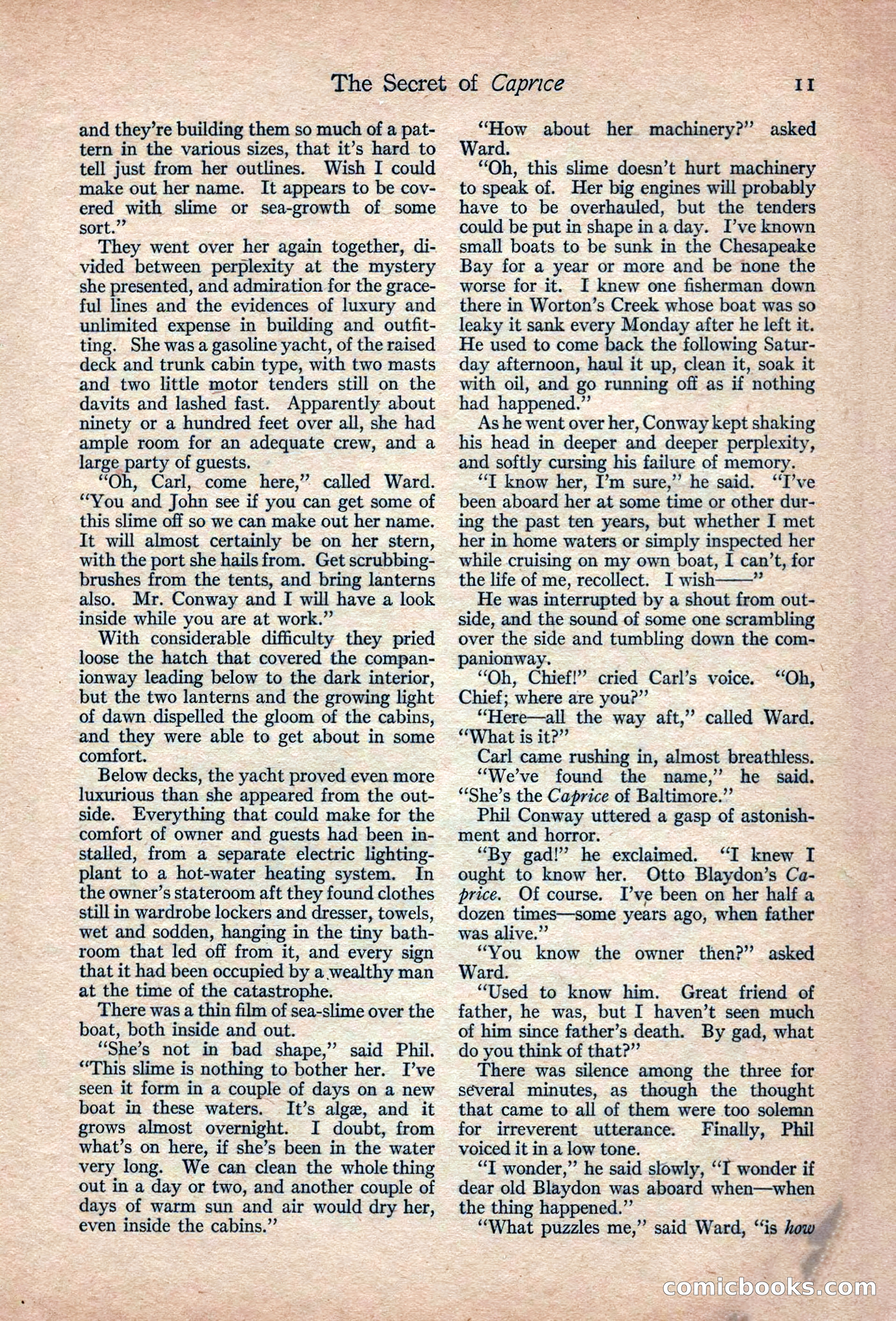
A restored page from Pulp Fiction, 1916. Page through the whole issue in the reader above.
📄 Transcribed text from this page (OCR, searchable)
Machine-transcribed from the original scan — historical spelling and the odd misread are preserved.
The Secret of Caprice and they’re building them so much of a pat- tern in the various sizes, that it’s hard to tell just from her outlines. Wish I could make out her name. It appears to be cov- ered with slime or sea-growth of some sort.” They went over her again together, di- vided between perplexity at the mystery she presented, and admiration for the grace- ful lines and the evidences of luxury and unlimited expense in building and outfit- ting. She was a gasoline yacht, of the raised deck and trunk cabin type, with two masts and two little motor tenders still on the davits and lashed fast. Apparently about ninety or a hundred feet over all, she had ample room for an adequate crew, and a large party of guests. “Oh, Carl, come here,” called Ward. “You and John see if you can get some of this slime off so we can make out her name. It will almost certainly be on her stern, with the port she hails from. Get scrubbing- brushes from the tents, and bring lanterns also. Mr. Conway and I will have a look inside while you are at wor With considerable difficulty they pried loose the hatch that covered the compan- ionway leading below to the dark interior, but the two lanterns and the growing light of dawn dispelled the gloom of the cabins, and they were able to get about in some comfort. : Below decks, the yacht proved even more luxurious than she appeared from the out- side. Everything that could make for the comfort of owner and guests had been in- stalled, from a separate electric lighting- plant to a hot-water heating system. In the owner’s stateroom aft they found clothes still in wardrobe lockers and dresser, towels, wet and sodden, hanging in the tiny bath- room that led off from it, and every sign that it had been occupied by a wealthy man at the time of the catastrophe. There was a thin film of sea-slime over the boat, both inside and out. “She? s not in bad shape,” said Phil. “This slime is nothing to bother her. I’ve seen it form in a couple of days on a new boat in these waters. It’s alge, and it grows almost overnight. I doubt, from what’s on here, if she’s been in the water very long. We can clean the whole thing out in a day or two, and another couple of days of warm sun and air would dry her, even inside the cabins.” If “How about her machinery?” asked Ward. “Oh, this slime doesn’t hurt machinery to speak of. Her big engines will probably have to be overhauled, but the tenders could be put in shape ina day. I’ve known small boats to be sunk in the Chesapeake Bay for a year or more and be none the | worse for it. I knew one fisherman down there in Worton’s Creek whose boat was so leaky it sank every Monday after he left it. He used to come back the following Satur- day afternoon, haul it up, clean it, soak it with oil, and go running off as if nothing had happened. e : As he went over her, Conway kept shaking his head in deeper and deeper perplexity, and softly cursing his failure of memory. “T know her, I’m sure,’”’ he said. “I’ve been aboard her at some time or other dur- ing the past ten years, but whether I met her in home waters or simply inspected her while cruising on my own boat, I can’t, for the life of me, recollect. I wish——” He was interrupted by a shout from out- side, and the sound of some one scrambling over ule a. and tumbling down the com- panion “Oh, Chief! !” cried Carl’s voice. Chief; ‘where are your” “Here—all the way aft,” called Ward. “What is it?” Carl came rushing in, almost breathless. “We've found the name,” he “She’s the Caprice of Baltimore.” Phil Conway uttered a gasp of astonish- ment and horror. “By gad!” he exclaimed. “I knew I ought to know her. Otto Blaydon’s Ca- price. Of course. I’ve been on her half a dozen times—some years ago, when father was alive.” “You know the owner then?” Ward. “Used to know him. Great friend of father, he was, but I haven’t seen much of him since father’s death. By gad, what do you think of that?” There was silence among the three for séveral minutes, as though the thought that came to all of them were too solemn for irreverent utterance. Finally, Phil voiced it in a low tone. | “T wonder,” he said slowly, “I wonder if dear old Blaydon was aboard when—when the thing happened.”’ ‘‘What puzzles me,” said Ward, “is how “Oh, asked ry . _ _ micboo S (E) = a (E(0)