
Pulp Fiction, 1916 · page 11 of 228
Adventure Magazine, March 1916 — page 11: what you’re looking at
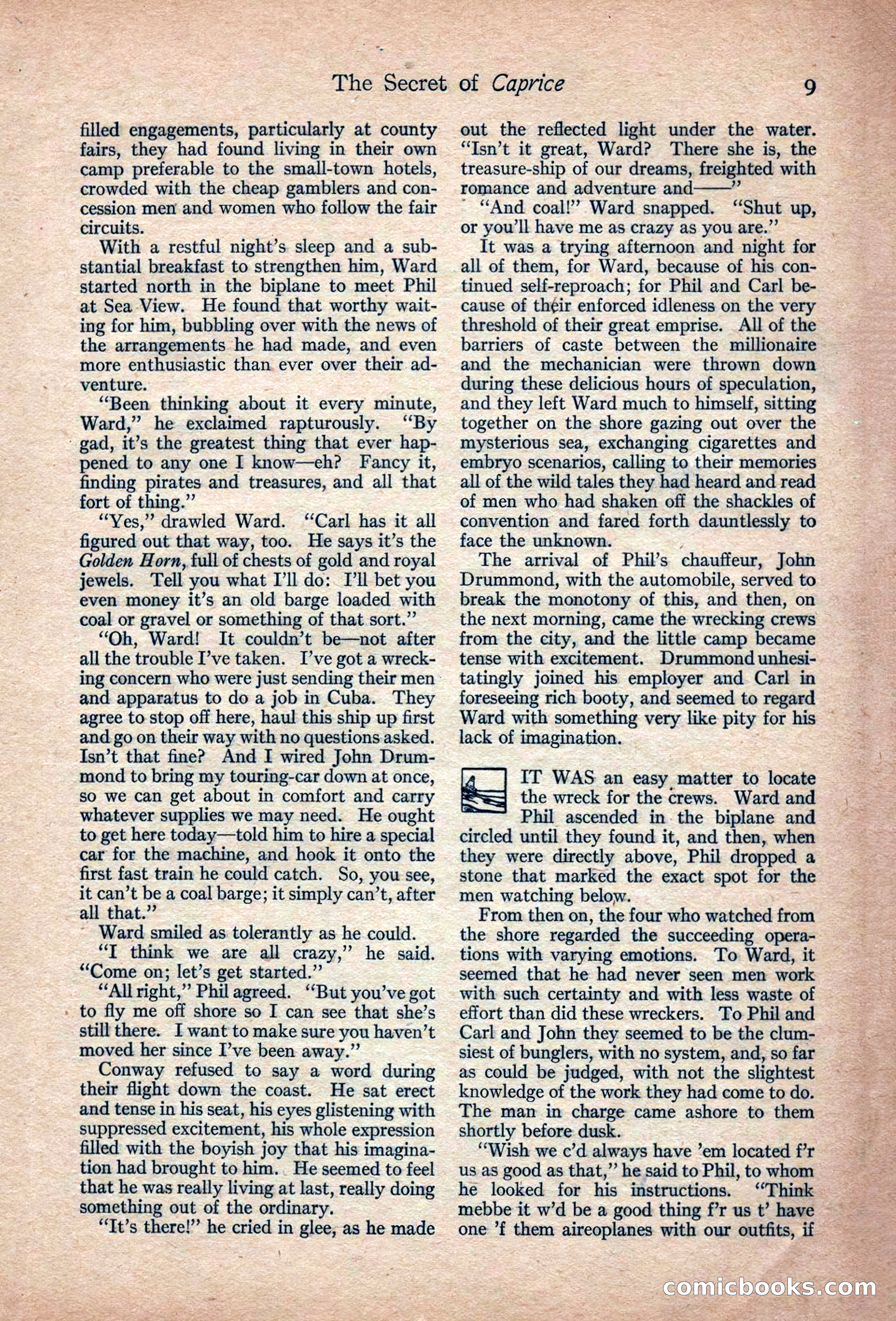
A restored page from Pulp Fiction, 1916. Page through the whole issue in the reader above.
📄 Transcribed text from this page (OCR, searchable)
Machine-transcribed from the original scan — historical spelling and the odd misread are preserved.
The Secret filled engagements, particularly at county fairs, they had found living in their own camp preferable to the small-town hotels, crowded with the cheap gamblers and con- cession men and women who follow the fair circuits. With a restful night’s sleep and a sub- stantial breakfast to strengthen him, Ward started north in the biplane to meet Phil at Sea View. He found that worthy wait- ing for him, bubbling over with the news of the arrangements he had made, and even more enthusiastic than ever over their ad- venture. “Been thinking about it every minute, Ward,” he exclaimed rapturously. “By gad, it’s the greatest thing that ever hap- pened to any one I know—eh? Fancy it, finding pirates and treasures, and all that fort of thing.” “Yes,” drawled Ward. “Carl has it all figured out that way, too. He says it’s the Golden Horn, full of chests of gold and royal jewels. Tell you what I'll do: Pll bet you even money it’s an old barge loaded with coal or gravel or something of that sort.” “Oh, Ward! It couldn’t be—not after all the trouble I’ve taken. I’ve got a wreck- ing concern who were just sending their men» and apparatus to do a job in Cuba. They agree to stop off here, haul this ship up first and go on their way with no questions. asked. Isn’t that fine? And I wired John Drum- mond to bring my touring-car down at once, so we can get about in comfort and carry whatever supplies we may need. He ought to get here today—told him to hire a special car for the machine, and hook it onto the first fast train he could catch. So, you see, it can’t be a coal barge; it simply can’t, after all that.” ~ Ward smiled as tolerantly as he could. “YT think we are all crazy,” he said. “Come on; let’s get started.” “Allright,” Phil agreed. “But you’ve got - to fly me off shore so I can see that she’s still there. I want to make sure you haven’t moved her since I’ve been away.” Conway refused to say a word during their flight down the coast. He sat erect and tense in his seat, his eyes glistening with suppressed excitement, his whole expression filled with the boyish joy that his imagina- tion had brought to him... He seemed to feel that he was really living at last, really doing something out of the ordinary. “It’s there!’’ he cried in glee; as he made of Caprice out the reflected light under the water. “Isn’t it great, Ward? There she is, the treasure-ship of our dreams, freighted with romance and adventure and——” _ “And coal!’ Ward snapped. “Shut up, or you'll have me as crazy as you are.” It was a trying afternoon and night for : all of them, for Ward, because of his con- tinued self-reproach; for Phil and Carl be- cause of their enforced idleness on the very threshold of their great emprise. All of the barriers of caste between the millionaire and the mechanician were thrown down during these delicious hours of speculation, and they left Ward much to himself, sitting together on the shore gazing out over the mysterious sea, exchanging cigarettes and embryo scenarios, calling to their memories all of the wild tales they had heard and read of men who had shaken off the shackles of convention and fared forth dauntlessly to face the unknown. : The arrival of Phil’s chauffeur, John Drummond, with the automobile, served to break the monotony of this, and then, on the next morning, came the wrecking crews from the city, and the little camp became tense with excitement. Drummond unhesi- tatingly joined his employer and Carl in foreseeing rich booty, and seemed to regard Ward with something very like pity for his — lack of imagination. 14 | IT WAS an easy matter to locate Ss «othe wreck for the crews. Ward and : Phil ascended in. the biplane and circled until they found it, and then, when they were directly above, Phil dropped a stone that marked the exact spot for the men watching below. From then on, the four who watched from the shore regarded the succeeding opera- tions with varying emotions. To Ward, it seemed that he had never seen men work with such certainty and with less waste of effort than did these wreckers. To Phil and Carl and John they seemed to be the clum- siest of bunglers, with no system, and, so far as could be judged, with not the slightest knowledge of the work they had come to do. The man in charge came ashore to them shortly before dusk. ‘Wish we c’d always have ’em located f’r us as good as that,”’ he said to Phil, to whom he looked for his instructions. “Think mebbe it w’d be a good thing f’r us t’ have one ’f them aireoplanes with our outfits, if “comicboo CO ee > rape