
Pulp Fiction, 1915 · page 93 of 228
Adventure, November 1915 — page 93: what you’re looking at
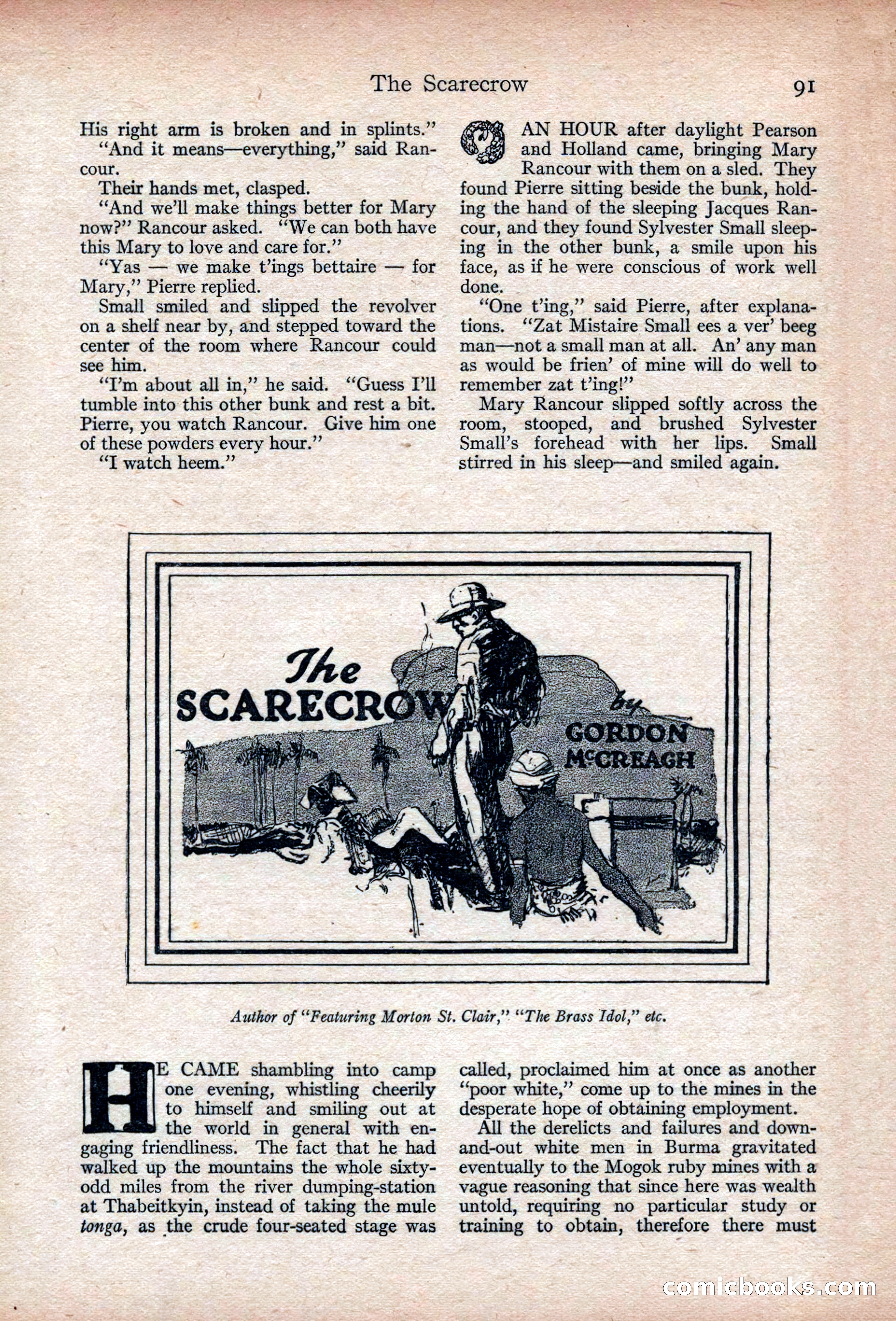
A restored page from Pulp Fiction, 1915. Page through the whole issue in the reader above.
📄 Transcribed text from this page (OCR, searchable)
Machine-transcribed from the original scan — historical spelling and the odd misread are preserved.
ore ee sree Fn Nr en ee oe | ee . sa. .& é His right arm is broken and in splints.” “And it means—everything,” said Ran- cour. Their hands met, clasped. “And we'll make things better for Mary now?” Rancour asked. ‘“‘We can both have this Mary to love and care for.”’ “Vas — we make t’ings bettaire — for Mary,” Pierre replied. Small smiled and slipped the revolver on a shelf near by, and stepped toward the center of the room where Rancour could see him. “T’m about all in,” he said. “Guess I'll tumble into this other bunk and rest a bit. Pierre, you watch Rancour. Give him one of these powders every hour.” . “T watch heem.”’ | remember zat t’ing OI AN HOUR after daylight Pearson and Holland came, bringing Mary Rancour with them on a sled. They found Pierre sitting beside the bunk, hold- ing the hand of the sleeping Jacques Ran- cour, and they found Sylvester Small sleep- ing in the other bunk, a smile upon his face, as if he were conscious of work well done. “One t’ing,” said Pierre, after explana- tions. ‘‘Zat Mistaire Small ees a ver’ beeg man—not a small man at all. An’ any man as would be frien’ of mine will do well to 2? ? Mary Rancour slipped softly across the room, stooped, and brushed Sylvester Small’s forehead with her lips. Small stirred in his sleep—and smiled again. Author of “Featuring Morton St. Clair,’ “The Brass Idol,” etc. E CAME shambling into camp one evening, whistling cheerily to himself and smiling out at the world in general with en- gaging friendliness. The fact that he had walked up the mountains the whole sixty- odd miles from the river dumping-station at Thabeitkyin, instead of taking the mule tonga, as the crude four-seated stage was called, proclaimed him at once as another “poor white,’”’ come up to the mines in the desperate hope of obtaining employment. All the derelicts and failures and down- and-out white men in Burma gravitated eventually to the Mogok ruby mines with a vague reasoning that since here was wealth untold, requiring no particular study or training to obtain, therefore there must Gomichboo S com