
Pulp Fiction, 1915 · page 76 of 228
Adventure, November 1915 — page 76: what you’re looking at
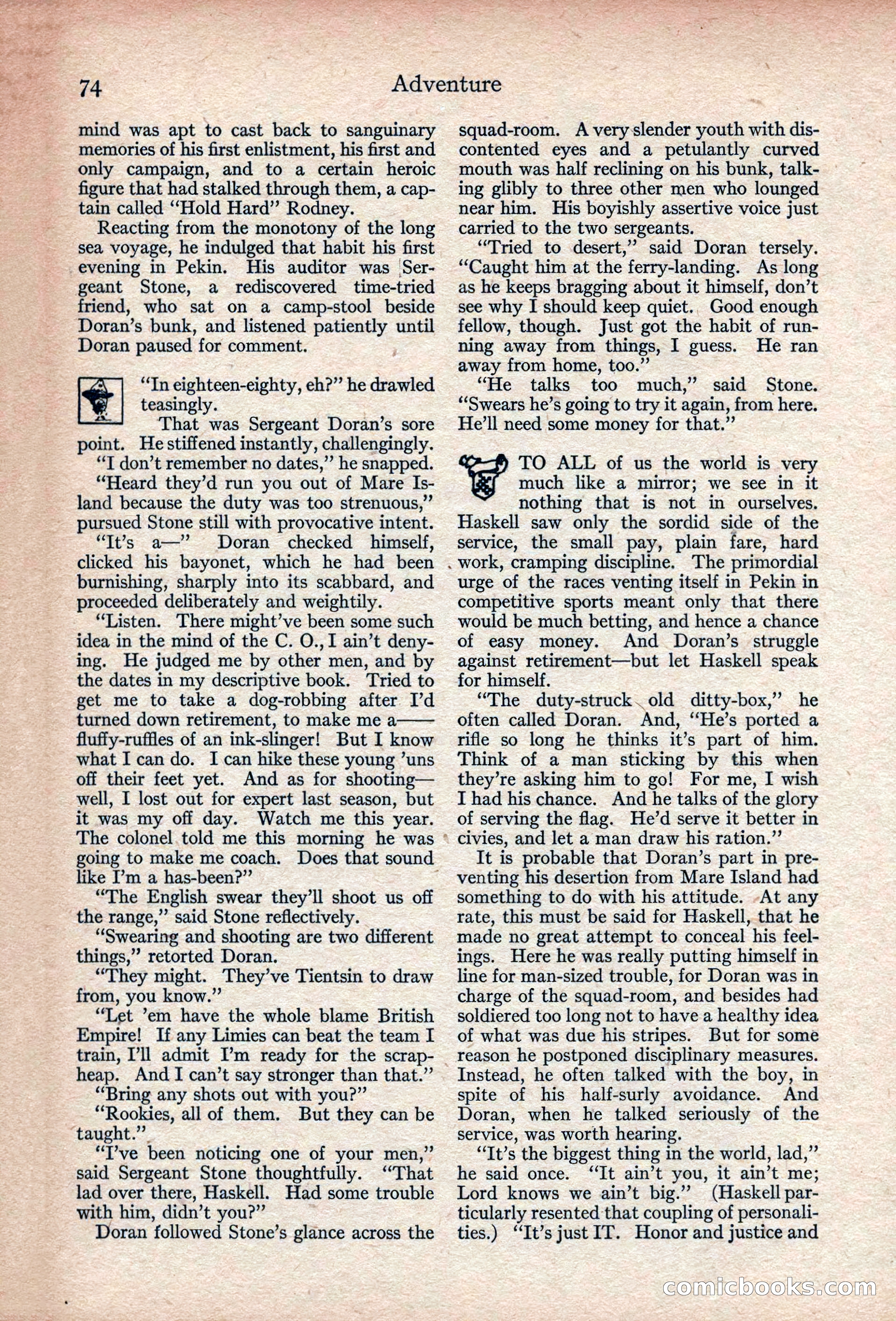
A restored page from Pulp Fiction, 1915. Page through the whole issue in the reader above.
📄 Transcribed text from this page (OCR, searchable)
Machine-transcribed from the original scan — historical spelling and the odd misread are preserved.
eet ee La a 74 mind was apt to cast back to sanguinary memories of his first enlistment, his first and only campaign, and to a certain heroic figure that had stalked through them, a cap- tain called ““Hold Hard” Rodney. Reacting from the monotony of the long sea voyage, he indulged that habit his first evening in Pekin. His auditor was Ser- geant Stone, a rediscovered time-tried friend, who sat on a camp-stool beside Doran’s bunk, and listened patiently until Doran paused for comment. : teasingly. ha That was Sergeant Doran’s sore point. Hestiffened instantly, challengingly. “T don’t remember no dates,” he snapped. “Heard they’d run you out of Mare Is- land because the duty was too strenuous,” pursued Stone still with provocative intent. “Tt’s a—’ Doran checked himself, clicked his bayonet, which he had been burnishing, sharply into its scabbard, and proceeded deliberately and weightily. “Listen. There might’ve been some such idea in the mind of the C. O.,I ain’t deny- ing. He judged me by other men, and by the dates in my descriptive book. Tried to get me to take a dog-robbing after I’d turned down retirement, to make me a—— fluffy-ruffles of an ink-slinger! But I know what I can do. I can hike these young ’uns off their feet yet. And as for shooting— well, I lost out for expert last season, but it was my off day. Watch me this year. “Tn eighteen-eighty, eh?” he drawled The colonel. told me this morning he was ° going to make me coach. Does that sound like I’m a has-been?” “The English swear they'll shoot us off the range,” said Stone reflectively. “Swearing and shooting are two different things,”’ retorted Doran. “They might. They’ve Tientsin to draw from, you know.” “Let ’em have the whole blame British Empire! If any Limies can beat the team I train, Pll admit I’m ready for the scrap- | heap. And I can’t say stronger than that.” “Bring any shots out with your” “Rookies, all of them. But they can be taught.” “T’ve been noticing one of your men,” said Sergeant Stone thoughtfully. ‘That lad over there, Haskell. Had some trouble with him, didn’t you?” Doran followed Stone’s glance across the Adventure squad-room. A veryslender youth with dis- contented eyes and a petulantly curved mouth was half reclining on his bunk, talk- ing glibly to three other men who lounged near him. His boyishly assertive voice just carried to the two sergeants. “Tried to desert,” said Doran tersely. “Caught him at the ferry-landing. As long as he keeps bragging about it himself, don’t see why I should keep quiet.. Good enough fellow, though. Just got the habit of run- ning away from things, I guess. He ran away from home, too.” “He talks too much,” said Stone. ““Swears he’s going to try it again, from here. He’ll need some money for that.”’ TO ALL of us the world is very much like a mirror; we see in it nothing that is not in ourselves. Haskell saw only the sordid side of the service, the small pay, plain fare, hard . work, cramping discipline. The primordial urge of the races venting itself in Pekin in competitive sports meant only that there would be much betting, and hence a chance of easy money. And Doran’s struggle against retirement—but let Haskell speak for himself. “The duty-struck. old ditty-box,” he often called Doran. And, ‘“‘He’s ported a rifle so long he thinks it’s part of him. Think of a man sticking by this when they’re asking him to go! For me, I wish I had his chance. And he talks of the glory of serving the flag. He’d serve it better in civies, and let a man draw his ration.” It is probable that Doran’s part in pre- venting his desertion from Mare Island had something to do with his attitude. -At any rate, this must be said for Haskell, that he made no great attempt to conceal his feel- ings. Here he was really putting himself in line for man-sized trouble, for Doran was in charge of the squad-room, and besides had soldiered too long not to have a healthy idea of what was due his stripes. But for some reason he postponed disciplinary measures. Instead, he often talked with the boy, in | spite of his half-surly avoidance. And Doran, when he talked seriously of the service, was worth hearing. “Tt’s the biggest thing in the world, lad,” he said once. “It ain’t you, it ain’t me; Lord knows we ain’t big.” (Haskell par- ticularly resented that coupling of personali- ties.) ‘It’s just IT. Honor and justice and Eomichbooks (C@