
Pulp Fiction, 1915 · page 40 of 228
Adventure, November 1915 — page 40: what you’re looking at
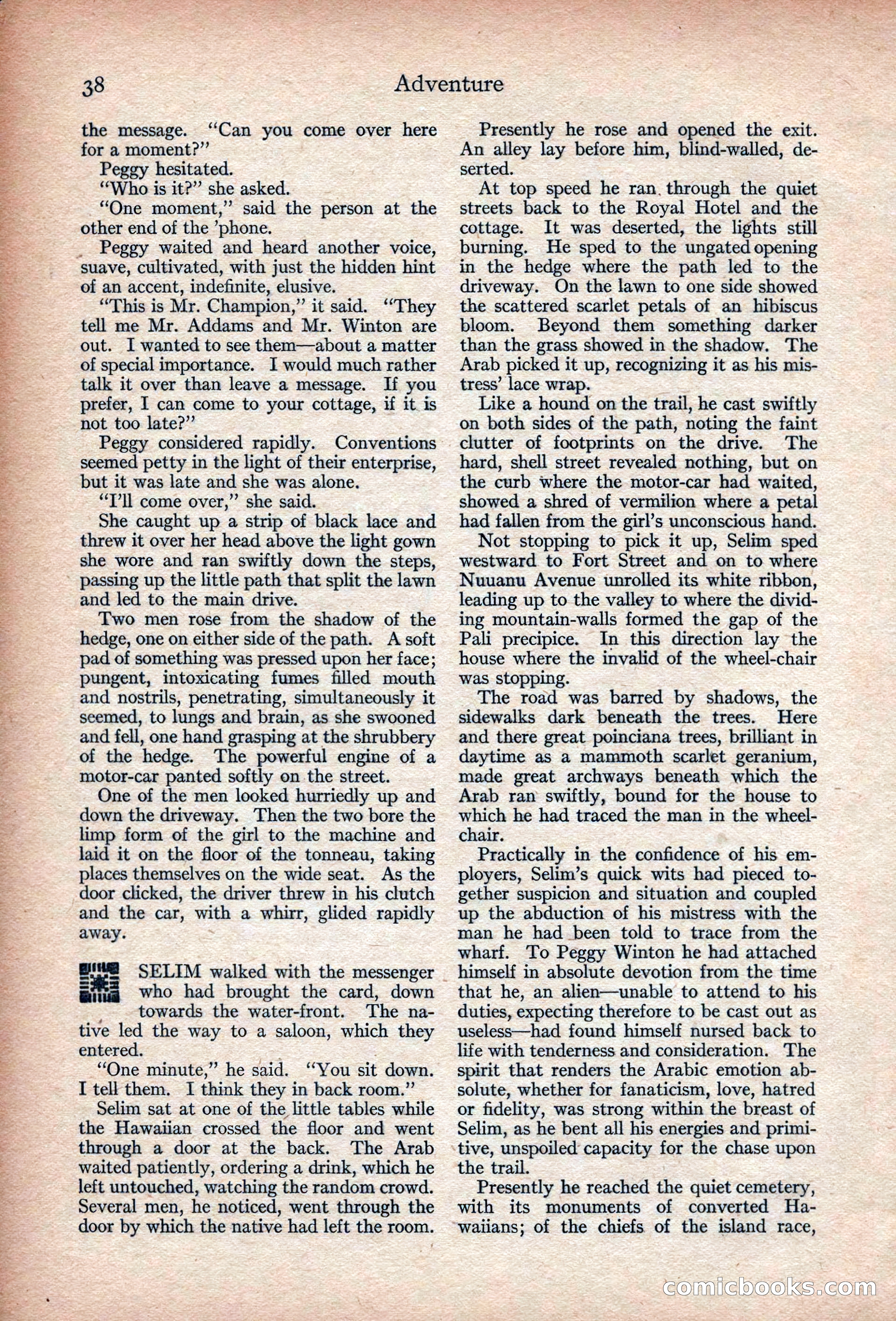
A restored page from Pulp Fiction, 1915. Page through the whole issue in the reader above.
📄 Transcribed text from this page (OCR, searchable)
Machine-transcribed from the original scan — historical spelling and the odd misread are preserved.
> we Phd ot ath ee eke SS Pe LANE eh coy Soe Be : hee RTRs OA Sa) Per pee NS a ee ‘Wit hae ‘ yf hy “ fy hay ‘ ; cay ey ferent ARr or > 4 The " a! ye f . r Pal Dads Le RS Vee Fein Wal th , ite 7 ‘ : tate v ie i ‘ S Ao> boas aL AAA 4 Ul Ante nit X ar i be i A at Ver; » SNRs ly CAF a“ 9 $2 Ha) peo 4 5 Fi et es We i) Ce , Vey ya aiieh Ve . ast . . b rs : NV . : ‘ ae 7 : ris ‘ x ric ys \ ‘ ' , ee), he is Ais Cian AEA LS i de etal aM NG is ib aha al dC 38 Adventure the message. ‘“‘Can you come over here for a moment?”’ Peggy hesitated. ‘Who is it?” she asked. “One moment,” said the person at the other end of the ’phone. Peggy waited and heard another voice, ‘suave, cultivated, with just the hidden hint of an accent, indefinite, elusive. “This is Mr. Champion,” it said. “They tell me Mr. Addams and Mr. Winton are out. I wanted to see them—about a matter of special importance. I would much rather talk it over than leave a message. If you prefer, I can come to your cottage, if it is not too late?” Peggy considered rapidly. Conventions seemed petty in the light of their enterprise, but it was late and she was alone. “T’ll come over,” she said. She caught up a strip of black lace and threw it over her head above the light gown she wore and ran swiftly down the steps, - passing up the little path that split the lawn and led to the main drive. Two men rose from the shadow of the hedge, one on either side of the path. A soft pad of something was pressed upon her face; pungent, intoxicating fumes filled mouth and nostrils, penetrating, simultaneously it seemed, to lungs and brain, as she swooned and fell, one hand grasping at the shrubbery of the hedge. The powerful engine of a motor-car panted softly on the street. One of the men looked hurriedly up and down the driveway. Then the two bore the limp form of the girl to the machine and laid it on the floor of the tonneau, taking places themselves on the wide seat. As the door clicked, the driver threw in his clutch and the car, with a whirr, glided rapidly away. gig SELIM walked with the messenger | Eis who had brought the card, down towards the water-front. The na- tive led the way to a saloon, which they entered. . “One minute,” he said. ‘“You sit down. I tell them. I think they in back room.” Selim sat at one of the little tables while the Hawaiian crossed the floor and went through a door at the back. The Arab waited patiently, ordering a drink, which he left untouched, watching the random crowd. Several men, he noticed, went through the door by which the native had left the room. Presently he rose and opened the exit. An alley lay before him, blind-walled, de- serted. At top speed he ran. through the quiet streets back to the Royal Hotel and the cottage. It was deserted, the lights still burning. He sped to the ungated opening in the hedge where the path led to the driveway. On the lawn to one side showed the scattered scarlet petals of an hibiscus bloom. Beyond them something darker than the grass showed in the shadow. The Arab picked it up, recognizing it as his mis- tress’ lace wrap. Like a hound on the trail, he cast swiftly on both sides of the path, noting the faint clutter of footprints on the drive. The hard, shell street revealed nothing, but on the curb where the motor-car had waited, showed a shred of vermilion where a petal had fallen from the girl’s unconscious hand. Not stopping to pick it up, Selim sped westward to Fort Street and on to where Nuuanu Avenue unrolled its white ribbon, leading up to the valley to where the divid- ing mountain-walls formed the gap of the Pali precipice. In this direction lay the house where the invalid of the wheel-chair was stopping. The road was barred by shadows, the sidewalks dark beneath the trees. Here and there great poinciana trees, brilliant in daytime as a mammoth scarlet geranium, made great archways beneath which the Arab ran swiftly, bound for the house to which he had traced the man in the wheel- chair. Practically in the confidence of his em- ployers, Selim’s quick wits had pieced to- gether suspicion and situation and coupled up the abduction of his mistress with the man he had been told to trace from the wharf. To Peggy Winton he had attached himself in absolute devotion from the time that he, an alien—unable to attend to his duties, expecting therefore to be cast out as useless—had found himself nursed back to life with tenderness and consideration. The spirit that renders the Arabic emotion ab- solute, whether for fanaticism, love, hatred or fidelity, was strong within the breast of Selim, as he bent all his energies and primi- ‘tive, unspoiled capacity for the chase upon the trail. Presently he reached the quiet cemetery, with its monuments of converted Ha- “waiians; of the chiefs of the island race, (CO PMICLOOOKS (€©) LAL