
Pulp Fiction, 1915 · page 37 of 228
Adventure, November 1915 — page 37: what you’re looking at
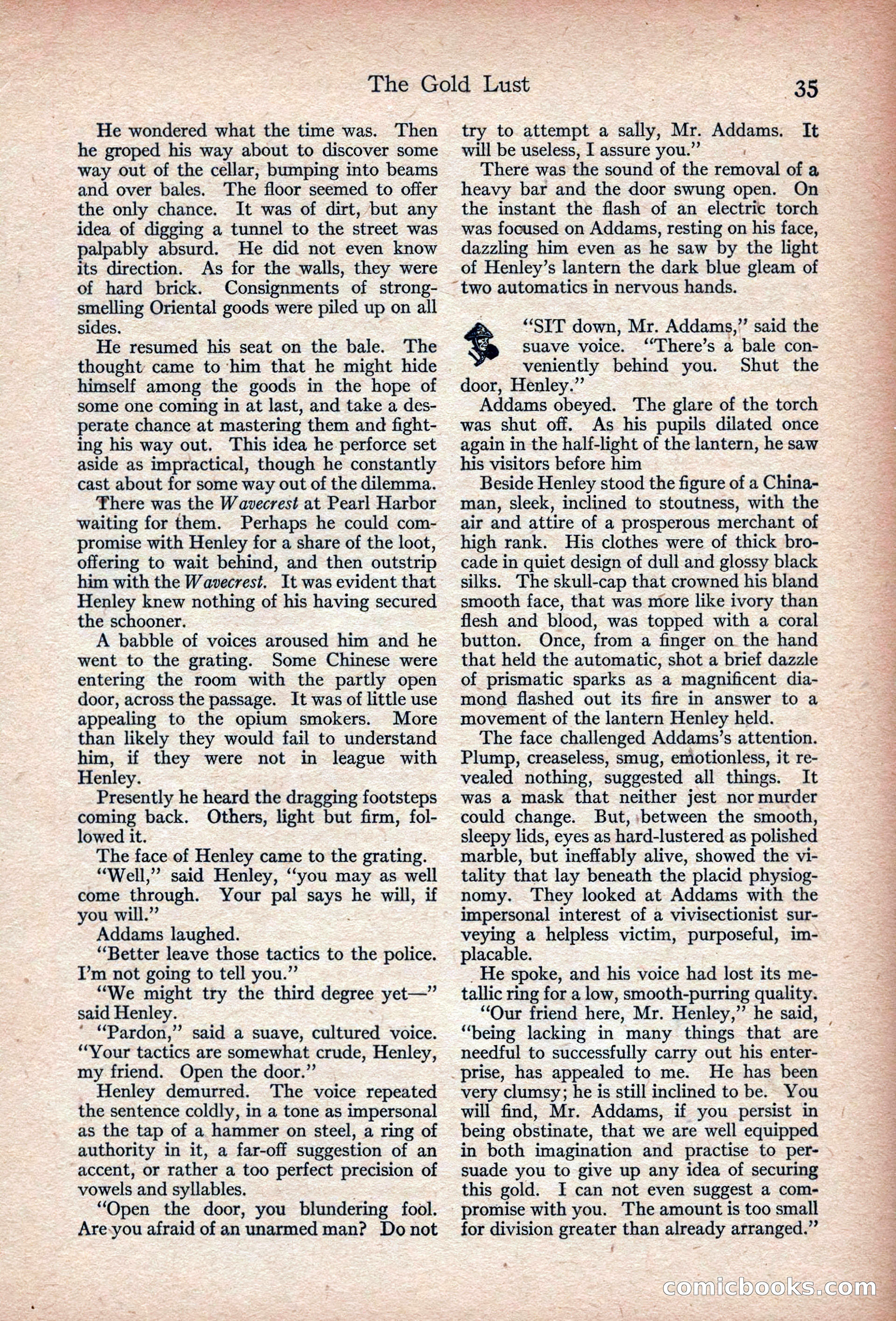
A restored page from Pulp Fiction, 1915. Page through the whole issue in the reader above.
📄 Transcribed text from this page (OCR, searchable)
Machine-transcribed from the original scan — historical spelling and the odd misread are preserved.
The Gold Lust He wondered what the time was. Then he groped his way about to discover some way out of the cellar, bumping into beams and over bales. The floor seemed to offer the only chance. It was of dirt, but any idea of digging a tunnel to the street was palpably absurd. He did not even know its direction. As for the walls, they were of hard brick. Consignments of strong- smelling Oriental goods were piled up on all sides. He resumed his seat on the bale. The thought came to him that he might hide himself among the goods in the hope of some one coming in at last, and take a des- perate chance at mastering them and fight- ing his way out. This idea he perforce set aside as impractical, though he constantly cast about for some way out of the dilemma. There was the Wavecrest at Pearl Harbor waiting for them. Perhaps he could com- promise with Henley for a share of the loot, offering to wait behind, and then outstrip him with the Wavecrest. It was evident that Henley knew nothing of his having secured the schooner. A babble of voices aroused him and he went to the grating. Some Chinese were entering the room with the partly open door, across the passage. It was of little use appealing to the opium smokers. More than likely they would fail to understand him, if they were not in league with Henley. Presently he heard the dragging footsteps coming back. Others, light but firm, fol- lowed it. The face of Henley came to the grating. “Well,” said Henley, “you may as well come through. Your pal cre he will, if you will.” Addams laughed. “Better leave those tactics to the police. I’m not going to tell you.” “We might try the third degree yet—” said Henley. * “Pardon,” said a suave, cultured voice. “Your tactics are somewhat crude, Henley, my friend. Open the door.” Henley demurred. The voice repeated the sentence coldly, in a tone as impersonal as the tap of a hammer on steel, a ring of authority in it, a far-off suggestion of an accent, or rather a too perfect precision of vowels and syllables. “Open the door, you blundering fool. Are-you afraid of an ‘unarmed man? Do not prise, has appealed to me. 35 try to attempt a sally, Mr. Addams. It will be useless, I assure you.”’ There was the sound of the removal of a heavy bar and the door swung open. On the instant the flash of an electric torch was focused on Addams, resting on his face, dazzling him even as he saw by the light of Henley’s lantern the dark blue gleam of “two automatics in nervous hands. “SIT down, Mr. Addams,” said the RS suave voice. ‘There’s a bale con- veniently behind you. Shut the door, Henley.’ Addams obeyed. The glare of the torch was shut off. As his pupils dilated once again in the half-light of the lantern, he saw his visitors before him Beside Henley stood the figure of a China- man, sleek, inclined to stoutness, with the air and attire of a prosperous merchant of high rank. His clothes were of thick bro- cade in quiet design of dull and glossy black silks. The skull-cap that crowned his bland smooth face, that was more like ivory than flesh and blood, was topped with a coral button. Once, from a finger on the hand that held the automatic, shot a brief dazzle of prismatic sparks as a magnificent dia- mond flashed out its fire in answer to a movement of the lantern Henley held. The face challenged Addams’s attention. Plump, creaseless, smug, emotionless, it re- vealed nothing, suggested all things. It was a mask that neither jest nor murder could change. But, between the smooth, sleepy lids, eyes as hard-lustered as polished marble, but ineffably alive, showed the vi- tality that lay beneath the placid physiog- nomy. They looked at Addams with the impersonal interest of a vivisectionist sur- veying a helpless victim, purposeful, im- placable. He spoke, and his voice had lost its me- tallic ring for a low, smooth-purring quality. “Our friend here, Mr. Henley,” he said, — “being lacking in many things that are needful to successfully carry out his enter- He has been very clumsy; he is still inclined to be. You will find, Mr. Addams, if you persist in being obstinate, that we are well equipped in both imagination and practise to per- suade you to give up any idea of securing this gold. I can not even suggest a com- promise with you. The amount is too small for division greater than already arranged.” 9)(0)(0) AIC S (CE) (EO) m: Tae - “ » , i4 4 rs » i