
Pulp Fiction, 1915 · page 222 of 228
Adventure, November 1915 — page 222: what you’re looking at
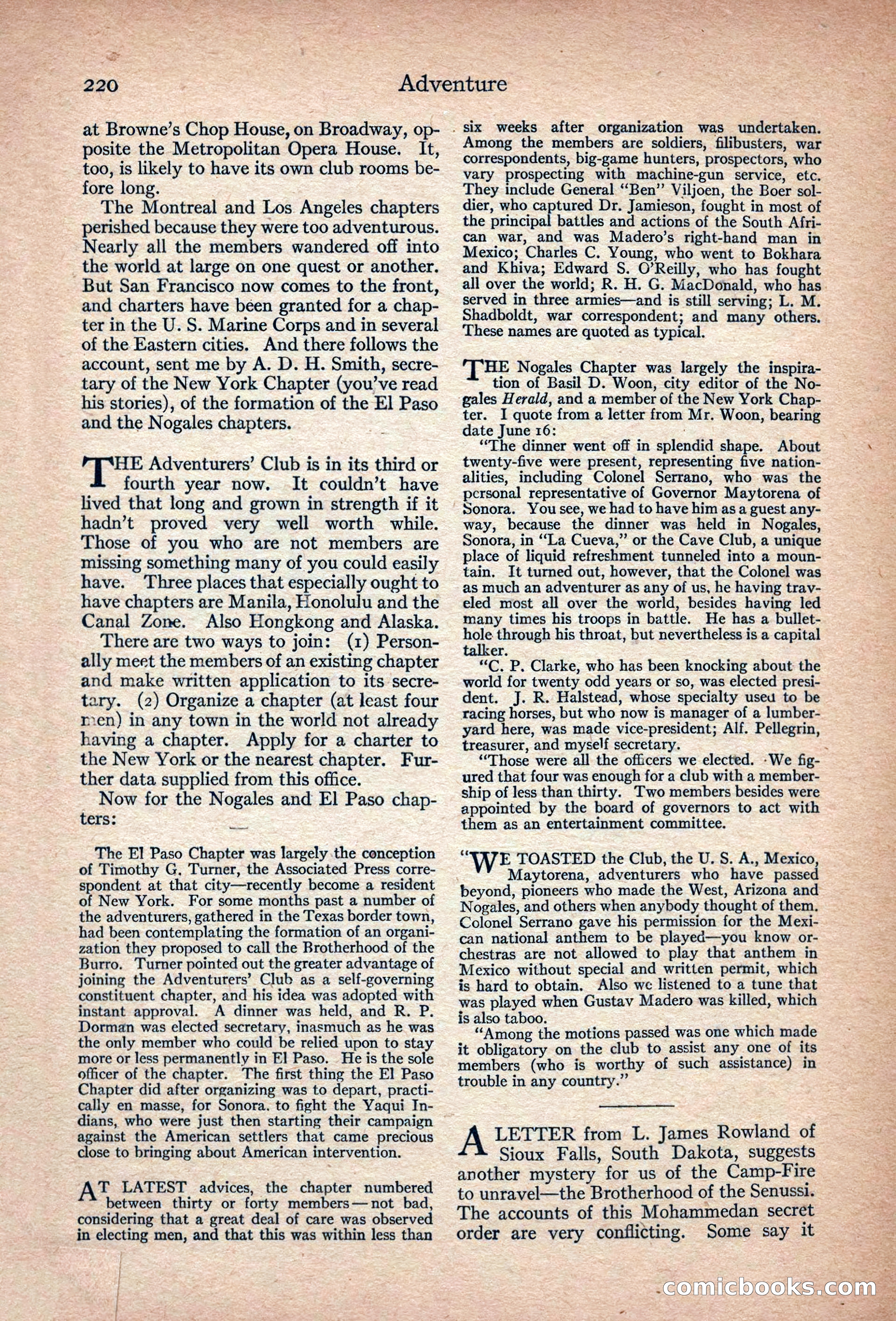
A restored page from Pulp Fiction, 1915. Page through the whole issue in the reader above.
📄 Transcribed text from this page (OCR, searchable)
Machine-transcribed from the original scan — historical spelling and the odd misread are preserved.
ms ee 220 at Browne’s Chop House, on Broadway, op- posite the Metropolitan Opera House. It, too, is likely to have its own club rooms be- fore long. The Montreal and Los Angeles chapters perished because they were too adventurous. Nearly all the members wandered off into the world at large on one quest or another. But San Francisco now comes to the front, and charters have béen granted for a chap- ter in the U. S. Marine Corps and in several of the Eastern cities. And there follows the account, sent me by A. D. H. Smith, secre- tary of the New York Chapter (you’ve read his stories), of the formation of the El Paso and the Nogales chapters. HE Adventurers’ Club is in its third or fourth year now. It couldn’t have lived that long and grown in strength if it hadn’t proved very well worth while. Those of you who are not members are missing something many of you could easily have. Three places that especially ought to have chapters are Manila, Honolulu and the Canal Zone. Also Hongkong and Alaska. There are two ways to join: (1) Person- ally meet the members of an existing chapter and make written application to its secre- tary. (2) Organize a chapter (at least four men) in any town in the world not already having a chapter. Apply for a charter to the New York or the nearest chapter. Fur- ther data supplied from this office. Now for the Nogales and El Paso chap- ters: The El Paso Chapter was largely the conception of Timothy G, Turner, the Associated Press corre- spondent at that city—recently become a resident of New York. For some months past a number of the adventurers, gathered in the Texas border town, had been contemplating the formation of an organi- zation they proposed to call the Brotherhood of the Burro. Turner pointed out the greater advantage of joining the Adventurers’ Club as a self-governing constituent chapter, and his idea was adopted with instant approval. A dinner was held, and R. P. Dorman was elected secretary, inasmuch as he was the only member who could be relied upon to stay more or less permanently in El Paso. He is the sole officer of the chapter. The first thing the El Paso Chapter did after organizing was to depart, practi- cally en masse, for Sonora. to fight the Yaqui In- dians, who were just then starting their campaign against the American settlers that came precious close to bringing about American intervention. At LATEST advices, the chapter numbered between thirty or forty members—not bad, considering that a great deal of care was observed in electing men, and that this was within less than ' Adventure . six weeks after organization was undertaken. Among the members are soldiers, filibusters, war correspondents, big-game hunters, prospectors, who vary prospecting with machine-gun service, etc. They include General “Ben” Viljoen, the Boer sol- dier, who captured Dr. Jamieson, fought in most of the principal battles and actions of the South Afri- can war, and was Madero’s right-hand man in Mexico; Charles C. Young, who went to Bokhara and Khiva; Edward S. O’Reilly, who has fought all over the world; R. H. G. MacDonald, who has. served in three armies—and is still serving; L. M. Shadboldt, war correspondent; and many others. These names are quoted as typical. HE Nogales Chapter was largely the inspira- tion of Basil D. Woon, city editor of the No- gales Herald, and a member of the New York Chap- ter. I quote from a letter from Mr. Woon, bearing date June 16: : ‘“‘The dinner went off in splendid shape. About twenty-five were present, representing five nation- alities, including Colonel Serrano, who was the personal representative of Governor Maytorena of Sonora. You see, we had to have him as a guest any- way, because the dinner was held in Nogales, Sonora, in ‘‘La Cueva,” or the Cave Club, a unique place of liquid refreshment tunneled into a moun- tain. It turned out, however, that the Colonel was as much an adventurer as any of us, he having tray- eled most all over the world, besides having led many times his troops in battle. He has a bullet- hole through his throat, but nevertheless is a capital cer. “C, P. Clarke, who has been knocking about the world for twenty odd years or so, was elected presi- dent. J. R. Halstead, whose specialty useu to be racing horses, but who now is manager of a lumber- yard here, was made vice-president; Alf. Pellegrin, treasurer, and myself secretary. ‘Those were all the officers we elected. -We fig- ured that four was enough for a club with a member- ship of less than thirty. —Two members besides were appointed by the board of governors to act with them as an entertainment committee. “WWE TOASTED the Club, the U. S. A., Mexico, Maytorena, adventurers who have passed beyond, pioneers who made the West, Arizona and Nogales, and others when anybody thought of them. Colonel Serrano gave his permission for the Mexi- can national anthem to be played—you know or- chestras are not allowed to play that anthem in Mexico without special and written permit, which is hard to obtain. Also we listened to a tune that was played when Gustav Madero was killed, which is also taboo. : “Among the motions passed was one which made it obligatory on the club to assist any one of its members (who is worthy of such assistance) in trouble in any country.” A LETTER from L. James Rowland of Sioux Falls, South Dakota, suggests another mystery for us of the Camp-Fire to unravel—the Brotherhood of the Senussl. The accounts of this Mohammedan secret order are very conflicting. Some say it “S “EOMICDOO