
Pulp Fiction, 1915 · page 216 of 228
Adventure, November 1915 — page 216: what you’re looking at
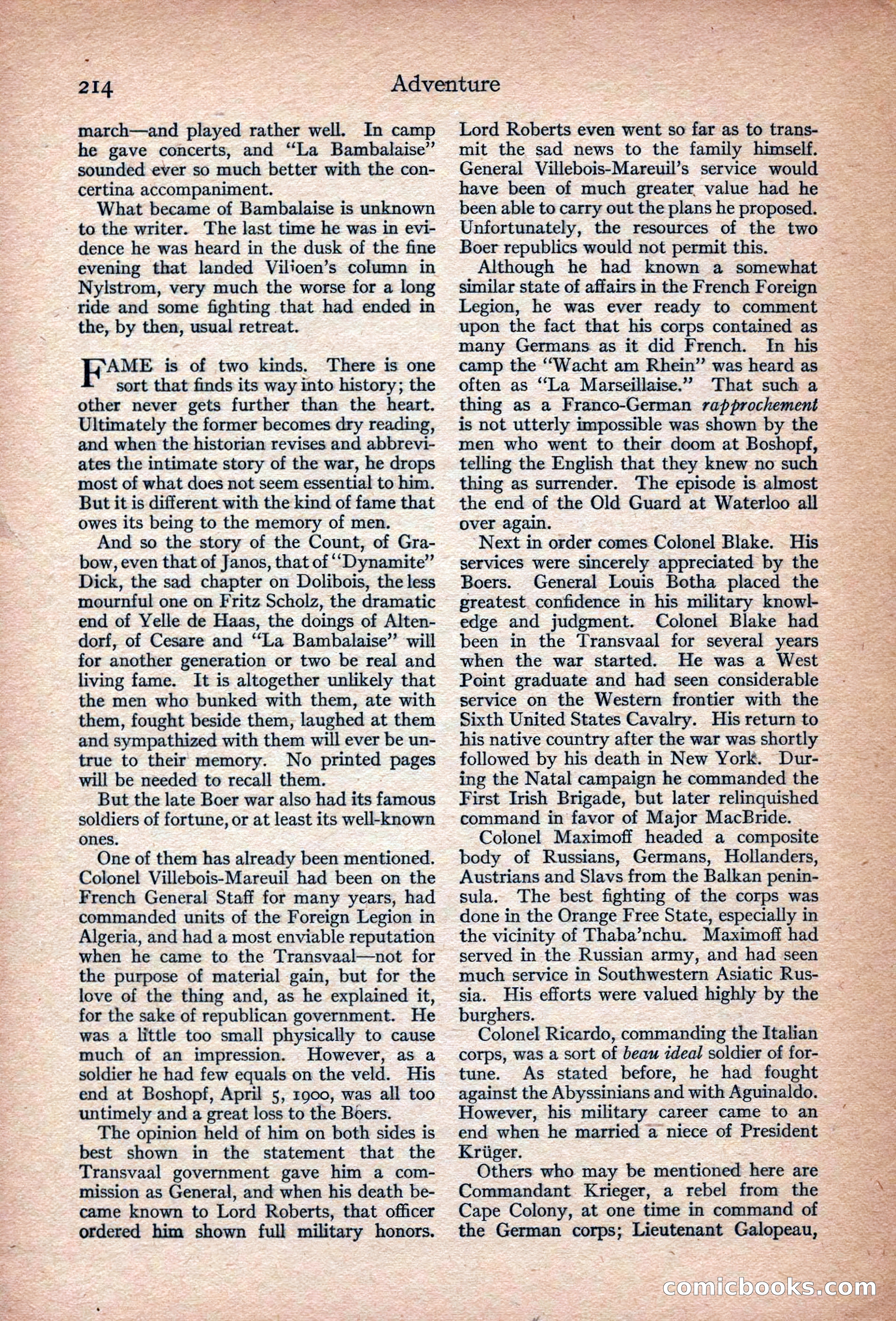
A restored page from Pulp Fiction, 1915. Page through the whole issue in the reader above.
📄 Transcribed text from this page (OCR, searchable)
Machine-transcribed from the original scan — historical spelling and the odd misread are preserved.
214 march—and played rather well. In camp he gave concerts, and “La Bambalaise”’ sounded ever so much better with the con- certina accompaniment. What became of Bambalaise is unknown - to the writer. The last time he was in evi- dence he was heard in the dusk of the fine evening that landed Vilioen’s column in Nylstrom, very much the worse for a long - ride and some fighting that had ended in the, by then, usual retreat. AME is of two kinds. There is one sort that finds its way into history; the other never gets further than the heart. Ultimately the former becomes dry reading, and when the historian revises and abbrevi- ates the intimate story of the war, he drops most of what does not seem essential to him. But it is different with the kind of fame that owes its being to the memory of men. And so the story of the Count, of Gra- bow, even that of Janos, that of ““Dynamite” Dick, the sad chapter on Dolibois, the less mournful one on Fritz Scholz, the dramatic end of Yelle de Haas, the doings of Alten- dorf, of Cesare and “La Bambalaise”’ will for another generation or two be real and living fame. It is altogether unlikely that the men who bunked with them, ate with them, fought beside them, laughed at them and sympathized with them will ever be un- true to their memory. No printed pages will be needed to recall them. 3 But the late Boer war also had its famous soldiers of fortune, or at least its well-known ones. One of them has already been mentioned. Colonel Villebois-Mareuil had been on the French General Staff for many years, had commanded units of the Foreign Legion in Algeria, and had a most enviable reputation when he came to the Transvaal—not for the purpose of material gain, but for the love of the thing and, as he explained it, for the sake of republican government. He was a little too small physically to cause much of an impression. However, as a soldier he had few equals on the veld. His end at Boshopf, April 5, 1900, was all too untimely and a great loss to the Boers. The opinion held of him on both sides is best shown in the statement that the Transvaal government gave him a com- mission as General, and when his death be- came known to Lord Roberts, that officer ordered him shown full military honors. Adventure Lord Roberts even went so far as to trans- mit the sad news to the family himself. General Villebois-Mareuil’s service would have been of much greater value had he been able to carry out the plans he proposed. Unfortunately, the resources of the two Boer republics would not permit this. Although he had known a somewhat similar state of affairs in the French Foreign Legion, he was ever ready to comment © upon the fact that his corps contained as many Germans as it did French. In his camp the “Wacht am Rhein” was heard as often as “La Marseillaise.” That such a thing as a Franco-German rapprochement —_ is not utterly impossible was shown by the men who went to their doom at Boshopf, telling the English that they knew no such thing as surrender. The episode is almost the end of the Old Guard at Waterloo all over again. Next in order comes Colonel Blake. His services were sincerely appreciated by the Boers. General Louis Botha placed the greatest. confidence in his military knowl- edge and judgment. Colonel Blake had been in the Transvaal for several years when the war started. He was a West Point graduate and had seen considerable service on the Western frontier with the Sixth United States Cavalry. His return to his native country after the war was shortly followed by his death in New York. Dur- — ing the Natal campaign he commanded the | First Irish Brigade, but later relinquished command in favor of Major MacBride. Colonel Maximoff headed a composite body of Russians, Germans, Hollanders, Austrians and Slavs from the Balkan penin- sula. The best fighting of the corps was done in the Orange Free State, especially in the vicinity of Thaba’nchu. Maximoff had served in the Russian army, and had seen much service in Southwestern Asiatic Rus- sia. His efforts were valued highly by the burghers. Colonel Ricardo, commanding the Italian corps, was a sort of beau ideal soldier of for- tune. As stated before, he had fought against the Abyssinians and with Aguinaldo. However, his military career came to an end when he married a niece of President — Kriiger. Others who may be mentioned here are Commandant Krieger, a rebel from the Cape Colony, at one time in command of the German corps; Lieutenant Galopeau, (€(0) 0)(0\(0) (E <S Af} as ie Wt : A Be Tey bY “4 + com ORL Oe SE ee Pe cal: AGRA ous ae et ge a i) ies