
Pulp Fiction, 1915 · page 204 of 228
Adventure, November 1915 — page 204: what you’re looking at
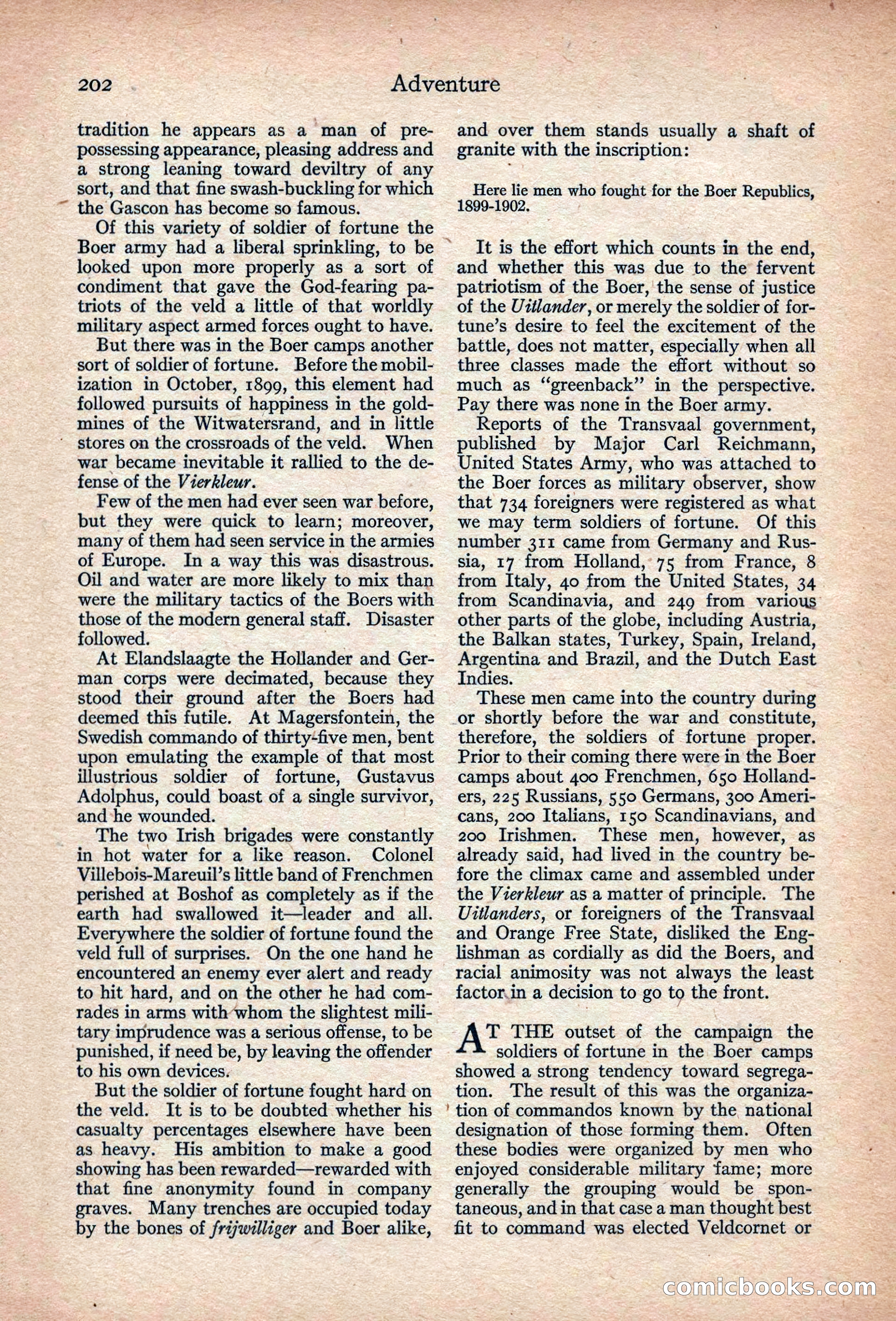
A restored page from Pulp Fiction, 1915. Page through the whole issue in the reader above.
📄 Transcribed text from this page (OCR, searchable)
Machine-transcribed from the original scan — historical spelling and the odd misread are preserved.
202 tradition he appears as a man of pre- possessing appearance, pleasing address and a strong leaning toward deviltry of any sort, and that fine swash-buckling for which the Gascon has become so famous. Of this variety of soldier of fortune the Boer army had a liberal sprinkling, to be ~ looked upon more properly as a sort of condiment that gave the God-fearing pa- triots of the veld a little of that worldly military aspect armed forces ought to have. But there was in the Boer camps another sort of soldier of fortune. Before the mobil- ization in October, 1899, this element had followed pursuits of happiness in the gold- mines of the Witwatersrand, and in little ‘ stores on the crossroads of the veld. When war became inevitable it rallied to the de- fense of the Vierkleur. Few of the men had ever seen war before, but they were quick to learn; moreover, many of them had seen service in the armies of Europe. In a way this was disastrous. Oil and water are more likely to mix than were the military tactics of the Boers with those of the modern general staff. Disaster followed. see At Elandslaagte the Hollander and Ger- man corps were decimated, because they stood their ground after the Boers had deemed this futile. At Magersfontein, the Swedish commando of thirty-five men, bent upon emulating the example of that most illustrious soldier of fortune, Gustavus Adolphus, could boast of a single survivor, and he wounded. The two Irish brigades were constantly in hot water for a like reason. Colonel Villebois-Mareuil’s little band of Frenchmen perished at Boshof as completely as if the earth had swallowed it—leader and all. Everywhere the soldier of fortune found the veld full of surprises. On the one hand he encountered an enemy ever alert and ready to hit hard, and on the other he had com- rades in arms with‘whom the slightest mili- tary imprudence was a serious offense, to be punished, if need be, by leaving the offender to his own devices. But the soldier of fortune fought hard on the veld. It is to be doubted whether his casualty percentages elsewhere have been as heavy. His ambition to make a good showing has been rewarded—rewarded with that fine anonymity found in company graves. Many trenches are occupied today by the bones of frijwilliger and Boer alike, We ere. : cA ¥ < ~, Adventure and over them stands usually a shaft of granite with the inscription: Here lie men who fought for the Boer Republics, 1899-1902. It is the effort which counts in the end, and whether this was due to the fervent patriotism of the Boer, the sense of justice of the Uztlander, or merely the soldier of for- tune’s desire to feel the excitement of the battle, does not matter, especially when all three classes made the effort without so much as “greenback” in the perspective. Pay there was none in the Boer army. Reports of the Transvaal government, published by Major Carl Reichmann, United States Army, who was attached to the Boer forces as military observer, show that 734 foreigners were registered as what we may term soldiers of fortune. Of this number 311 came from Germany and Rus- sia, 17 from Holland, 75 from France, 8 from Italy, 40 from the United States, 34 from Scandinavia, and 249 from various other parts of the globe, including Austria, the Balkan states, Turkey, Spain, Ireland, Argentina and Brazil, and the Dutch East Indies. These men came into the country during or shortly before the war and constitute, therefore, the soldiers of fortune proper. Prior to their coming there were in the Boer camps about 400 Frenchmen, 650 Holland- ers, 225 Russians, 550 Germans, 300 Ameri- cans, 200 Italians, 150 Scandinavians, and 200 Irishmen. ‘These men, however, as already said, had lived in the country be- fore the climax came and assembled under the Vierkleur as a matter of principle. The Uitlanders, or foreigners of the Transvaal and Orange Free State, disliked the Eng- lishman as cordially as did the Boers, and racial animosity was not always the least factor.in a decision to go to the front. At THE outset of the campaign the soldiers of fortune in the Boer camps showed a strong tendency toward segrega- tion. The result of this was the organiza- tion of commandos known by the national designation of those forming them. Often these bodies were organized by men who enjoyed considerable military fame; more generally the grouping would be _ spon- taneous, and in that case a man thought best fit to command was elected Veldcornet or Gomichbooks (E@)