
Pulp Fiction, 1915 · page 195 of 228
Adventure, November 1915 — page 195: what you’re looking at
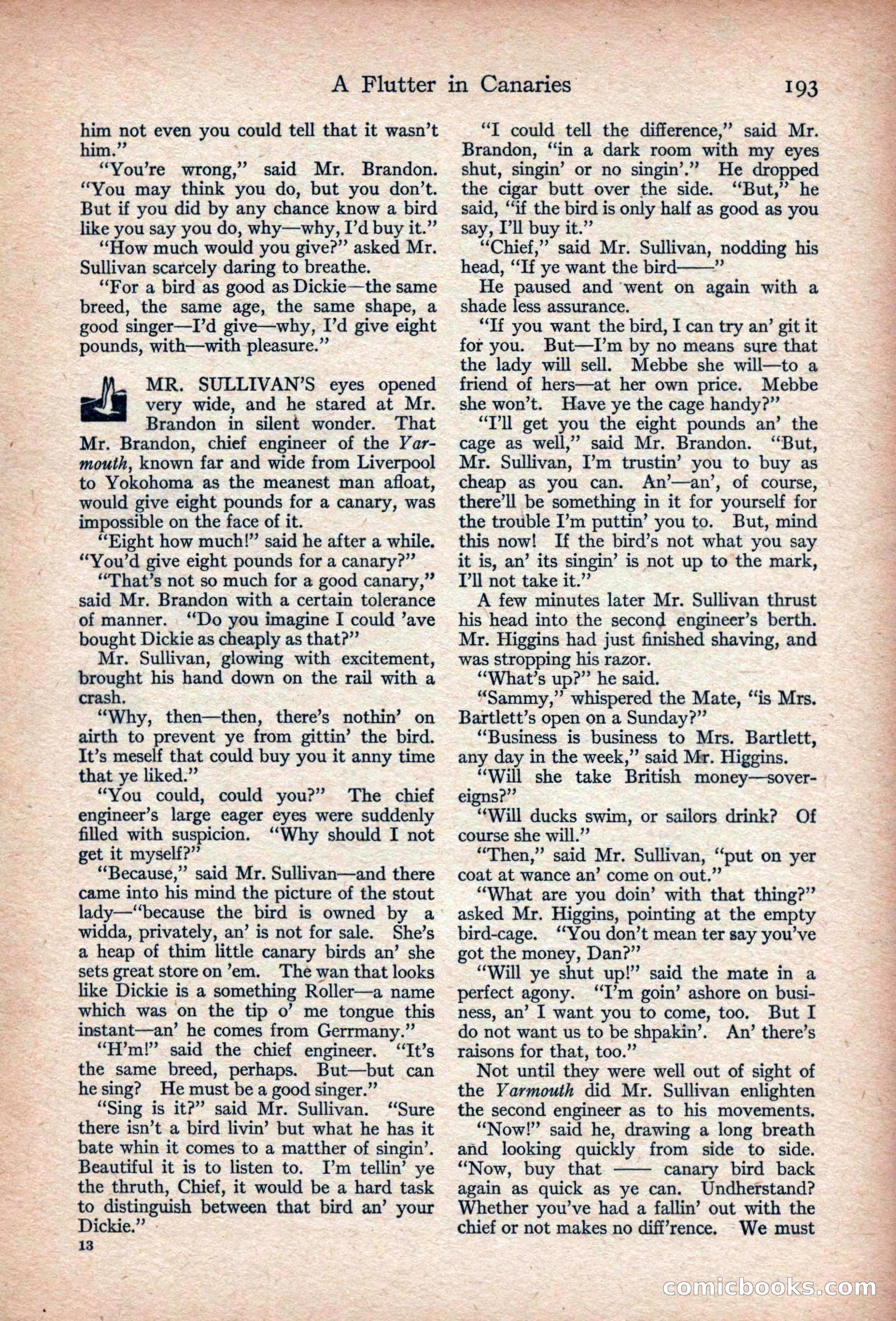
A restored page from Pulp Fiction, 1915. Page through the whole issue in the reader above.
📄 Transcribed text from this page (OCR, searchable)
Machine-transcribed from the original scan — historical spelling and the odd misread are preserved.
A Flutter in Canaries him not even you him.” : “Vou’re wrong,” said Mr. Brandon. “You may think you do, but you don’t. But if you did by any chance know a bird like you say you do, why—why, I’d buy it.” “How much would you give?” asked Mr. Sullivan scarcely daring to breathe. “For a bird as good as Dickie—the same breed, the same age, the same shape, a good singer—I’d give—why, I’d give eight pounds, with—with pleasure.” MR. SULLIVAN’S eyes opened very wide, and he stared at Mr. Brandon in silent wonder. That Mr. Brandon, chief engineer of the Yar- mouth, known far and wide from Liverpool to Yokohoma as the meanest man afloat, would give eight pounds for a canary, was impossible on the face of it. “Eight how much!” said he after a while. ““Vou’d give eight pounds for a canary?” “‘That’s not so much for a good canary,” said Mr. Brandon with a certain tolerance of manner. ‘Do you imagine I could ’ave bought Dickie as cheaply as that?” Mr. Sullivan, glowing with excitement, brought his hand down on the rail with a crash. “Why, then—then, there’s nothin’ on airth to prevent ye from gittin’ the bird. It’s meself that could buy you it anny time that ye liked.” “You could, could you?” The chief engineer’s large eager eyes were suddenly filled with suspicion. ‘Why should I not get it myself?” “Because,” said Mr. Sullivan—and there came into his mind the picture of the stout lady—“‘because the bird is owned by a widda, privately, an’ is not for sale. She’s a heap of thim little canary birds an’ she sets great storeon’em. The wan that looks like Dickie is a something Roller—a name which was on the tip o’ me tongue this instant—an’ he comes from Gerrmany.” “H’m!” said the chief engineer. “It’s the same breed, perhaps. But—but can he sing? He must be a good singer.” “Sing is it?” said Mr. Sullivan. ‘Sure there isn’t a bird livin’ but what he has it bate whin it comes to a matther of singin’. Beautiful it is to listen to. I’m tellin’ ye the thruth, Chief, it would be a hard task to distinguish between that bird an’ your Dickie.” - 13 could tell that it wasn’t 193 “T could tell the difference,” said Mr. Brandon, “in a dark room with my eyes shut, singin’ or no singin’.” He dropped the cigar butt over the side. ‘But,’ he said, “if the bird is only half as good as you say, I'll buy it.” “Chief,” said Mr. Sullivan, nodding his head, “If ye want the bird” He paused and ‘went on again with a shade less assurance. “Tf you want the bird, I can try an’ git it for you. But—I’m by no means sure that the lady will sell. Mebbe she will—to a friend of hers—at her own price. Mebbe she won’t. Have ye the cage handy?” “Tl get you the eight pounds an’ the cage as well,” said Mr. Brandon. “But, Mr. Sullivan, I’m trustin’ you to buy as cheap as you can. An’—an’, of course, there'll be something in it for yourself for the trouble I’m puttin’ you to. But, mind this now! If the bird’s not what you say it is, an’ its singin’ is not up to the mark, V’ll not take it.” A few minutes later Mr. Sullivan thrust his head into the second engineer’s berth. Mr. Higgins had just finished shaving, and was stropping his razor. “What’s up?” he said. “Sammy,’’ whispered the Mate, ‘is Mrs. Bartlett’s open on a Sunday?” “Business is business to Mrs. Bartlett, any day in the week,” said Mr. Higgins. “Will she take British money—sover- elgns?”’ “Will ducks swim, or sailors drink? Of course she will.” “Then,” said Mr. Sullivan, “put on yer coat at wance an’ come on out.” “What are you doin’ with that thing?” asked Mr. Higgins, pointing at the empty bird-cage. “You don’t mean ter say you’ve got the money, Dan?” “Will ye shut up!” said the mate in a perfect agony. “I’m goin’ ashore on busi- ness, an’ I want you to come, too. But I do not want us to be shpakin’. An’ there’s raisons for that, too.” Not until they were well out of sight of the Yarmouth did Mr. Sullivan enlighten the second engineer as to his movements, “Now!” said he, drawing a long breath and looking quickly from side to side. “Now, buy that —— canary bird back again as quick as ye can. Undherstand? Whether you’ve had a fallin’ out with the chief or not makes no diff’rence. We must Gomichoo (E@) SS