
Pulp Fiction, 1915 · page 179 of 228
Adventure, November 1915 — page 179: what you’re looking at
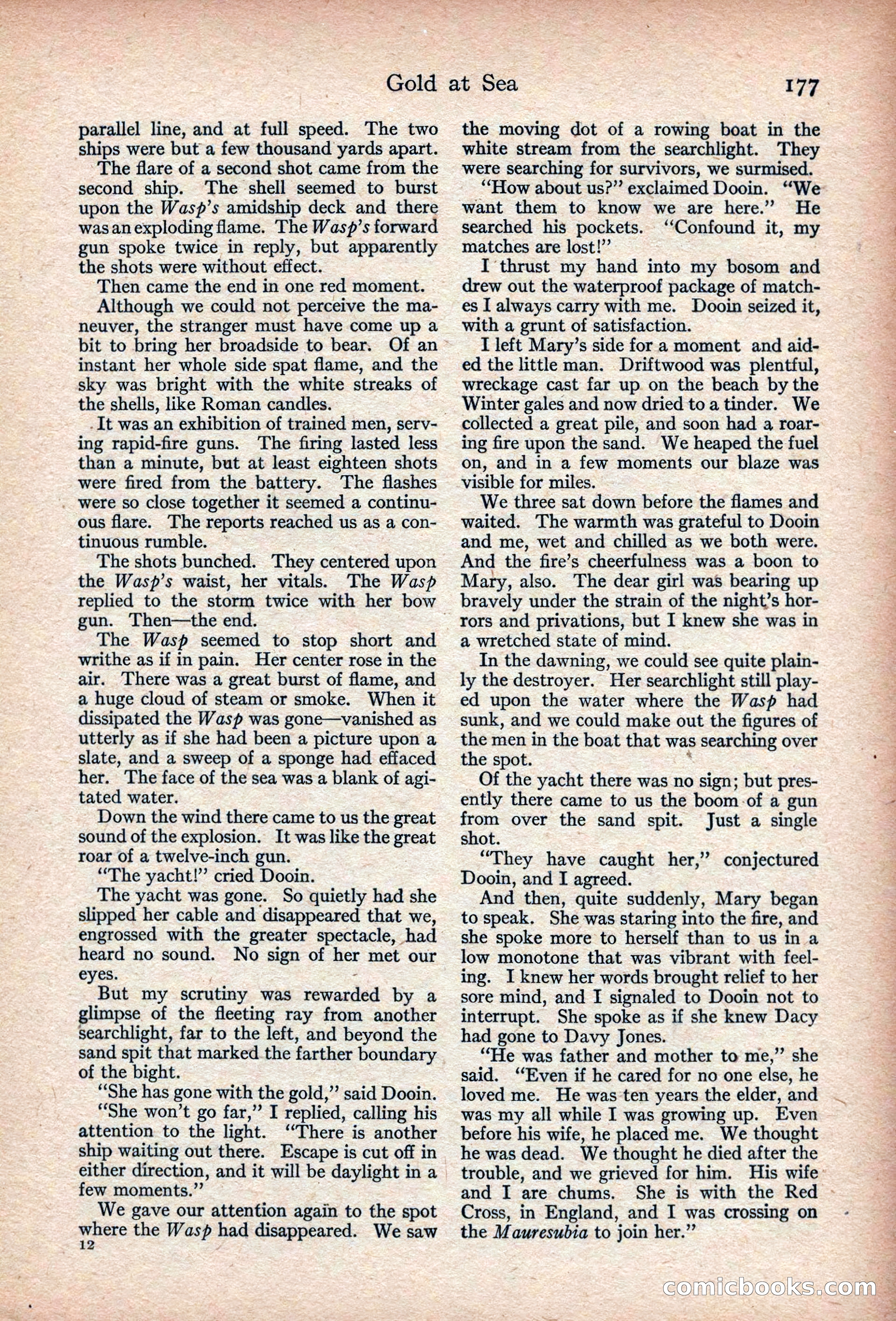
A restored page from Pulp Fiction, 1915. Page through the whole issue in the reader above.
📄 Transcribed text from this page (OCR, searchable)
Machine-transcribed from the original scan — historical spelling and the odd misread are preserved.
Gold at Sea parallel line, and at full speed. The two ships were but a few thousand yards apart. The flare of a second shot came from the second ship. The shell seemed to burst upon the Wasp’s amidship deck and there was an exploding flame. The Wasp’s forward gun spoke twice in reply, but apparently the shots were without effect. Then came the end in one red moment. Although we could not perceive the ma- neuver, the stranger must have come up a bit to bring her broadside to bear. Of an instant her whole side spat flame, and the sky was bright with the white streaks of the shells, like Roman candles. It was an exhibition of trained men, serv- ing rapid-fire guns. The firing lasted less than a minute, but at least eighteen shots were fired from the battery. The flashes . were so close together it seemed a continu- ous flare. The reports reached us as a con- tinuous rumble. — 3 The shots bunched. They centered upon the Wasp’s waist, her vitals. The Wasp replied to the storm twice with her bow gun. Then—the end. The Wasp seemed to stop short and writhe as if in pain. Her center rose in the air. There was a great burst of flame, and a huge cloud of steam or smoke. When it dissipated the Wasp was gone—vanished as utterly as if she had been a picture upon a slate, and a sweep of a sponge had effaced her. The face of the sea was a blank of agi- tated water. Down the wind there came to us the great sound of the explosion. It was like the great roar of a twelve-inch gun. “The yacht!” cried Dooin. The yacht was gone. So quietly had she slipped her cable and disappeared that we, engrossed with the greater spectacle, had heard no sound. No sign of her met our eyes. ) - But my scrutiny was rewarded by a glimpse of the fleeting ray from another searchlight, far to the left, and beyond the sand spit that marked the farther boundary of the bight. “She has gone with the gold,’’ said Dooin. “She won’t go far,” I replied, calling his attention to the light. ‘There is another ship waiting out there. Escape is cut off in either direction, and it will be daylight in a few moments.” | We gave our attention again to the spot where the Wasp had disappeared. We saw the moving dot of a rowing boat in the white stream from the searchlight. They were searching for survivors, we surmised. ‘““How about us?” exclaimed Dooin. “We want them to know we are here.” He searched his pockets. ‘‘Confound it, my matches are lost!”’ I thrust my hand into my bosom and drew out the waterproof package of match- es I always carry with me. Dooin seized it, with a grunt of satisfaction. I left Mary’s side for a moment and aid- ed the little man. Driftwood was plentful, wreckage cast far up on the beach by the Winter gales and now dried toa tinder. We collected a great pile, and soon had a, roar- ing fire upon the sand. We heaped the fuel on, and in a few moments our blaze was visible for miles. We three sat down before the flames and waited. The warmth was grateful to Dooin and me, wet and chilled as we both were. And the fire’s cheerfulness was a boon to Mary, also. The dear girl was bearing up bravely under the strain of the night’s hor- rors and privations, but I knew she was in a wretched state of mind. In the dawning, we could see quite plain- ly the destroyer. Her searchlight still play- ed upon the water where the Wasp had sunk, and we could make out the figures of the men in the boat that was searching over the spot. : Of the yacht there was no sign; but pres- ently there came to us the boom-of a gun from over the sand spit. Just a single shot. “They have caught her,’’ conjectured Dooin, and I agreed. And then, quite suddenly, Mary began to speak. She was staring into the fire, and she spoke more to herself than to us in a low monotone that was vibrant with feel- ing. I knew her words brought relief to her sore mind, and [I signaled to Dooin not to interrupt. She spoke as if she knew Dacy had gone to Davy Jones. “He was father and mother to me,” she said. ‘Even if he cared for no one else, he loved me. He was ten years the elder, and was my all while I was growing up. Even before his wife, he placed me. We thought he was dead. We thought he died after the trouble, and we grieved for him. His wife: She is with the Red > and I are chums. Cross, in England, and I was crossing on the Mauresubia to join her.”’ 177, 62: 3 al ae CONN) S (CO) 1.OO . ~o4