
Pulp Fiction, 1915 · page 156 of 228
Adventure, November 1915 — page 156: what you’re looking at
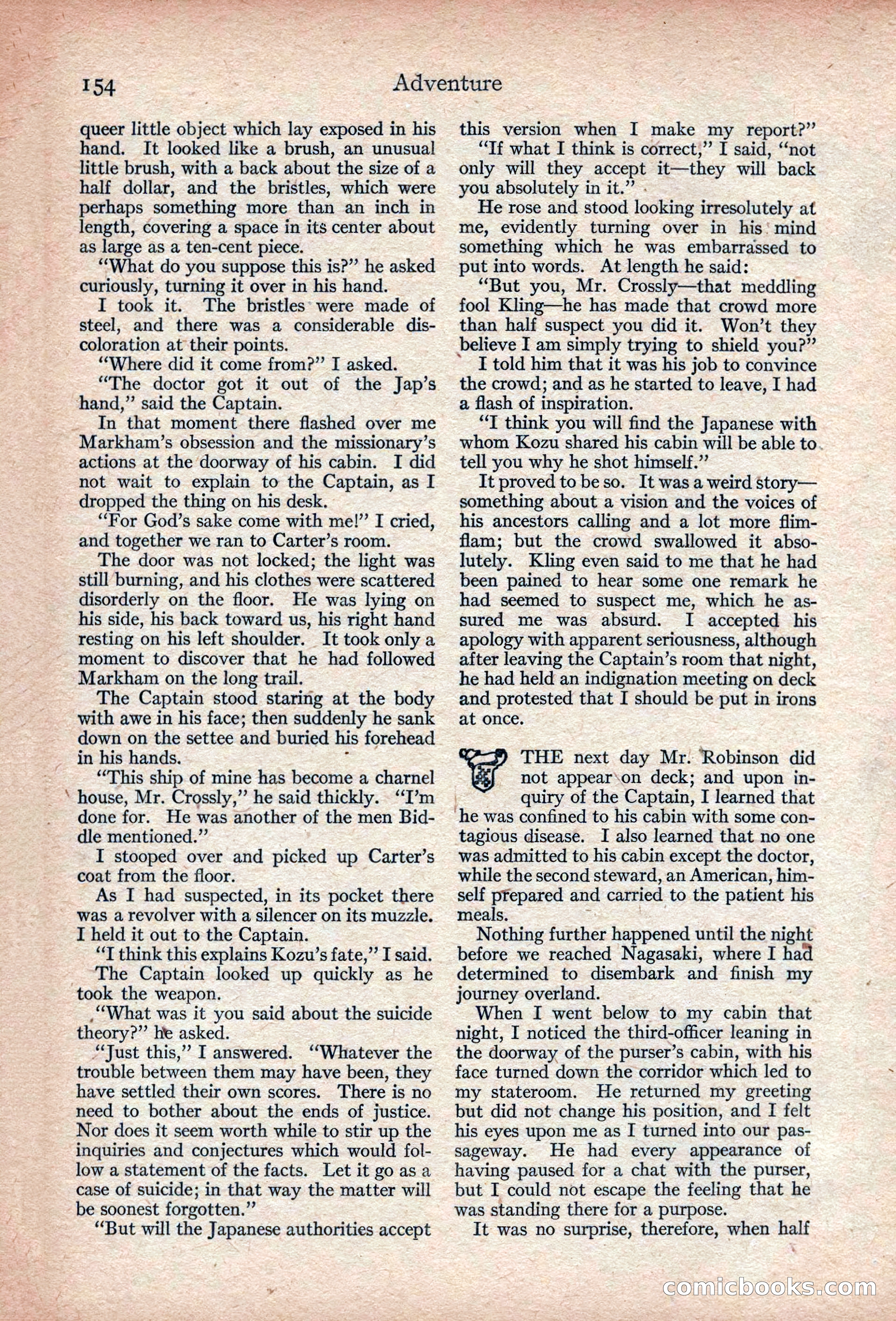
A restored page from Pulp Fiction, 1915. Page through the whole issue in the reader above.
📄 Transcribed text from this page (OCR, searchable)
Machine-transcribed from the original scan — historical spelling and the odd misread are preserved.
a“ 154 queer little object which lay exposed in his hand. It looked like a brush, an unusual little brush, with a back about the size of a half dollar, and the bristles, which were perhaps something more than an inch in length, covering a space in its center about as large as a ten-cent piece. “What do you suppose this is?”’ he asked curiously, turning it over in his hand. I took it. The bristles: were made of steel, and there was a considerable dis- coloration at their points. “Where did it come from?” I asked. “The doctor got it out of the Jap’s hand,” said the Captain. In that moment there flashed over me Markham’s obsession and the missionary’s actions at the doorway of his cabin. I did not wait to explain to the Captain, as I dropped the thing on his desk, “For God’s sake come with me!”’ I cried, and together we ran to Carter’s room. The door was not locked; the light was still burning, and his clothes were scattered disorderly on the floor. He was lying on his side, his back toward us, his right hand resting on his left shoulder. It took only a moment to discover that he had followed Markham on the long trail. The Captain stood staring at the body with awe in his face; then suddenly he sank down on the settee and buried his forehead in his hands. : “This ship of mine has become a charnel house, Mr. Crossly,” he said thickly. “I’m done for. He was another of the men Bid- dle mentioned.” I stooped over and picked up Carter’s coat from the floor. As I had suspected, in its pocket there was a revolver with a silencer on its muzzle. I held it out to the Captain. “T think this explains Kozu’s fate,” I said. The Captain looked up quickly as he took the weapon. What was it you said about the suicide theory?”’ he asked. “Just this,” I answered. ‘‘Whatever the trouble between them may have been, they have settled their own scores. There is no need to bother about the ends of justice. Nor does it seem worth while to stir up the inquiries and conjectures which would fol- low a statement of the facts. Let it go asa case of suicide; in that way the matter will be soonest forgotten.” “But will the Japanese authorities accept ¥ Adventure this version when I make my report?” “Tf what I think is correct,” I said, “not only will they accept it—they will back you absolutely in it.” . He rose and stood looking irresolutely at me, evidently turning over in his! mind something which he was embarrassed to put into words. At length he said: “But you, Mr. Crossly—that meddling fool Kling—he has made that crowd more than half suspect you did it. Won’t they believe I am simply trying to shield you?” I told him that it was his job to convince the crowd; and as he started to leave, I had a flash of inspiration. “T think you will find the Japanese with whom Kozu shared his cabin will be able to. tell you why he shot himself.”’ It proved to beso. It was a weird story— something about a vision and the voices of his ancestors calling and a lot more flim- flam; but the crowd swallowed it abso- lutely. Kling even said to me that he had been pained to hear some one remark he had seemed to suspect me, which he as- sured me was absurd. I accepted his apology with apparent seriousness, although after leaving the Captain’s room that night, he had held an indignation meeting on deck and protested that I should be put in irons at once. THE next day Mr. Robinson did not appearson deck; and upon in- | quiry of the Captain, I learned that ‘he was confined to his cabin with some con- tagious disease. I also learned that no one was admitted to his cabin except the doctor, while the second steward, an American, him- self prepared and carried to the patient his meals. Nothing further happened until the night before we reached Nagasaki, where I had determined to disembark and finish my journey overland. When I went below to my cabin that night, I noticed the third-officer leaning in the doorway of the purser’s cabin, with his face turned down the corridor which led to my stateroom. He returned my greeting but did not change his position, and I felt his eyes upon me as [| turned into our pas- sageway. He had every appearance of having paused for a chat with the purser, but I could not escape the feeling that he was standing there for a purpose. It was no surprise, therefore, when half CONIC OOOKS