
Pulp Fiction, 1915 · page 149 of 228
Adventure, November 1915 — page 149: what you’re looking at
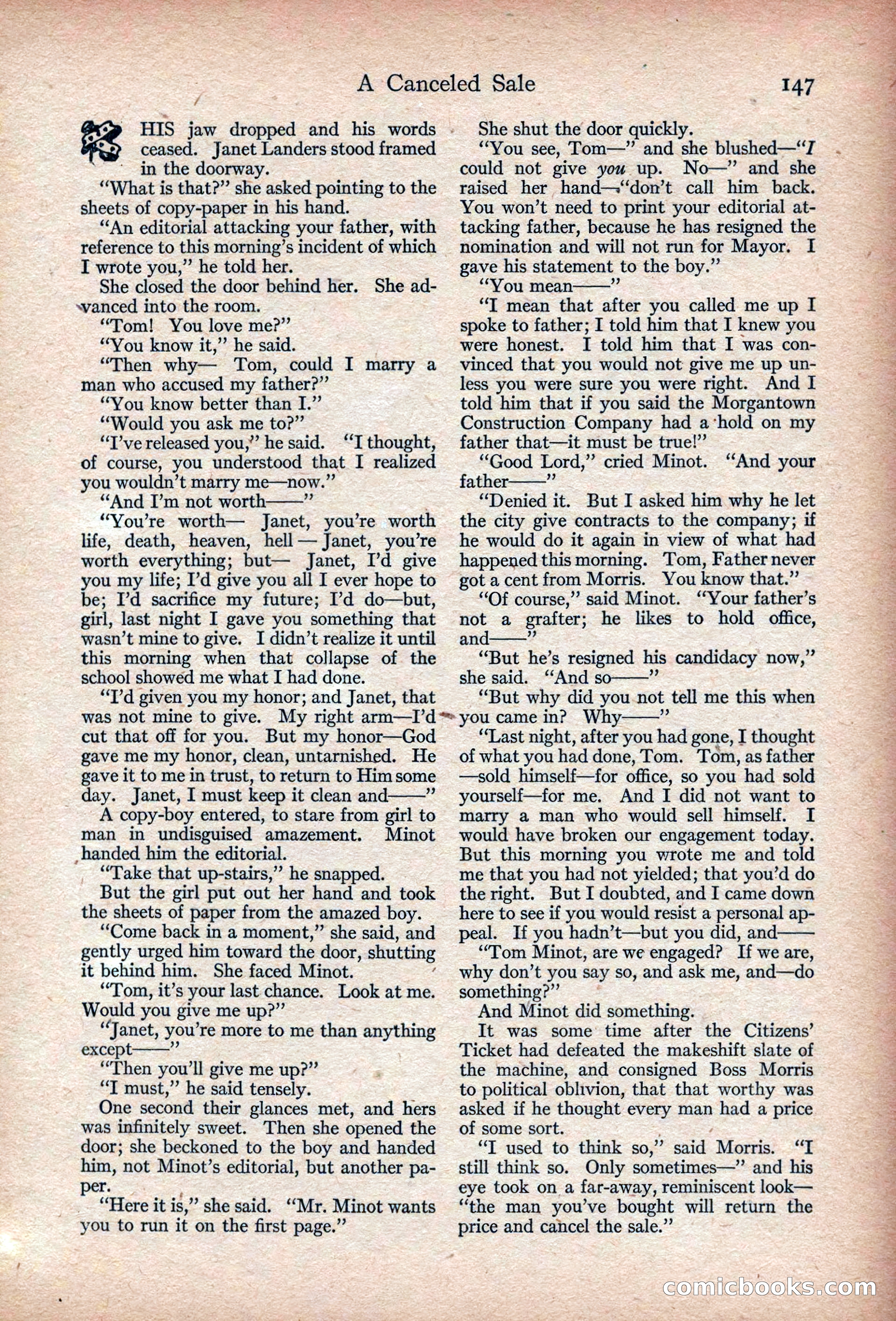
A restored page from Pulp Fiction, 1915. Page through the whole issue in the reader above.
📄 Transcribed text from this page (OCR, searchable)
Machine-transcribed from the original scan — historical spelling and the odd misread are preserved.
A Canceled Sale / HIS jaw dropped and his words . ceased. Janet Landers stood framed in the doorway. “What is that?” she asked pointing to the sheets of copy-paper in his hand. “‘An editorial attacking your father, with reference to this morning’s incident of which I wrote you,” he told her. She closed the door behind her. She ad- ‘vanced into the room. “Tom! You love me?” “You know it,” he said. “Then why— Tom, could I marry a man who accused my father?” “You know better than I.” “Would you ask me to?” “T’ve released you,” he said. “I thought, of course, you understood that I realized you wouldn’t marry me—now.”’ “And I’m not worth——” . “You’re worth— Janet, you’re worth life, death, heaven, hell — Janet, you’re worth everything; but— Janet, I’d give you my life; I’d give you all I ever hope to be; I'd sacrifice my future; ’'d do—but, girl, last night I gave you something that wasn’t mine to give. I didn’t realize it until this morning when that collapse of the school showed me what I had done. “T’d given you my honor; and Janet, that was not mine to give. cut that off for you. But my honor—God gave me my honor, clean, untarnished. He gave it to me in trust, to return to Him some day. Janet, I must keep it clean and——” A copy-boy entered, to stare from girl to man in undisguised amazement. Minot _handed him the editorial. “Take that up-stairs,’”’ he snapped. But the girl put out her hand and took the sheets of paper from the amazed boy. “Come back in a moment,” she said, and gently urged him toward the door, shutting it behind him. She faced Minot. “Tom, it’s your last. chance. Look at me. Would you give me up?” ‘Janet, you’re more to me than anything except” “Then you’ll give me up?” “T must,” he said tensely. One second their glances met, and hers was infinitely sweet. Then she opened the door; she beckoned to the boy and handed him, not Minot’s editorial, but another pa- per. t “Here it is,” she said. ‘Mr. Minot wants you to run it on the first page.”’ 147 She shut the door quickly. “You see, Tom—” and she blushed—‘‘T could not give you up. No—” and she raised her hand—‘“‘don’t call him back. You won’t need to print your editorial at- tacking father, because he has resigned the nomination and will not run for Mayor. I gave his statement to the boy.” “You mean——” “T mean that after you called me up I spoke to father; I told him that I knew you were honest. I told him that I was con- vinced that you would not give me up un- less you were sure you were right. And I told him that if you said the Morgantown Construction Company had a‘hold on my father that—it must be true!”’ “Good Lord,” cried Minot. father “Denied it. But I asked him why he let the city give contracts to the company; if he would do it again in view of what had happened this morning. Tom, Father never got a cent from Morris. You know that.” “Of course,” said Minot. ‘Your father’s not a grafter; he likes to hold office, and——” “But he’s resigned his candidacy now,” she said. ‘And so——” “But why did you.not tell me this when “And your My right arm—I’d“ you came in? Why——” “Last night, after you had gone, I thought of what you had done, Tom. Tom, as father —sold himself—for office, so you had sold yourself—for me. And I did not want to martry a man who would sell himself. I would have broken our engagement today. But this morning you wrote me and told me that you had not yielded; that you’d do the right. But I doubted, and I came down here to see if you would resist a personal ap- peal. If you hadn’t—but you did, and—— “Tom Minot, are we engaged? If we are, why don’t you say so, and ask me, and—do something?” And Minot did something. It was some time after the Citizens’ Ticket had defeated the makeshift slate of the machine, and consigned Boss Morris to political oblivion, that that worthy was asked if he thought every man had a price of some sort. “T used to think so, ”? said Morris. “I still think so. Only sometimes—” and his eye took on a far-away, reminiscent look— “the man you’ve bought will return the price and cancel the sale.” OOK (C@) <- e oe 2a ~ a —— 2 pie “39 mi ae Ae r.¥44) 4 ; ~ Pt? vite (C@) ¢ y y r fy ‘ es ? : _ J ¥ " ’ ; baa