
Pulp Fiction, 1915 · page 144 of 228
Adventure, November 1915 — page 144: what you’re looking at
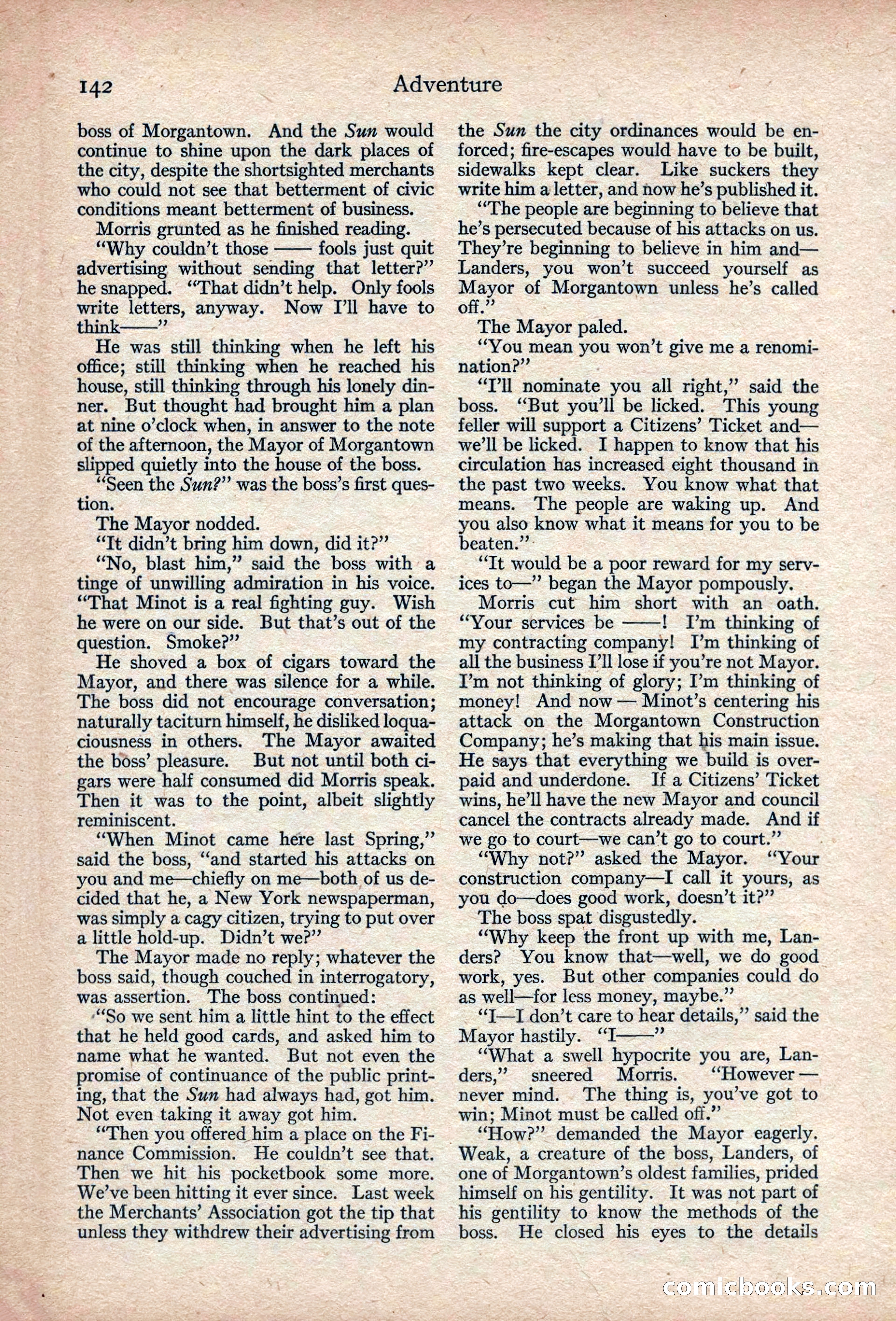
A restored page from Pulp Fiction, 1915. Page through the whole issue in the reader above.
📄 Transcribed text from this page (OCR, searchable)
Machine-transcribed from the original scan — historical spelling and the odd misread are preserved.
142 boss of Morgantown. And the Sun would continue to shine upon the dark places of the city, despite the shortsighted merchants who could not see that betterment of civic conditions meant betterment of business. Morris grunted as he finished reading. “Why couldn’t those —— fools just quit advertising without sending that letter?” _ hesnapped. ‘That didn’t help. Only fools write letters, anyway. Now I'll have to think——”’ He was still thinking when he left his office; still thinking when he reached his house, still thinking through his lonely din- ner. But thought had brought him a plan at nine o’clock when, in answer to the note of the afternoon, the Mayor of Morgantown slipped quietly into the house of the boss. “Seen the Sun?”’ was the boss’s first ques- tion. The Mayor nodded. “Tt didn’t bring him down, did it?” “No, blast him,” said the boss with a tinge of unwilling admiration in his voice. “That Minot is a real fighting guy. Wish he were on our side. But that’s out of the question. Smoke?” He shoved a box of cigars toward the Mayor, and there was silence for a while. The boss did not encourage conversation; naturally taciturn himself, he disliked loqua- ciousness in others. The Mayor awaited the boss’ pleasure. But not until both ci- gars were half consumed did Morris speak. Then it was to the point, albeit slightly reminiscent. “When Minot came here last Spring,’ said the boss, “‘and started his attacks on you and me—chiefly on me—both of us de- cided that he, a New York newspaperman, was simply a cagy citizen, trying to put over a little hold-up. Didn’t we?” The Mayor made no reply; whatever the boss said, though couched in interrogatory, was assertion. The boss continued: ‘“So we sent him a little hint to the effect that he held good cards, and asked him to name what he wanted. But not even the promise of continuance of the public print- ing, that the Sun had always had, got him. Not even taking it away got him. ‘Then you offered him a place on the Fi- _ nance Commission. He couldn’t see that. Then we hit his pocketbook some more. We’ve been hitting it ever since. Last week the Merchants’ Association got the tip that unless they withdrew their advertising from Adventure the Sun the city ordinances would be en- forced; fire-escapes would have to be built, sidewalks kept clear. Like suckers they write him a letter, and now he’s published it. ‘‘The people are beginning to believe that he’s persecuted because of his attacks on us. They’re beginning to believe in him and— Landers, you won’t succeed yourself as Mayor of Morgantown unless he’s called off.” The Mayor paled. ‘You mean you won’t give me a renomi- nation?” “T’ll nominate you all right,” said the boss. “But you'll be licked. This young feller will support a Citizens’ Ticket and— we'll be licked. I happen to know that his circulation has increased eight thousand in the past two weeks. You know what that means. The people are waking up. And you also know what it means for you to be beaten.” “It would be a poor reward for my serv- ices to—”’ began the Mayor pompously. Morris cut him short with an oath. “Your services be ! I’m thinking of my contracting company! I’m thinking of all the business I’ll lose if you’re not Mayor. I’m not thinking of glory; I’m thinking of money! And now — Minot’s centering his attack on the Morgantown Construction Company; he’s making that his main issue. He says that everything we build is over- paid and underdone. If a Citizens’ Ticket wins, he’ll have the new Mayor and council cancel the contracts already made. And if we go to court—we can’t go to court.” “Why not?” asked the Mayor. construction company—lI call it yours, as you do—does good work, doesn’t it?” The boss spat disgustedly. ‘“‘Why keep the front up with me, Lan- “Vour ders? You know that—well, we do good work, yes. But other companies could do as well—for less money, maybe.” ‘“‘T_J don’t care to hear details,” said the Mayor hastily. “ fs ‘What a swell hypocrite you are, Lan- ders,” sneered Morris. ‘However — never mind. The thing is, you’ve got to win; Minot must be called off.” “How?” demanded the Mayor eagerly. Weak, a creature of the boss, Landers, of one of Morgantown’s oldest families, prided himself on his gentility. It was not part of his gentility to know the methods of the boss. He closed his eyes to the details Comicbooks (¢ (E@)