
Pulp Fiction, 1929 · page 30 of 164
Adventure Trails, February 1929 — page 30: what you’re looking at
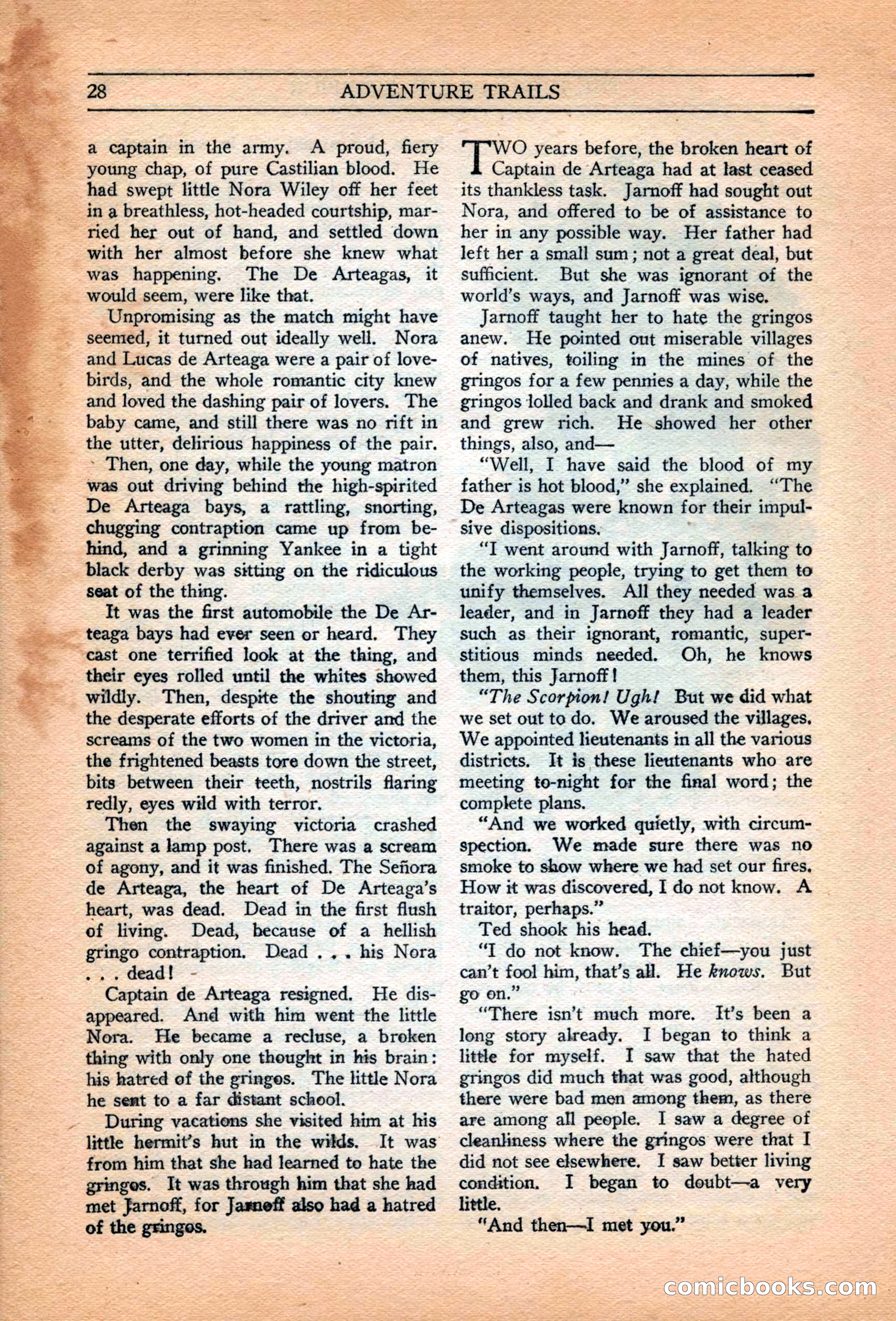
A restored page from Pulp Fiction, 1929. Page through the whole issue in the reader above.
📄 Transcribed text from this page (OCR, searchable)
Machine-transcribed from the original scan — historical spelling and the odd misread are preserved.
= = captain in the army. A proud, fiery 2s young chap, of pure Castilian blood. He = eae swept little Nora Wiley off her feet vf ina breathless, hot-headed courtship, mar- 3 = aed her out of hand, and settled down _ with her almost before she knew what was happening. The De Arteagas, it - would seem, were like that. Unpromising as the match might have seemed, it turned out ideally well. Nora and Lucas de Arteaga were a pair of love- birds, and the whole romantic city knew and loved the dashing pair of lovers. The baby came, and still there was no rift in f= _ the utter, delirious happiness of the pair. _ * Then, one day, while the young matron was out driving behind the high-spirited De Arteaga bays, a rattling, snorting, chugging contraption came up from be- hind, and a grinning Yankee in a tight black derby was sitting on the ridiculous seat of the thing. = Tt was the first automobile the De Ar- _ teaga bays had ever seen or heard. They __-—-€ast one terrified look at the thing, and __._ their eyes rolled until the whites showed wildly. Then, despite the shouting and ae the desperate efforts of the driver and the Sey screams of the two women in the victoria, the frightened beasts tore down the street, bits between their teeth, nostrils flaring redly, eyes wild with terror. Then the swaying victoria crashed against a lamp post. There was a scream of agony, and it was finished. The Sefiora . de Arteaga, the heart of De Arteaga’s eo heart, was dead. Dead in the first flush ss of living. Dead, because of a hellish . « » his Nora as gringo contraption. Dead Fs ... dead! - Captain de Arteaga resigned. He dis- appeared. And with him went the little Nora. He became a recluse, a broken thing with only one thought in his brain: his hatred of the gringes. The little Nora he semt to a far distant school. _ During vacations she visited him at his little hermit’s hut in the wilds. from him that she had learned to hate the gringes. It was through him that she had me er at OA AV itt rer) ' . reren saul} ti | Write tg * YA ai) Ae We Pare bac iee yyy , 7 Vee Paes Afar ~ ei US = met farnoff, for Jarneff also had a hatred = of the gringos. It was en hs ADVENTURE TRAILS. O years before, the broken heart of Captain de Arteaga had at last ceased its thankless task. Jarnoff had sought out Nora, and offered to be of assistance to her in any possible way. Her father had left her a small sum; not a great deal, but sufficient. But she was ignorant of the world’s ways, and Jarnoff was wise. Jarnoff taught her to hate the gringos anew. He pointed out miserable villages of natives, toiling in the mines of the gringos for a few pennies a day, while the gringos lolled back and drank and smoked and grew rich. He-showed her other things, also, and— “Well, I have said the blood of my father is hot blood,” she explained. “The De Arteagas were known for their impul- sive dispositions, “T went around with Jarnoff, talking to the working people, trying to get them to unify themselves. All they needed was a leader, and in Jarnoff they had a leader such as their ignorant, romantic, super- stitious minds needed. Oh, he knows them, this Jarnoff ! “The Scorpion! Ugh! But we did what we set out todo. We aroused the villages, We appointed lieutenants in all the various districts. It is these lieutenants who are meeting to-night for the final word; the complete plans. “And we worked quietly, with circum-_ spection. We made sure there was no smoke to show where we had set our fires, ~~ How it was discovered, I do not know. A traitor, perhaps.” Ted shook his head. “T do not know. The chief—you just can’t fool him, that’s al. He knows. But go on.” “There isn’t much more. It’s been a long story already. I began to think a little for myself. I saw that the hated gringos did much that was good, although there were bad men among them, as there are among all people. I saw a degree of cleanliness where the gringos were that I did not see elsewhere, I saw better living condition. I began to doubt—a very little. “And then—I met you.” cboo