
Pulp Fiction, 1928 · page 63 of 200
Adventure, July 1, 1928 — page 63: what you’re looking at
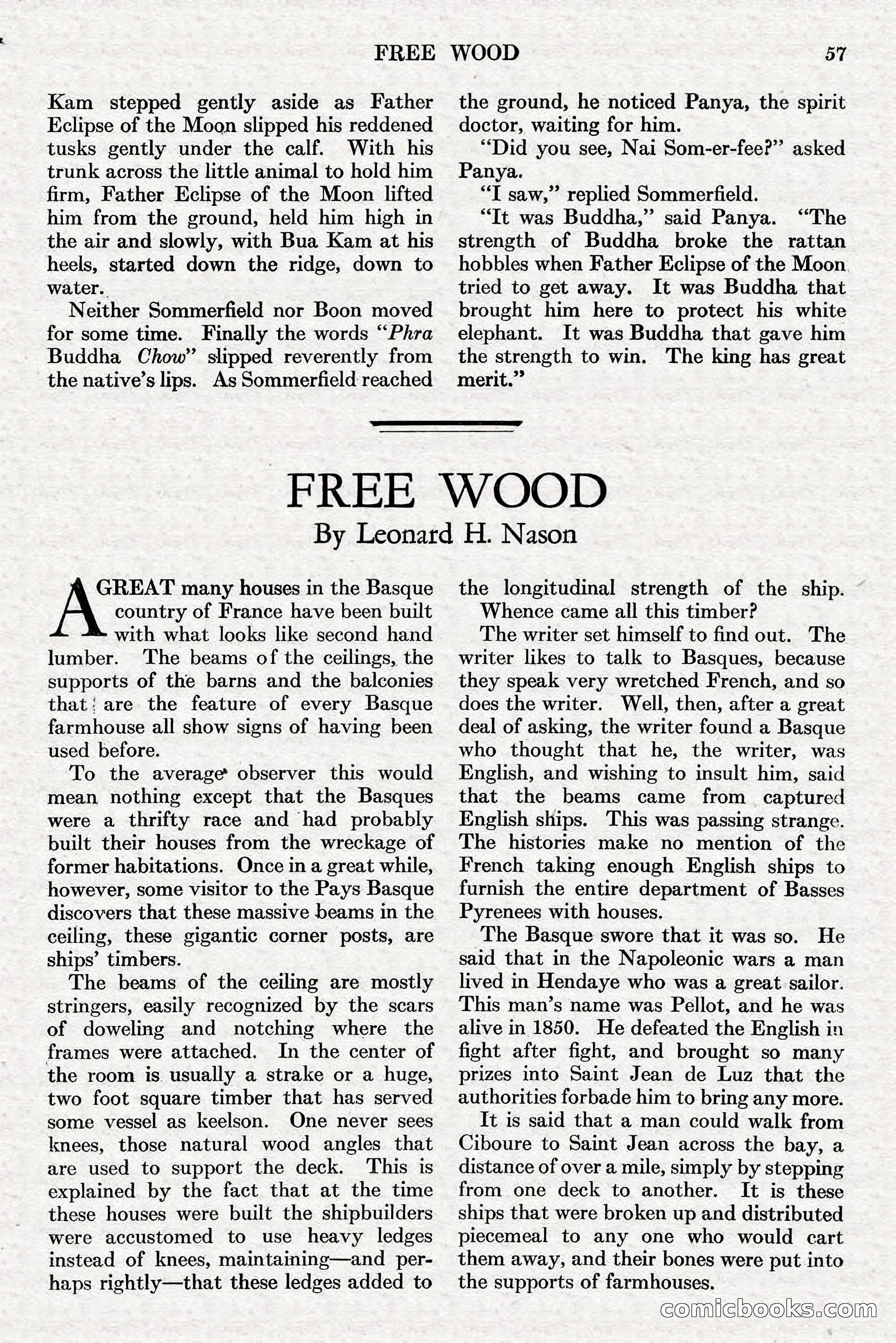
A restored page from Pulp Fiction, 1928. Page through the whole issue in the reader above.
📄 Transcribed text from this page (OCR, searchable)
Machine-transcribed from the original scan — historical spelling and the odd misread are preserved.
FREE WOOD 57 Kam stepped gently aside as Father Eclipse of the Moon slipped his reddened tusks gently under the calf. With his trunk across the little animal to hold him firm, Father Eclipse of the Moon lifted him from the ground, held him high in the air and slowly, with Bua Kam at his heels, started down the ridge, down to water. Neither Sommerfield nor Boon moved for some time. Finally the words “Phra Buddha Chow” slipped reverently from the native’s lips. As Sommerfield reached the ground, he noticed Panya, the spirit doctor, waiting for him. “Did you see, Nai Som-er-fee?”’ asked Panya. “T saw,” replied Sommerfield. “Tt was Buddha,” said Panya. “The strength of Buddha broke the rattan hobbles when Father Eclipse of the Moon tried to get away. It was Buddha that brought him here to protect his white elephant. It was Buddha that gave him the strength to win. The king has great merit.” FREE WOOD By Leonard H. Nason country of France have been built with what looks like second hand lumber. The beams of the ceilings, the supports of the barns and the balconies that: are the feature of every Basque farmhouse all show signs of having been used before. To the average observer this would mean nothing except that the Basques were a thrifty race and had probably built their houses from the wreckage of former habitations. Once in a great while, however, some visitor to the Pays Basque discovers that these massive beams in the ceiling, these gigantic corner posts, are ships’ timbers. The beams of the ceiling are mostly stringers, easily recognized by the scars of doweling and notching where the frames were attached. In the center of the room is usually a strake or a huge, two foot square timber that has served some vessel as keelson. One never sees knees, those natural wood angles that are used to support the deck. This is explained by the fact that at the time these houses were built the shipbuilders were accustomed to use heavy ledges instead of knees, maintaining—and per- haps rightly—that these ledges added to A GREAT many houses in the Basque the longitudinal strength of the ship. Whence came all this timber? The writer set himself to find out. The writer likes to talk to Basques, because they speak very wretched French, and so does the writer. Well, then, after a great deal of asking, the writer found a Basque who thought that he, the writer, was English, and wishing to insult him, said that the beams came from captured English ships. This was passing strange. The histories make no mention of the French taking enough English ships to furnish the entire department of Basses Pyrenees with houses. The Basque swore that it was so. He said that in the Napoleonic wars a man lived in Hendaye who was a great sailor. This man’s name was Pellot, and he was alive in 1850. He defeated the English in fight after fight, and brought so many prizes into Saint Jean de Luz that the authorities forbade him to bring any more. It is said that a man could walk from Ciboure to Saint Jean across the bay, a distance of over a mile, simply by stepping from one deck to another. It is these ships that were broken up and distributed piecemeal to any one who would cart them away, and their bones were put into the supports of farmhouses. comicloooks.com