
Pulp Fiction, 1928 · page 193 of 200
Adventure, July 1, 1928 — page 193: what you’re looking at
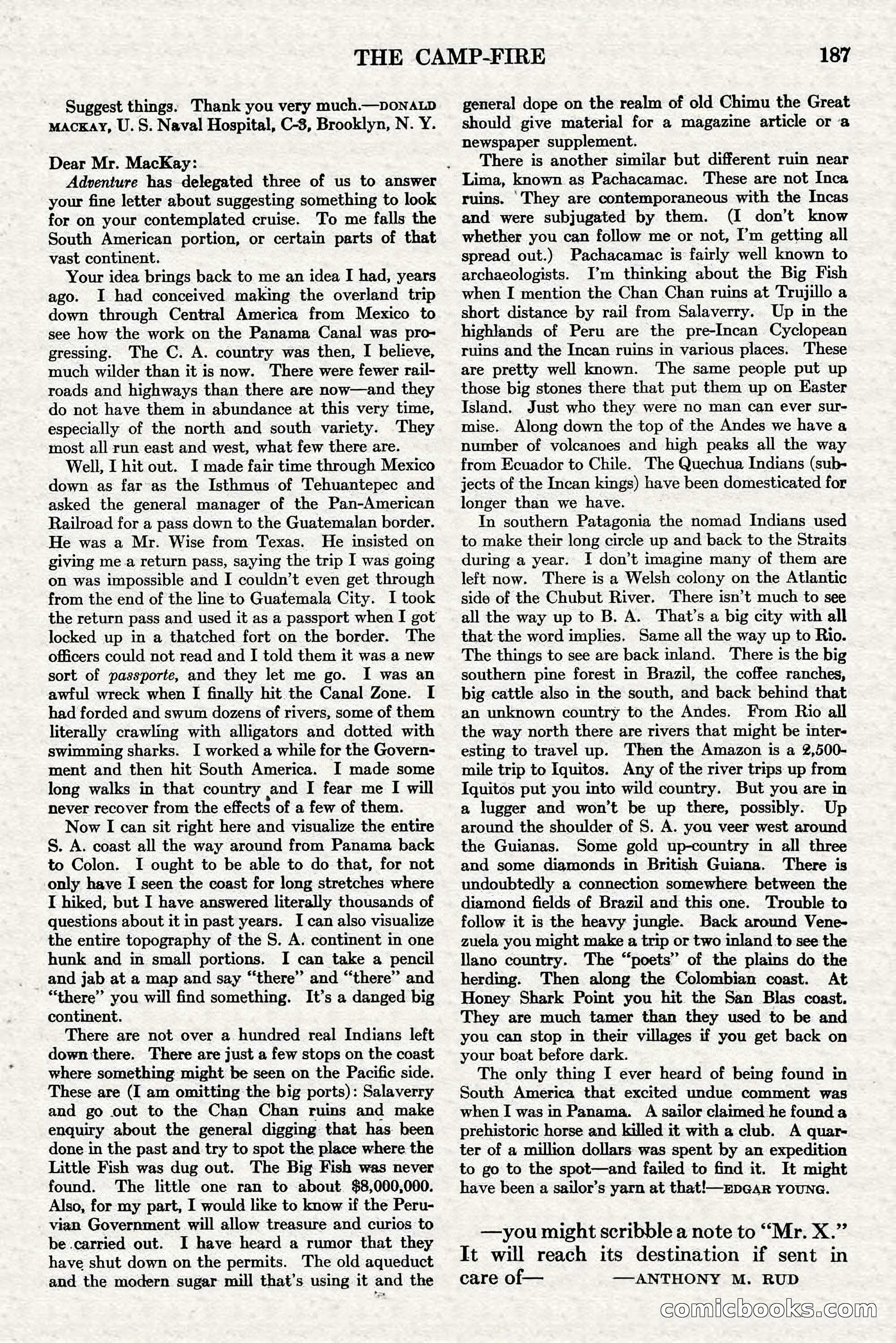
A restored page from Pulp Fiction, 1928. Page through the whole issue in the reader above.
📄 Transcribed text from this page (OCR, searchable)
Machine-transcribed from the original scan — historical spelling and the odd misread are preserved.
THE CAMP-FIRE Suggest things: Thank you very much.—DpoNALD mackay, U.S. Naval Hospital, C-8, Brooklyn, N. Y. Dear Mr. MacKay: Adventure has delegated three of us to answer your fine letter about suggesting something to look for on your contemplated cruise. To me falls the South American portion, or certain parts of that vast continent. Your idea brings back to me an idea I had, years ago. I had conceived making the overland trip down through Central America from Mexico to see how the work on the Panama Canal was pro- gressing. The C. A. country was then, I believe, much wilder than it is now. There were fewer rail- roads and highways than there are now—and they do not have them in abundance at this very time, especially of the north and south variety. They most all run east and west, what few there are. Well, I hit out. I made fair time through Mexico down as far-as the Isthmus of Tehuantepec and asked the general manager of the Pan-American Railroad for a pass down to the Guatemalan border. He was a Mr. Wise from Texas. He insisted on giving mea return pass, saying the trip I was going on was impossible and I couldn’t even get through from the end of the line to Guatemala City. I took the return pass and used it as a passport when I got’ locked up in a thatched fort on the border. The officers could not read and I told them it was.a new sort of passporte, and they let me go. I was an awful wreck when I finally hit the Canal Zone. I had forded and swum dozens of rivers, some of them literally crawling with alligators and dotted with swimming sharks. I worked a while for the Govern- ment and then hit South America. I made some long walks in that country and I fear me I will never recover from the effects of a few of them. Now I can sit right here and visualize the entire S. A. coast all the way around from Panama back to Colon. I ought to be able to do that, for not only have I seen the coast for long stretches where I hiked, but I have answered literally thousands of questions about it in past years. I can also visualize the entire topography of the S. A. continent in one hunk and in small portions. I can take a pencil and jab at a map and say “there” and “there” and “there”? you will find something. It’s a danged big continent. There are not over a hundred real Indians left down there. There are just a few stops on the coast where something might be seen on the Pacific side. These are (I am omitting the big ports): Salaverry and go out to the Chan Chan ruins and make enquiry about the general digging that has been done in the past and try to spot the place where the Little Fish was dug out. The Big Fish was never found. The little one ran to about. $8,000,000. Also, for my part, I would like to know if the Peru- vian Government will allow treasure and curios to be.carried out. I have heard a rumor that they have shut down on the permits. The old aqueduct and the modern sugar mill that’s using it and the 187 general dope on the realm of old Chimu the Great should give material for a magazine article or a Dewspaper supplement. There is another similar but different ruin near Lima, known as Pachacamac. These are not Inca ruins. ‘They are contemporaneous with the Incas and were subjugated by them. (I don’t know whether you can follow me or not, I’m getting all spread out.) Pachacamac is fairly well known to archaeologists. I’m thinking about the Big Fish when I mention the Chan Chan ruins at Trujillo a short distance by rail from Salaverry. Up in the highlands of Peru are the pre-Incan Cyclopean ruins and the Incan ruins in various places. These are pretty well known. The same people put up those big stones there that put them up on Easter Island. Just who they were no man can ever sur- mise. Along down the top of the Andes we have a number of volcanoes and high peaks all the way from Ecuador to Chile. The Quechua Indians (sub- jects of the Incan kings) have been domesticated for longer than we have. In southern Patagonia the nomad Indians used to make their long circle up and back to the Straits during a year. I don’t imagine many of them are left now. There is a Welsh colony on the Atlantic side of the Chubut River. There isn’t much to see all the way up to B. A. That’s a big city with all that the word implies, Same all the way up to Rio. The things to see are back inland. There is the big southern pine forest in Brazil, the coffee ranches, big cattle also in the south, and back behind that an unknown country to the Andes. From Rio all the way north there are rivers that might be inter- esting to travel up. Then the Amazon is a 2,500- mile trip to Iquitos. Any of the river trips up from Iquitos put you into wild country. But you are in a lugger and won't be up there, possibly. Up around the shoulder of S$. A. you veer west around the Guianas. Some gold up-country in all three and some diamonds in British Guiana. There is undoubtedly a connection somewhere between the diamond fields of Brazil and this one. Trouble to follow it is the heavy jungle. Back around Vene- zuela you might make a trip or two inland to see the llano country. The “poets” of the plains do the herding. Then along the Colombian coast. At Honey Shark Point you hit the San Blas coast. They are much tamer than they used to be and you can stop in their villages if you get back on your boat before dark. The only thing I ever heard of being found in South America that excited undue comment was when I was in Panama. A sailor claimed he found a prehistoric horse and killed it with a club. A quar- ter of a million dollars was spent by an expedition to go to the spot—and failed to find it. It might have been a sailor’s yarn at that!—rpGar YouNG. —you might scribble a note to “Mr. X.” Tt will reach its destination if sent in care of— —ANTHONY M. RUD comlicloooks.com