
Pulp Fiction, 1928 · page 191 of 200
Adventure, July 1, 1928 — page 191: what you’re looking at
A restored page from Pulp Fiction, 1928. Page through the whole issue in the reader above.
📄 Transcribed text from this page (OCR, searchable)
Machine-transcribed from the original scan — historical spelling and the odd misread are preserved.
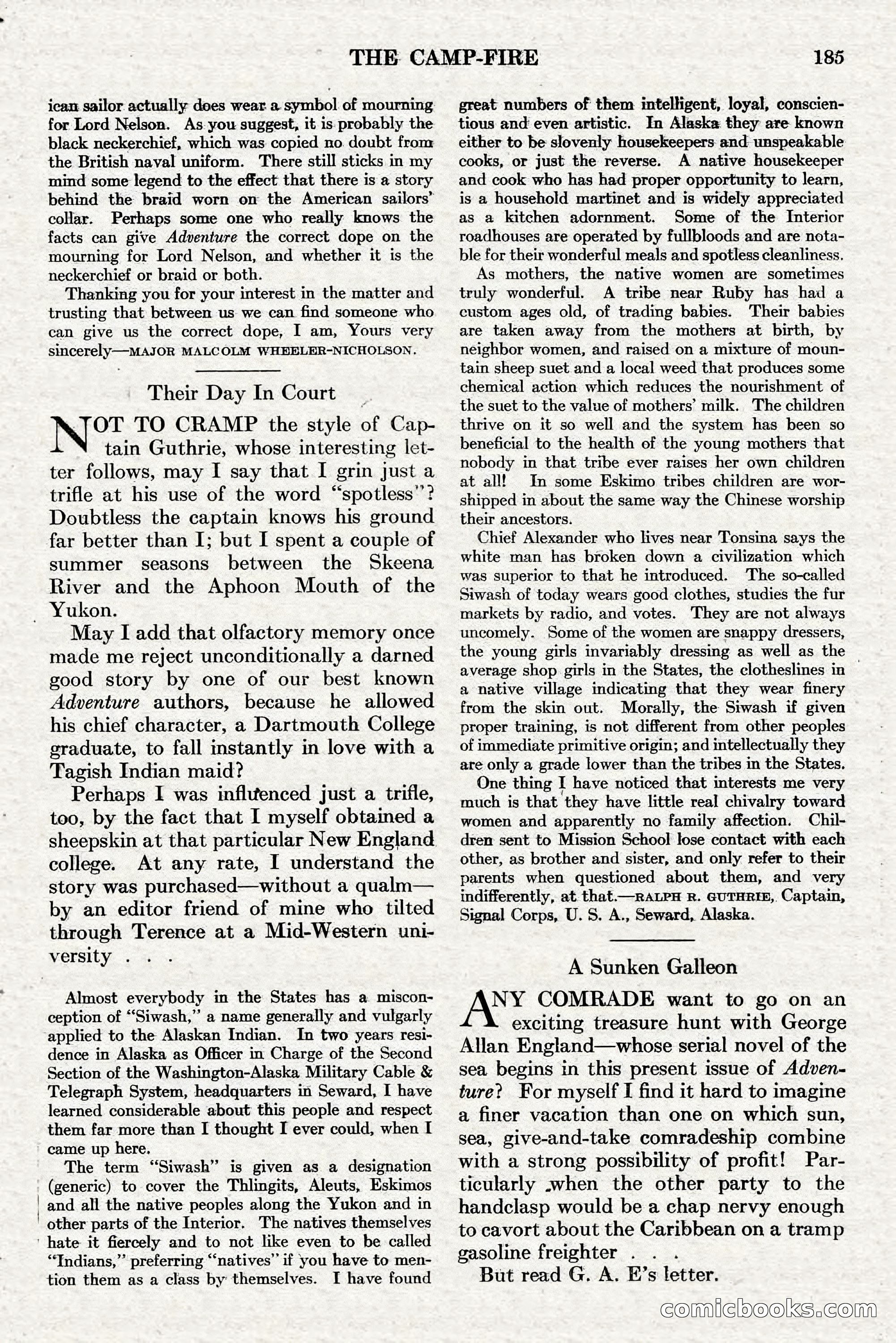
ican sailor actually does wear a. symbol of mourning for Lord Nelson. As-you suggest, it is: probably the black neckerchief, which was copied no. doubt from the British naval uniform. There still sticks in my mind some legend to the effect that there is a story behind the braid worn on the American sailors’ collar. Perhaps some one who really knows the facts can give Adventure the correct dope on the mourning for Lord Nelson, and whether it is the neckerchief or braid or both. Thanking you for your interest in the matter and trusting that between us. we can find someone who can give us the correct dope, I am, Yours very sincerely—MAJOR MALCOLM WHEELER-NICHOLSON. Their Day In Court OT TO CRAMP the style of Cap- tain Guthrie, whose interesting let- ter follows, may I say that I grin just a trifle at his use of the word “spotless’’? Doubtless the captain knows his ground far better than I; but I spent a couple of summer seasons between the Skeena River and the Aphoon Mouth of the _ Yukon. May I add that olfactory memory once made me reject unconditionally a darned good story by one of our best known Adventure authors, because he allowed his chief character, a Dartmouth College graduate, to fall instantly in love with a Tagish Indian maid? Perhaps I was influenced just a trifle, too, by the fact that I myself obtained a sheepskin at that particular New England college. At any rate, I understand the story was purchased—without a qualm— by an editor friend of mine who tilted through Terence at a Mid-Western uni- versity . Almost everybody in the States has a miscon- ception of “‘Siwash,”’ a name generally and vulgarly applied to the Alaskan Indian. In two years resi- dence in Alaska as Officer in Charge of the Second Section of the Washington-Alaska Military Cable & Telegraph System, headquarters in Seward, I have learned considerable about this people and respect them far more than I thought I ever could, when I came up here. The term “Siwash’” is given as a designation (generic) to cover the Thlingits, Aleuts, Eskimos and all the native peoples along the Yukon and in other parts of the Interior. The natives themselves ' hate it fiercely and to not like even to be called “Indians,”’ preferring “‘natives”’ if you have to men- tion them as a class by themselves. I have found 185 great numbers of them intelligent, loyal, conscien- tious and even artistic. In Alaska they are known either to be slovenly housekeepers and unspeakable cooks, or just the reverse. A native housekeeper and cook who has had proper opportunity to Jearn, is a household martinet and is widely appreciated as a kitchen adornment. Some of the Interior roadhouses are operated by fullbloods and are nota- ble for their wonderful meals and spotless cleanliness. As mothers, the native women are sometimes truly wonderful. A tribe near Ruby has had a custom ages old, of trading babies. Their babies are taken away from the mothers at birth, by neighbor women, and raised on a mixture of moun- tain sheep suet and a local weed that produces some chemical action which reduces the nourishment of the suet to the value of mothers’ milk. The children thrive on it so well and the system has been so beneficial to the health of the young mothers that nobody in that tribe ever raises her own children at all! In some Eskimo tribes children are wor- shipped in about the same way the Chinese worship their ancestors. Chief Alexander who lives near Tonsina says the white man has broken down a civilization which was superior to that he introduced. The so-called Siwash of today wears good clothes, studies the fur markets by radio, and votes. They are not always uncomely. Some of the women are snappy dressers, the young girls invariably dressing as well as the average shop girls in the States, the clotheslines in a native village indicating that they wear finery from the skin out. Morally, the Stwash if given proper training, is not different from other peoples of immediate primitive origin; and intellectually they are only a grade lower than the tribes in the States. One thing I have noticed that interests me very much is that they have little real chivalry toward women and apparently no family affection. Chil- dren sent to Mission School lose contact with each other, as brother and sister, and only refer to their parents when questioned about them, and very indifferently, at that —RALPH R. GUTHRIB, Captain, Signal Corps, U.S. A., Seward, Alaska. A Sunken Galleon NY COMRADE want to go on an exciting treasure hunt with George Allan England—whose serial novel of the sea begins in this present issue of Adven- ture? For myself I find it hard to imagine a finer vacation than one on which sun, sea, give-and-take comradeship combine with a strong possibility of profit! Par- ticularly -when the other party to the handclasp would be a chap nervy enough to ecavort about the Caribbean on a tramp gasoline freighter . . . But read G. A. E’s letter. comnlicloooks.com