
Pulp Fiction, 1928 · page 184 of 200
Adventure, July 1, 1928 — page 184: what you’re looking at
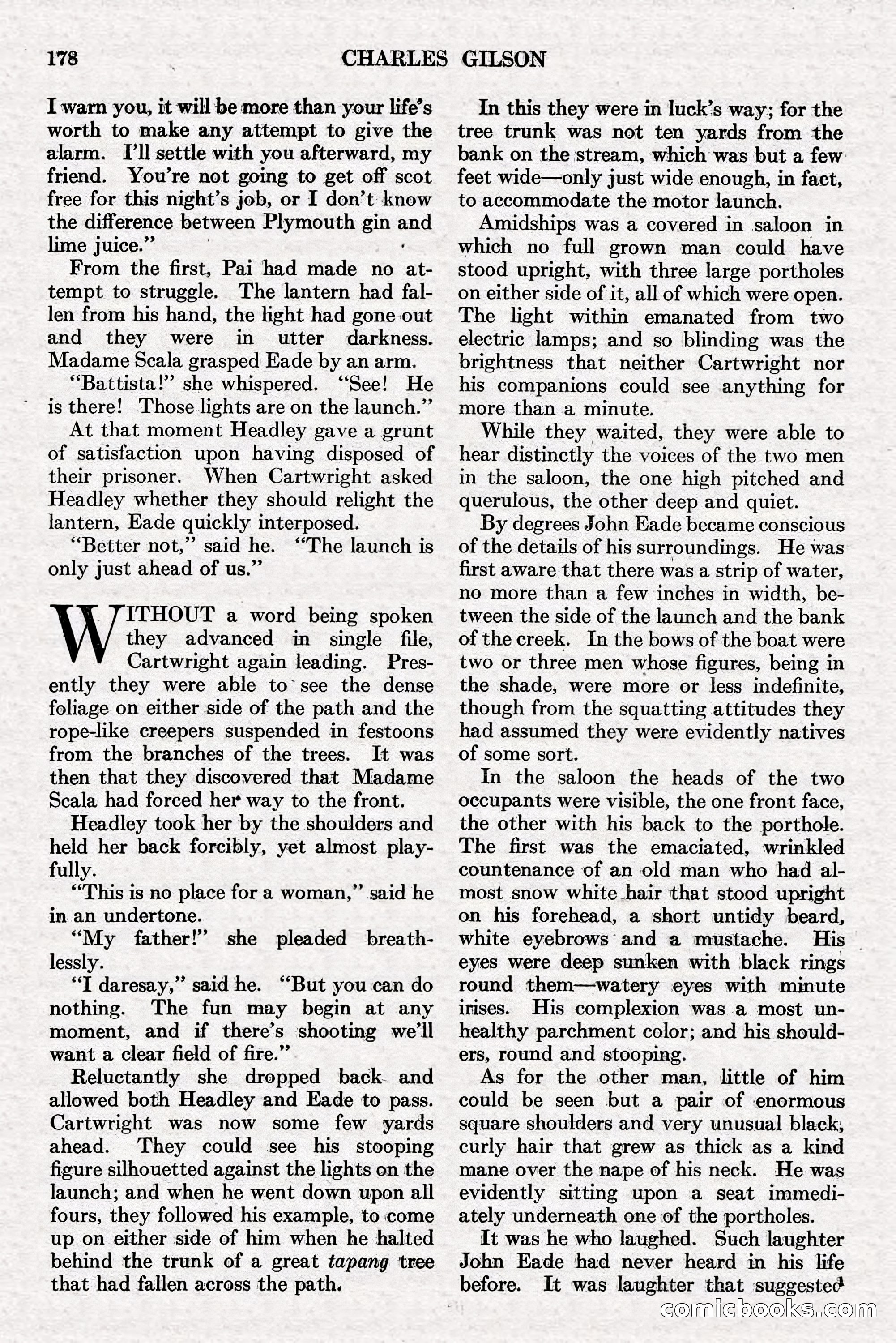
A restored page from Pulp Fiction, 1928. Page through the whole issue in the reader above.
📄 Transcribed text from this page (OCR, searchable)
Machine-transcribed from the original scan — historical spelling and the odd misread are preserved.
178 I warn you, it will be more than your life’s worth to make any attempt to give the alarm. [ll settle with you afterward, my friend. You’re not going to get off scot free for this night’s job, or I don’t know the difference between Plymouth gin aad lime juice.” From the first, Pai had made no at- tempt to struggle. The lantern had fal- len from his hand, the light had gone out and they were in utter darkness. Madame Scala grasped Eade by an arm. “Battista!” she whispered. “See! He is there! Those lights are on the launch.” At that moment Headley gave a grunt of satisfaction upon having disposed of their prisoner. When Cartwright asked Headley whether they should relight the lantern, Eade quickly interposed. “Better not,” said he. ‘The launch is only just ahead of us.” . YITHOUT a word being spoken they advanced in single file, Cartwright again leading. Pres- ently they were able to see the dense foliage on either side of the path and the rope-like creepers suspended in festoons from the branches of the trees. It was then that they discovered that Madame Scala had forced her way to the front. Headley took her by the shoulders and held her back forcibly, yet almost play- fully. “This is no place for a woman,” said he in an undertone. “My father!” she pleaded breath- lessly. “T daresay,” said he. ‘“‘But you can do nothing. The fun may begin at any moment, and if there’s shooting we'll want a clear field of fire.” Reluctantly she dropped back. and allowed both Headley and Eade to pass. Cartwright was now some few yards ahead. They could see his stooping figure silhouetted against the lights on the launch; and when he went down upon all fours, they followed his example, to come up on either side of him when he halted behind the trunk of a great tapang tree that had fallen across the path. before. CHARLES GILSON In this they were in luck’s way; for the tree trunk was not ten yards from the bank on the stream, which was but a few: feet wide—only just wide enough, in fact, to accommodate the motor launch. Amidships was a covered in saloon in which no full grown man could have stood upright, with three large portholes on either side of it, all of which were open. The light within emanated from two electric lamps; and so blinding was the brightness that neither Cartwright nor his companions could see anything for more than a minute. While they waited, they were able to hear distinctly the voices of the two men in the saloon, the one high pitched and querulous, the other deep and quiet. By degrees John Eade became conscious of the details of his surroundings. He was first aware that there was a strip of water, no more than a few inches in width, be- tween the side of the launch and the bank of the creek. In the bows of the boat were two or three men whose figures, being in the shade, were more or less indefinite, though from the squatting attitudes they had assumed they were evidently natives of some sort. In the saloon the heads of the two occupants were visible, the one front face, the other with his back to the porthole. The first was the emaciated, wrinkled countenance of an old man who had al- most snow white hair ‘that stood upright on his forehead, a short untidy beard, white eyebrows and a mustache. His | eyes were deep sunken with black rings round them—watery eyes with minute irises. His complexion was a most un- healthy parchment color; and his should- ers, round and stooping. As for the other man, little of him could be seen but a pair of enormous square shoulders and very unusual black, curly hair that grew as thick as a kind mane over the nape of his neck. He was evidently sitting upon a seat immedi- ately underneath one of the portholes. It was he who laughed. Such laughter John Eade had never heard im his life It was laughter that suggested comnlicloooks.com