
Pulp Fiction, 1928 · page 18 of 200
Adventure, July 1, 1928 — page 18: what you’re looking at
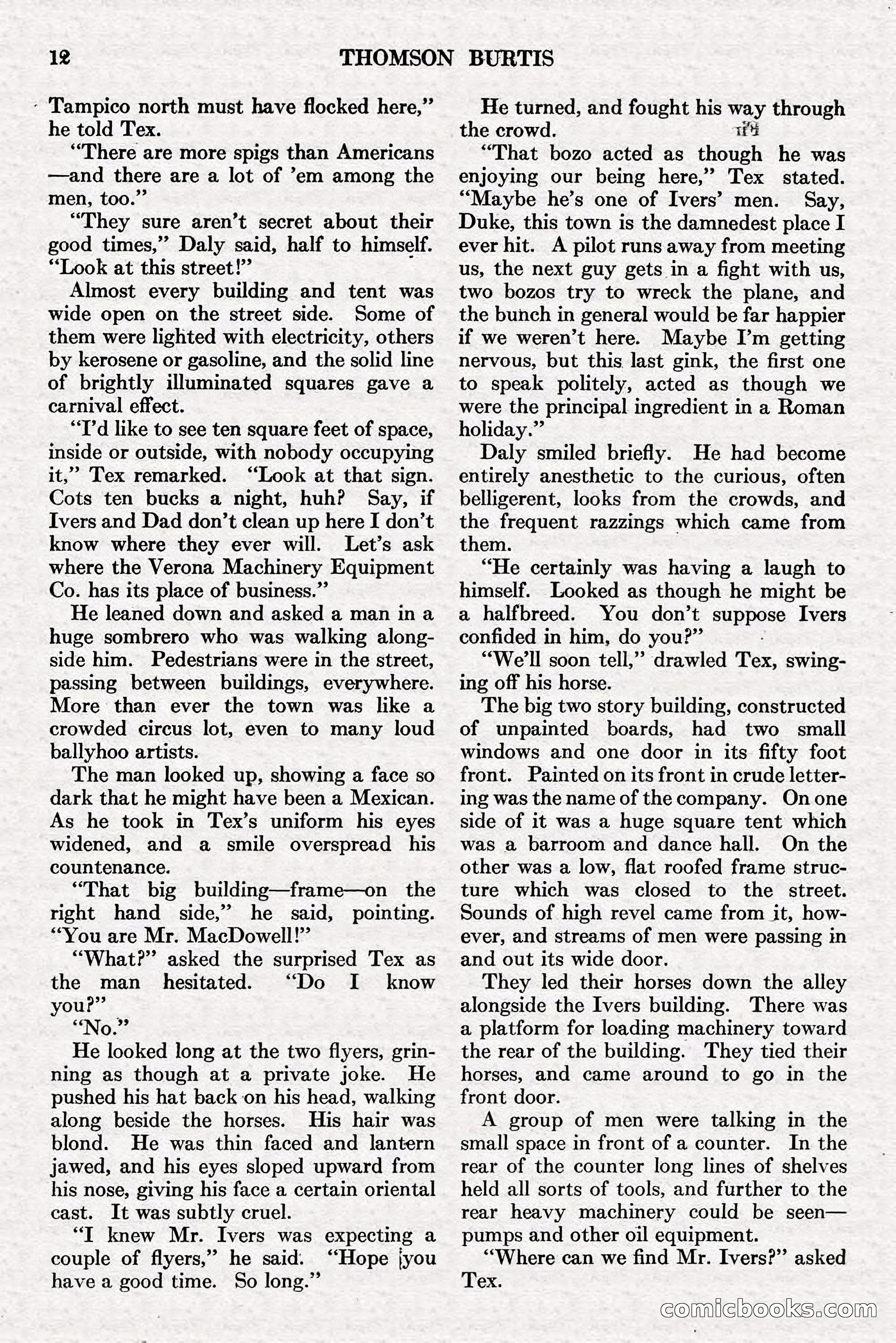
A restored page from Pulp Fiction, 1928. Page through the whole issue in the reader above.
📄 Transcribed text from this page (OCR, searchable)
Machine-transcribed from the original scan — historical spelling and the odd misread are preserved.
12 THOMSON BURTIS - Tampico north must have flocked here,” he told Tex. “There are more spigs than Americans —and there are a lot of ’em among the men, too.” “They sure aren’t secret about their good times,” Daly said, half to himself. “Look at this street!”’ Almost every building and tent was wide open on the street side. Some of them were lighted with electricity, others by kerosene or gasoline, and the solid line of brightly illuminated squares gave a carnival effect. “T’d like to see ten square feet of space, inside or outside, with nobody occupying it,” Tex remarked. “Look at that sign. Cots ten bucks a night, huh? Say, if Ivers and Dad don’t clean up here I don’t know where they ever will. Let’s ask where the Verona Machinery Equipment Co. has its place of business.” He leaned down and asked a man ina huge sombrero who was walking along- side him. Pedestrians were in the street, passing between buildings, everywhere. More than ever the town was like a crowded circus lot, even to many loud ballyhoo artists. The man looked up, showing a face so dark that he might have been a Mexican. As he took in Tex’s uniform his eyes widened, and a smile overspread his countenance. “That big building—frame—on the right hand side,” he said, pointing. “You are Mr. MacDowell!” “What?” asked the surprised Tex as the man hesitated. “Do I know He looked long at the two flyers, grin- ning as though at a private joke. He pushed his hat back on his head, walking along beside the horses. His hair was blond. He was thin faced and lantern jawed, and his eyes sloped upward from his nose, giving his face a certain oriental cast. It was subtly cruel. “I knew Mr. Ivers was expecting a couple of flyers,” he said. ‘Hope jyou have a good time. So long.” He turned, and fought his way through the crowd. 4 “That bozo acted as though he was enjoying our being here,” Tex stated. “Maybe he’s one of Ivers’ men. Say, Duke, this town is the damnedest place I ever hit. A pilot runs away from meeting us, the next guy gets in a fight with us, two bozos try to wreck the plane, and the bunch in general would be far happier if we weren’t here. Maybe I’m getting nervous, but this last gink, the first one to speak politely, acted as though we were the principal ingredient in a Roman holiday.” Daly smiled briefly. He had become entirely anesthetic to the curious, often belligerent, looks from the crowds, and the frequent razzings which came from them. “He certainly was having a laugh to himself. Looked as though he might be a halfbreed. You don’t suppose Ivers confided in him, do you?” “We'll soon tell,”’ drawled Tex, swing- ing off his horse. The big two story building, constructed of unpainted boards, had two small windows and one door in its fifty foot front. Painted on its front in crude letter- ing was the name of the company. On one side of it was a huge square tent which was a barroom and dance hall. On the other was a low, flat roofed frame struc- ture which was closed to the street. Sounds of high revel came from it, how- ever, and streams of men were passing in and out its wide door. They led their horses down the alley alongside the Ivers building. There was a platform for loading machinery toward the rear of the building. They tied their horses, and came around to go in the front door. A group of men were talking in the small space in front of a counter. In the rear of the counter long lines of shelves held all sorts of tools, and further to the rear heavy machinery could be seen— pumps and other oil equipment. “‘Where can we find Mr. Ivers?” asked Tex. comicloooks.com