
Pulp Fiction, 1928 · page 133 of 200
Adventure, July 1, 1928 — page 133: what you’re looking at
A restored page from Pulp Fiction, 1928. Page through the whole issue in the reader above.
📄 Transcribed text from this page (OCR, searchable)
Machine-transcribed from the original scan — historical spelling and the odd misread are preserved.
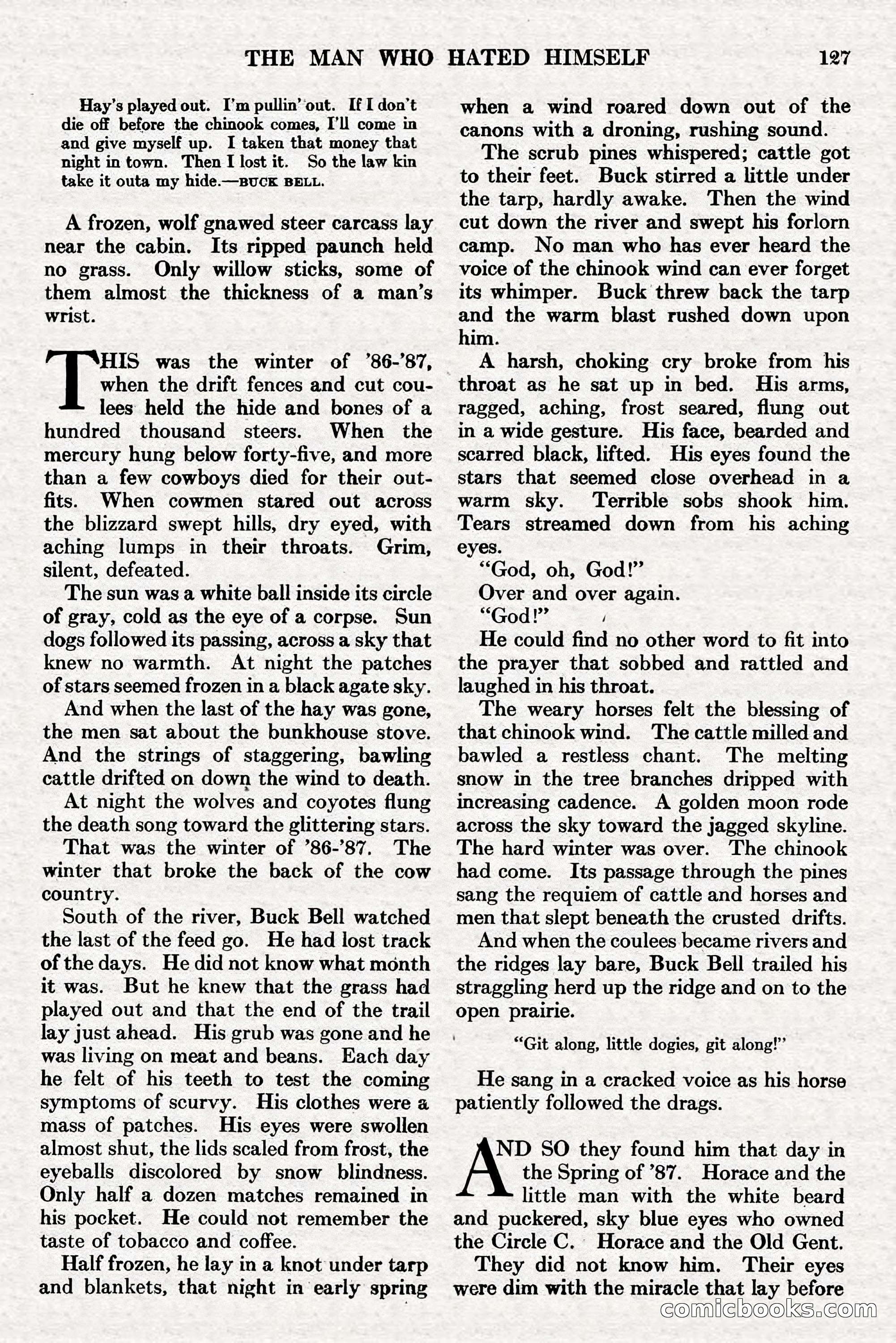
THE MAN WHO Hay’s played out. I'm pullin’ out. If I don’t die off before the chinook comes, I'll come in and give myself up. I taken that money that night in town. Then I lost it. So the law kin take it outa my hide.—BUCK BELL. A frozen, wolf gnawed steer carcass lay near the cabin. Its ripped paunch held no grass. Only willow sticks, some of them almost the thickness of a man’s wrist. HIS was the winter of ’86-’87, when the drift fences and cut cou- lees held the hide and bones of a hundred thousand steers. When the mercury hung below forty-five, and more than a few cowboys died for their out- fits. When cowmen stared out across the blizzard swept hills, dry eyed, with aching lumps in their throats. Grim, silent, defeated. The sun was a white ball inside its circle of gray, cold as the eye of a corpse. Sun dogs followed its passing, across a sky that knew no warmth. At night the patches of stars seemed frozen in a black agate sky. And when the last of the hay was gone, the men sat about the bunkhouse stove. And the strings of staggering, bawling cattle drifted on down the wind to death. At night the wolves and coyotes flung the death song toward the glittering stars. That was the winter of ’86-’87. The winter that broke the back of the cow country. South of the river, Buck Bell watched the last of the feed go. He had lost track of the days. He did not know what month it was. But he knew that the grass had played out and that the end of the trail lay just ahead. His grub was gone and he was living on meat and beans. Each day he felt of his teeth to test the coming symptoms of scurvy. His clothes were a mass of patches. His eyes were swollen almost shut, the lids scaled from frost, the eyeballs discolored by snow blindness. Only half a dozen matches remained in his pocket. He could not remember the taste of tobacco and coffee. Half frozen, he lay in a knot under tarp and blankets, that night in early spring HATED HIMSELF 127 when a wind roared down out of the canons with a droning, rushing sound. The scrub pines whispered; cattle got to their feet. Buck stirred a little under the tarp, hardly awake. Then the wind cut down the river and swept his forlorn camp. No man who has ever heard the voice of the chinook wind can ever forget its whimper. Buck threw back the tarp and the warm blast rushed down upon him. A harsh, choking cry broke from his throat as he sat up in bed. His arms, ragged, aching, frost seared, flung out in a wide gesture. His face, bearded and scarred black, lifted. His eyes found the stars that seemed close overhead in a warm sky. Terrible sobs shook him. Tears streamed down from his aching eyes. “God, oh, God!” Over and over again. “God yr? / He could find no other word to fit into the prayer that sobbed and rattled and laughed in his throat. The weary horses felt the blessing of that chinook wind. The cattle milled and bawled a restless chant. The melting snow in the tree branches dripped with increasing cadence. A golden moon rode across the sky toward the jagged skyline. The hard winter was over. The chinook had come. Its passage through the pines sang the requiem of cattle and horses and men that slept beneath the crusted drifts. And when the coulees became rivers and the ridges lay bare, Buck Bell trailed his straggling herd up the ridge and on to the open prairie. “Git along, little dogies, git along!” He sang in a cracked voice as his horse patiently followed the drags. ND SO they found him that day in the Spring of ’87. Horace and the little man with the white beard and puckered, sky blue eyes who owned the Circle C. Horace and the Old Gent. They did not know him. Their eyes were dim with the miracle that lay before comicloooks.com