
Pulp Fiction, 1928 · page 112 of 200
Adventure, July 1, 1928 — page 112: what you’re looking at
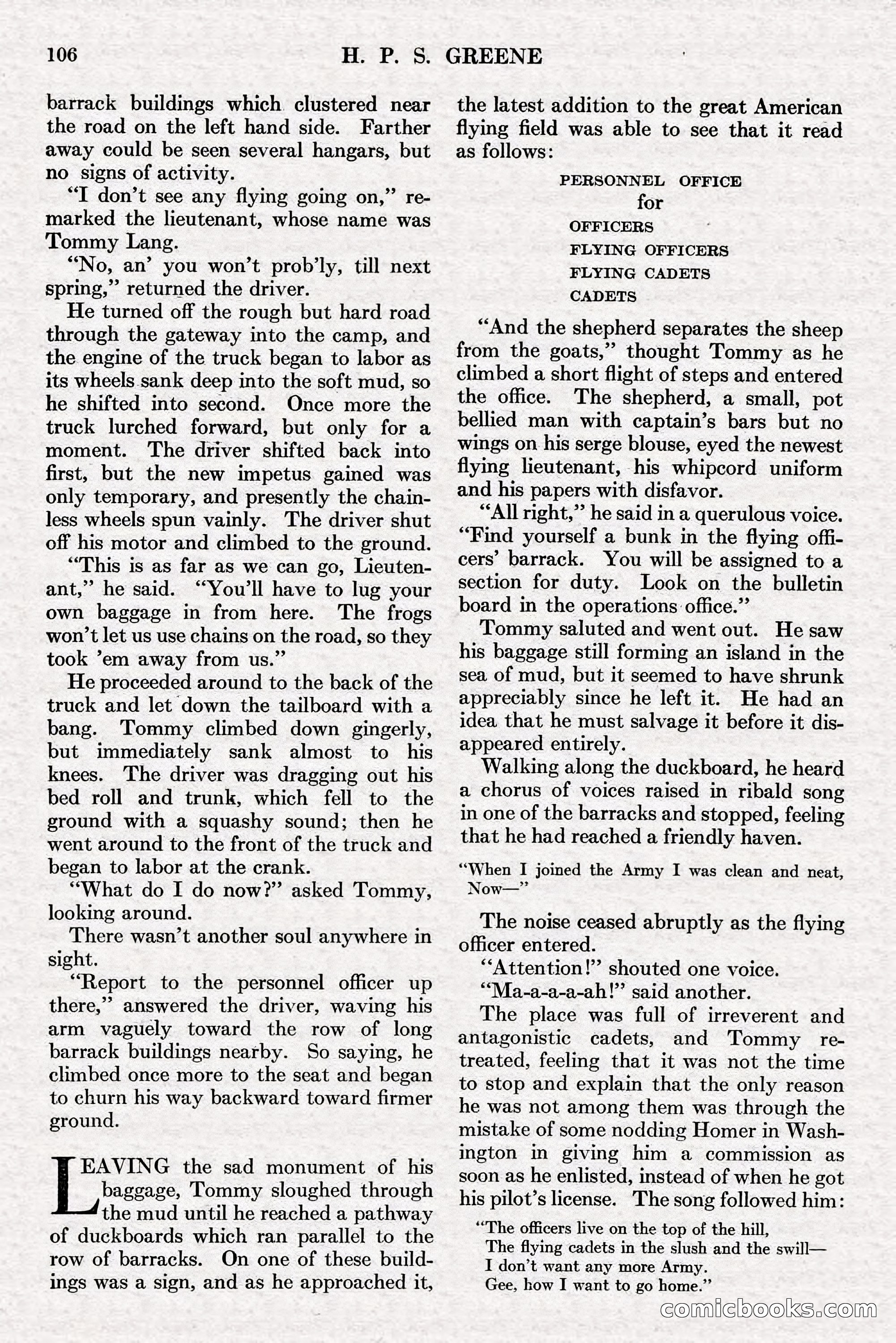
A restored page from Pulp Fiction, 1928. Page through the whole issue in the reader above.
📄 Transcribed text from this page (OCR, searchable)
Machine-transcribed from the original scan — historical spelling and the odd misread are preserved.
106 barrack buildings which clustered near the road on the left hand side. Farther away could be seen several hangars, but no signs of activity. “I don’t see any flying going on,” re- marked the lieutenant, whose name was Tommy Lang. “No, an’ you won’t prob’ly, till next spring,” returned the driver. He turned off the rough but hard road through the gateway into the camp, and the engine of the truck began to labor as its wheels sank deep into the soft mud, so he shifted into second. Once more the truck lurched forward, but only for a moment. The driver shifted back into first, but the new impetus gained was only temporary, and presently the chain- less wheels spun vainly. The driver shut off his motor and climbed to the ground. “This is as far as we can go, Lieuten- ant,” he said. “You'll have to lug your own baggage in from here. The frogs won't let us use chains on the road, so they took ’em away from us.” He proceeded around to the back of the truck and let down the tailboard with a bang. Tommy climbed down gingerly, but immediately sank almost to his knees. The driver was dragging out his bed roll and trunk, which fell to the ground with a squashy sound; then he went around to the front of the truck and began to labor at the crank. “What do I do now?” asked Tommy, looking around. There wasn’t another soul anywhere in sight. “Report to the personnel officer up there,” answered the driver, waving his arm vaguely toward the row of long barrack buildings nearby. So saying, he climbed once more to the seat and began to churn his way backward toward firmer ground. baggage, Tommy sloughed through the mud until he reached a pathway of duckboards which ran parallel to the row of barracks. On one of these build- ings was a sign, and as he approached it, EAVING the sad monument of his H. P. S. GREENE the latest addition to the great American flying field was able to see that it read as follows: PERSONNEL OFFICE for OFFICERS FLYING OFFICERS FLYING CADETS CADETS “And the shepherd separates the sheep from the goats,” thought Tommy as he climbed a short flight of steps and entered the office. The shepherd, a small, pot bellied man with captain’s bars but no wings on his serge blouse, eyed the newest flying lieutenant, his whipcord uniform and his papers with disfavor. “All right,” he said in a querulous voice. “Find yourself a bunk in the flying offi- cers’ barrack. You will be assigned to a section for duty. Look on the bulletin board in the operations office.” Tommy saluted and went out. He saw his baggage still forming an island in the sea of mud, but it seemed to have shrunk appreciably since he left it. He had an idea that he must salvage it before it dis- appeared entirely. Walking along the duckboard, he heard a chorus of voices raised in ribald song in one of the barracks and stopped, feeling that he had reached a friendly haven. “When I joined the Army I was clean and neat, Now—” The noise ceased abruptly as the flying officer entered. “Attention!” shouted one voice. “Ma-a-a-a-ah!”’ said another. The place was full of irreverent and antagonistic cadets, and Tommy re- treated, feeling that it was not the time to stop and explain that the only reason he was not among them was through the mistake of some nodding Homer in Wash- ington in giving him a commission as soon as he enlisted, instead of when he got his pilot’s license. The song followed him: “The officers live on the top of the hill, The flying cadets in the slush and the swill— I don’t want any more Army. Gee, how I want to go home.” comnicloooks.com