
Pulp Fiction, 1928 · page 106 of 200
Adventure, July 1, 1928 — page 106: what you’re looking at
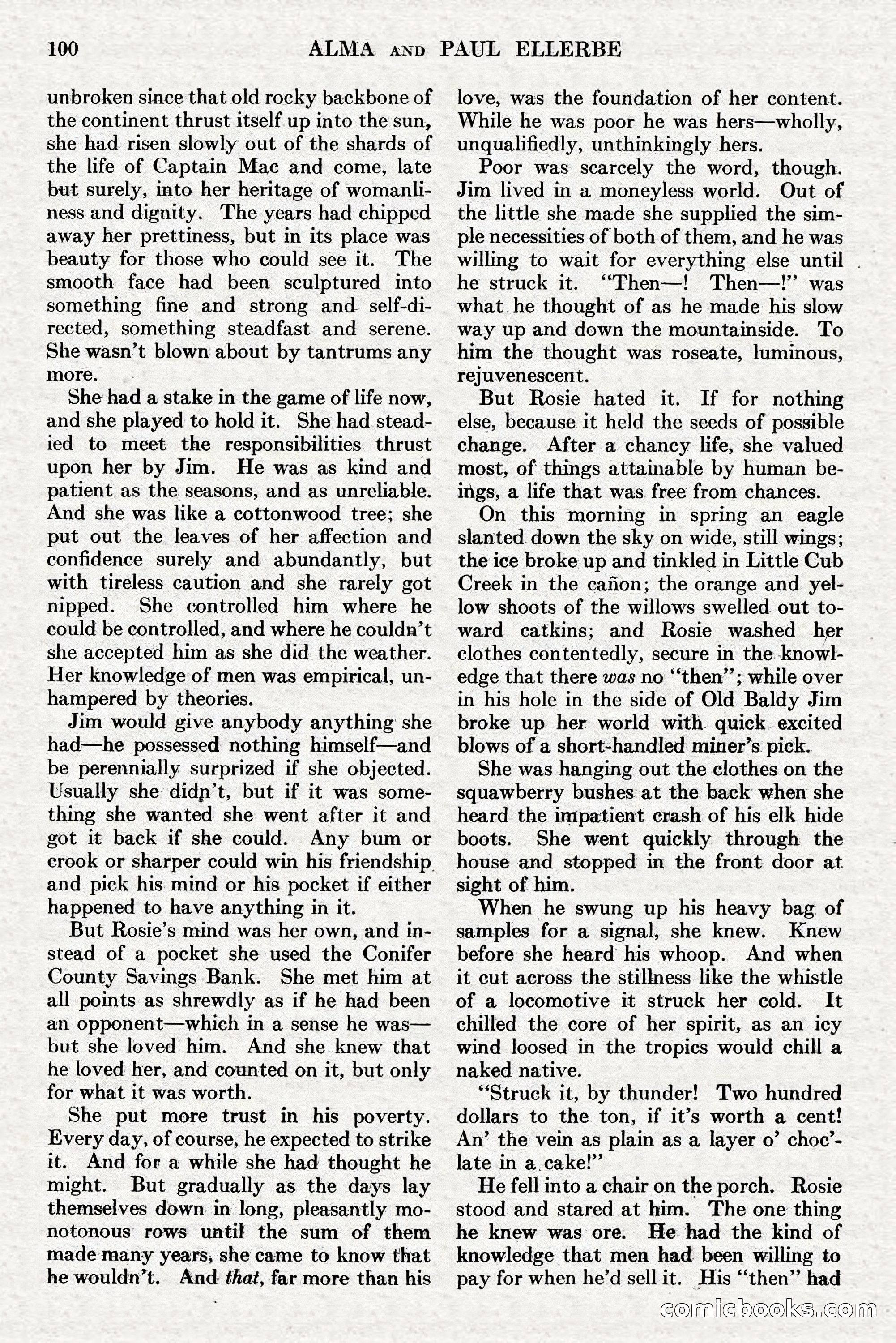
A restored page from Pulp Fiction, 1928. Page through the whole issue in the reader above.
📄 Transcribed text from this page (OCR, searchable)
Machine-transcribed from the original scan — historical spelling and the odd misread are preserved.
100 unbroken since that old rocky backbone of the continent thrust itself up into the sun, she had. risen slowly out of the shards of the life of Captain Mac and come, late but surely, into her heritage of womanli- ness and dignity. The years had chipped away her prettiness, but in its place was beauty for those who could see it. The smooth face had been sculptured into something fine and strong and self-di- rected, something steadfast and serene. She wasn’t blown about by tantrums any more. She had a stake in the game of life now, and she played to hold it. She had stead- ied to meet the responsibilities thrust upon her by Jim. He was as kind and patient as the seasons, and as unreliable. And she was like a cottonwood tree; she put out the leaves of her affection and confidence surely and abundantly, but with tireless caution and she rarely got nipped. She controlled him where he could be controlled, and where he couldn’t she accepted him as she did the weather. Her knowledge of men was empirical, un- hampered by theories. Jim would give anybody anything she had—he possessed: nothing himself—and be perennially surprized if she objected. Usually she didn’t, but if it was some- thing she wanted she went after it and got it back if she could. Any bum or crook or sharper could win his friendship, and pick his mind or his pocket if either happened to have anything in it. But Rosie’s mind was her own, and in- stead of a pocket she used the Conifer County Savings Bank. She met him at all points as shrewdly as if he had been an opponent—which in a sense he was— but she loved him. And she knew that he loved her, and counted on it, but only for what it was worth. She put more trust in his poverty. Every day, of course, he expected to strike it. And for a while she had thought he might. But gradually as the days lay themselves down in long, pleasantly mo- notonous rows until the sum of them made many years, she came to know that he wouldn’t. And: that, far more than his ALMA anp PAUL ELLERBE love, was the foundation of her content. While he was poor he was hers—wholly, unqualifiedly, unthinkingly hers. Poor was scarcely the word, though. Jim lived in a moneyless world. Out of the little she made she supplied the sim- ple necessities of both of them, and he was willing to wait for everything else until . he struck it. “Then—! Then—!” was what he thought of as he made his slow way up and down the mountainside. To him the thought was roseate, luminous, rejuvenescent. But Rosie hated it. If for nothing else, because it held the seeds of possible change. After a chancy life, she valued most, of things attainable by human be- ings, a life that was free from chances. On this morning in spring an eagle slanted. down the sky on wide, still wings; the ice broke up and tinkled in Little Cub Creek in the cajfion; the orange and yel- low shoots of the willows swelled out to- ward catkins; and Rosie washed her clothes contentedly, secure in the knowl- edge that there was no “‘then”’; while over in his hole in the side of Old Baldy Jim broke up. her world with. quick excited blows of a short-handled miner’s pick. She was hanging out the clothes on the squawberry bushes at the back when she heard the impatient crash of his elk hide boots. She went quickly through the house and stopped in the front door at sight of him. When he swung up his heavy bag of samples for a signal, she knew. Knew before she heard his whoop. And when it cut across the stillness like the whistle of a locomotive it struck her cold. It chilled the core of her spirit, as an icy wind loosed in the tropics would chill a naked native. “Struck it, by thunder! Two hundred dollars to the ton, if it’s worth a cent! An’ the vein as plain as a layer o’ choc’- late in a.cake!” He fell into a chair on the porch. Rosie stood and stared at him. The one thing he knew was ore. He had the kind of knowledge that men had been willing to pay for when he’d sell it. His “then’’ had comlicloooks.com