
Pulp Fiction, 1919 · page 98 of 204
Adventure, August 3, 1919 — page 98: what you’re looking at
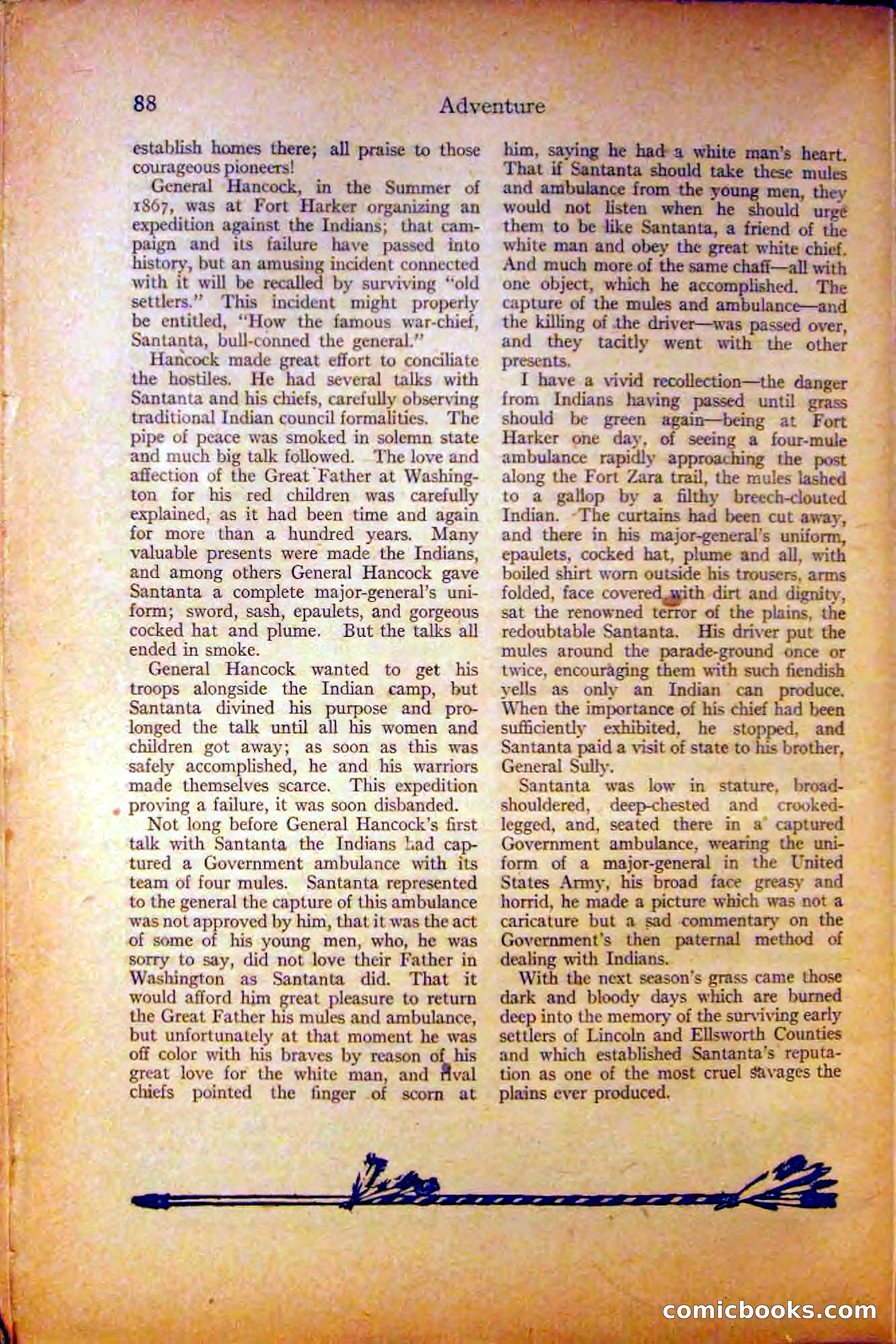
A restored page from Pulp Fiction, 1919. Page through the whole issue in the reader above.
📄 Transcribed text from this page (OCR, searchable)
Machine-transcribed from the original scan — historical spelling and the odd misread are preserved.
- =—- wo ee 88 Adventure establish homes there; all praise to those courageous pioneers! General Hancock, in the Summer of 1867, was at Fort Harker organizing an expedition against the Indians; that cam- paign and its failure have passed into history, but an amusing incident connected with it will be recalled by surviving “old settlers.” This incident might properly be entitled, ‘How the famous war-chief, Santanta, bull-conned the general.” Hancock made great effort to conciliate the hostiles, He had several talks with Santanta and his chiefs, carefully observing traditional Indian council formalities. The pipe of peace was smoked in solemn state and much big talk followed. The love and affection of the Great Father at Washing- ton for his red children was carefully explained, as it had been time and again for more than a hundred years, Many valuable presents were made the Indians, and among others General Hancock gave Santanta a complete major-general’s uni- form; sword, sash, epaulets, and gorgeous cocked hat and plume. But the talks all ended in smoke. General Hancock wanted to get his troops alongside the Indian camp, but Santanta divined his purpose and pro- longed the talk until all his women and children got away; as soon as this was safely accomplished, he and his warriors made themselves scarce. This expedition proving a failure, it was soon disbanded. Not long before General Hancock’s first talk with Santanta the Indians had cap- tured a Government ambulance with its team of four mules. Santanta represented to the general the capture of this ambulance was not approved by him, that it was the act of some of his young men, who, he was sorry to say, did not love their Father in Washington as Santanta did. That it would afford him great pleasure to return the Great Father his mules and ambulance, but unfortunately at that moment he was off color with his braves by reason of_his great love for the white man, and fival chiefs pointed the finger of scorn at comicbooks.com ms! 2 ee ur them to bedllen Gantaathe a tsend of tke white man and obey the great white chief, And much more of the same chaff—all with one object, which he lished. The capture of the mules and ambulance—and the killing of the driver—was passed over, and they tacitly went with the other presents, I have a vivid recollection—the danger from Indians haying passed until grass should be green again—being at Fort Harker one day, of seeing a four-mule ambulance rapidly approaching the post along the Fort Zara trail, the mules lashed to a gallop by a filthy breech-clouted Indian. ~The curtains had been cut away, and there in his major-general’s uniform, epaulets, cocked hat, plume and all, with boiled shirt worn outside his trousers, arms folded, face covered gyith dirt and dignity, sat the renowned terror of the plains, the redoubtable Santanta. His driver put the mules around the parade-ground once or twice, encouraging them with such fiendish yells as only an Indian can produce. When the importance of his chief had been sufficiently exhibited, he stopped, and Santanta paid a visit of state to his brother, General Sully. Santanta was low in stature, broad- shouldered, deep-chested and crooked- legged, and, seated there in a captured Government ambulance, wearing the uni- form of a major-general in the United States Army, his broad face greasy and horrid, he made a picture which was not a caricature but a sad commentary on the Government’s then paternal method of dealing with Indians. With the next season’s grass came those dark and bloody days which are burned deep into the memory of the surviving early settlers of Lincoln and Ellsworth Counties and which established Santanta’s reputa- tion as one of the most cruel savages the plains ever produced.