
Pulp Fiction, 1919 · page 81 of 204
Adventure, August 3, 1919 — page 81: what you’re looking at
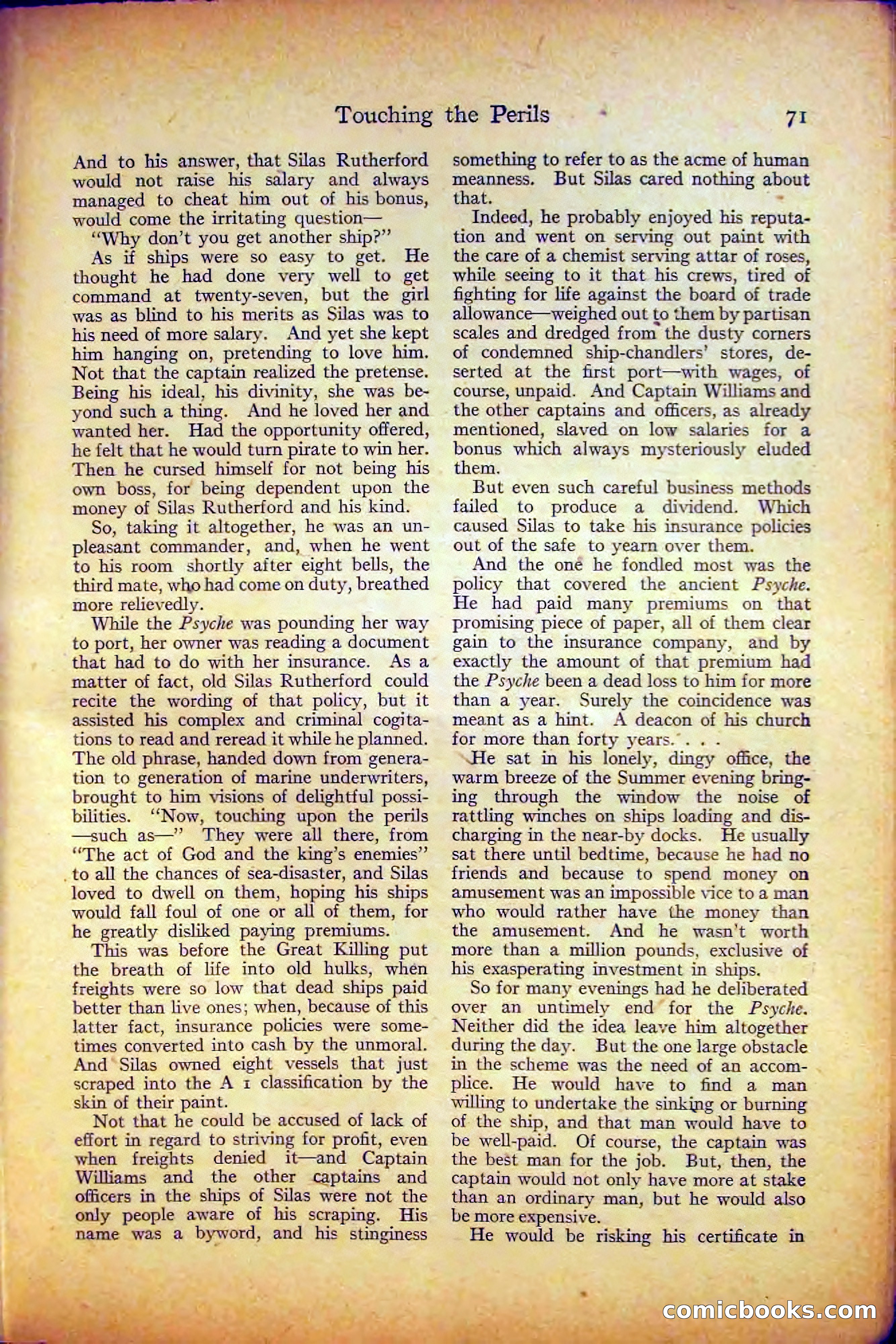
A restored page from Pulp Fiction, 1919. Page through the whole issue in the reader above.
📄 Transcribed text from this page (OCR, searchable)
Machine-transcribed from the original scan — historical spelling and the odd misread are preserved.
a ———— — —— | ei = ae oF 1 ty Ly | * 2 ae a cl ba see es ats And to his answer, that Silas Rutherford would not raise his salary and always managed to cheat him out of his bonus, would come the irritating question— “Why don’t you get another ship?” As if ships were so easy to get. He thought he had done very well to get command at twenty-seven, but the girl was as blind to his merits as Silas was to his need of more salary. And yet she kept him hanging on, pretending to love him. Not that the captain realized the pretense. Being his ideal, his divinity, she was be- yond such a thing. And he loved her and wanted her. Had the opportunity offered, he felt that he would turn pirate to win her. Then he cursed himself for not being his own boss, for being dependent upon the money of Silas Rutherford and his kind. So, taking it altogether, he was an un- pleasant commander, and, when he went to his room shortly after ‘eight bells, the third mate, who had come on duty, breathed more relievedly. While the Psyche was pounding her way to port, her owner was reading a document that had to do with her imsurance. As a matter of fact, old Silas Rutherford could recite the wording of that policy, but it assisted his complex and criminal cogita- tions to read and reread it while he planned. The old phrase, handed down from genera- tion to generation of marine underwriters, brought to him visions of delightful possi- bilities. ‘‘Now, touching upon the perils —such as—” They were all there, from “The act of God and the king’s enemies” _to all the chances of sea-disaster, and Silas loved to dwell on them, hoping his ships would fall foul of one or all of them, for he greatly disliked paying premiums. This was before the Great Killing put the breath of life into old hulks, when freights were so low that dead ships paid better than live ones; when, because of this latter fact, insurance policies were some- times converted into cash by the unmoral. And’ Silas owned eight vessels that just scraped into the A 1x classification by the skin of their paint. Not that he could be accused of lack of effort in regard to striving for profit, even when freights denied it—and Captain Williams and the other captains and officers in the ships of Silas were not the se aware of his scraping. His a Touching the Perils ‘ 71 something to refer to as the acme of human meanness. But Silas cared nothing about that. Indeed, he probably enjoyed his sani tion and went on serving out paint with the care of a chemist serving attar of roses, while seeing to it that his crews, tired of fighting for life against the board of trade allowance—weighed out to them by partisan scales and dredged from the dusty corners of condemned ship-chandlers’ stores, de- serted at the first port—with wages, of course, unpaid. And Captain Williams and the other captains and officers, as already mentioned, slaved on low salaries for a bonus which always mysteriously eluded them. But even such careful business methods failed to produce a dividend. Which caused Silas to take his insurance policies out of the safe to yearn over them. And the oné he fondled most was the policy that covered the ancient Psyche. He had paid many premiums on that promising piece of paper, all of them clear gain to the insurance company, and by exactly the amount of that premium had the Psyche been a dead loss to him for more than a year. Surely the coincidence was meant as a hint. A deacon of his church for more than forty years.”. . “He sat in his lonely, dingy office, the warm breeze of the Summer evening bring- ing through the window the noise of rattling winches on ships loading and dis- charging in the near-by docks. He usually sat there until bedtime, because he had no friends and because to spend money on amusement was an impossible vice to a man who would rather have the money than the amusement. And he wasn’t worth more than a million pounds, exclusive of his exasperating investment in ships. So for many evenings had he deliberated Over an untimely end for the Psyche. Neither did the idea leave him altogether during the day. But the one large obstacle in the scheme was the need of an accom- plice. He would have to find a man willing to undertake the sinking or burning of the ship, and that man would have to_ be well-paid. Of course, the captain was the best man for the job. But, then, the i captain would not only have more at stake than an ordinary man, but he would also be more expensive. a __. He would be risking his certificate ages a FAME “. = * eo BMiebGoks. com