
Pulp Fiction, 1919 · page 54 of 204
Adventure, August 3, 1919 — page 54: what you’re looking at
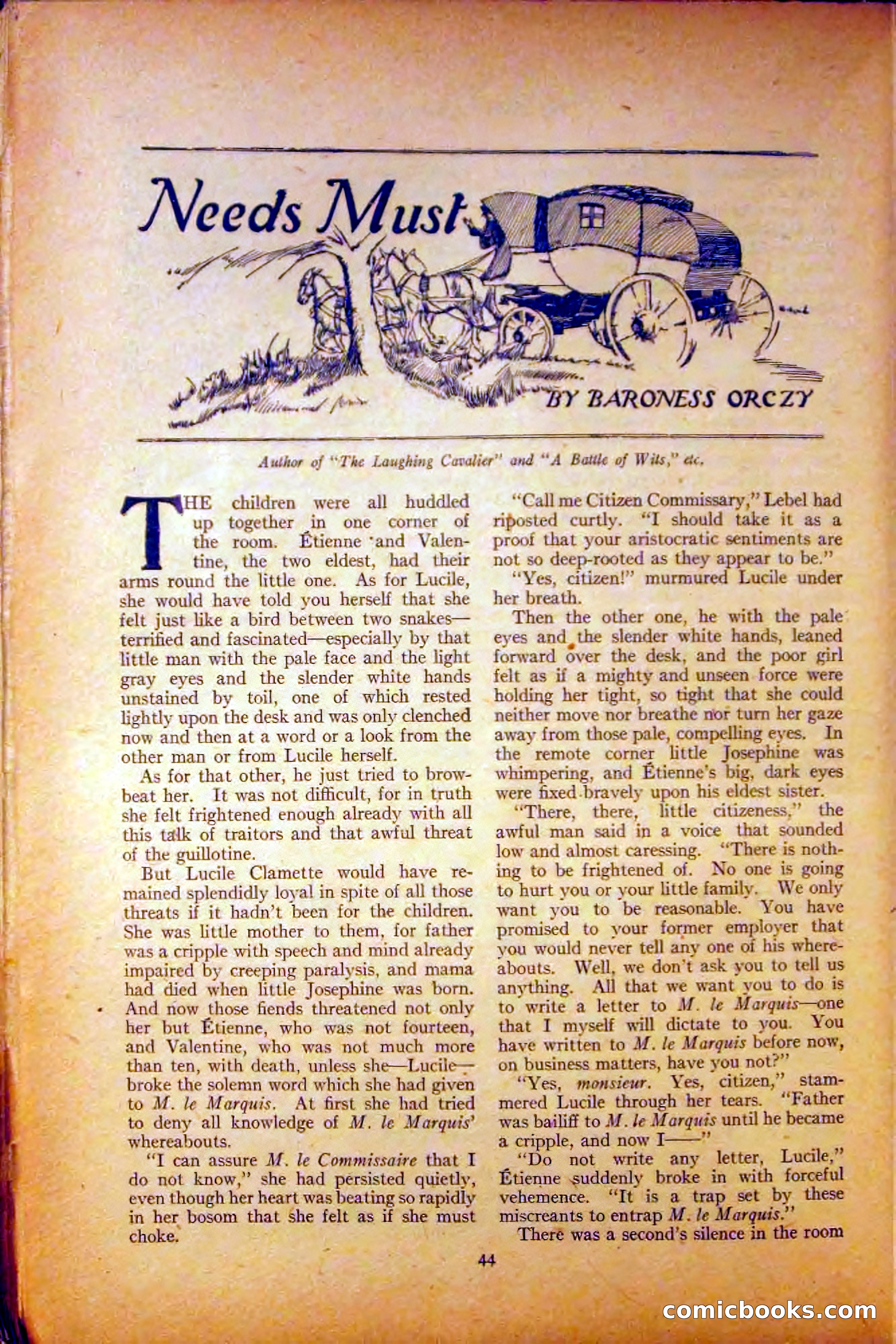
A restored page from Pulp Fiction, 1919. Page through the whole issue in the reader above.
📄 Transcribed text from this page (OCR, searchable)
Machine-transcribed from the original scan — historical spelling and the odd misread are preserved.
Author of “The Laughing Cavalier" and “A Batile of Wits,” ae, HE children were all huddled up together in one corner of the room. Etienne ‘and Valen- tine, the two eldest, had their arms round the little one. As for Lucile, she would have told you herself that she felt just like a bird between two snakes— terrified and fascinated—especially by that little man with the pale face and the light gray eyes and the slender white hands unstained by toil, one of which rested lightly upon the desk and was only clenched now and then at a word or a look from the other man or from Lucile herself. As for that other, he just tried to brow- beat her. It was not difficult, for in truth she felt frightened enough already with all this talk of traitors and that awful threat of the guillotine. But Lucile Clamette would have re- mained splendidly loyal in spite of all those threats if it hadn’t been for the children. She was little mother to them, for father was a cripple with speech and mind already impaired by creeping paralysis, and mama had died when little Josephine was born. And now those fiends threatened not only her but Etienne, who was not fourteen, and Valentine, who was not much more than ten, with death, unless she—Lucile— broke the solemn word which she had given to M. le Marquis. At first she had tried to deny all knowledge of M. le Marquis’ whereabouts. “T can assure M. le Commissaire that I do not know,” she had persisted quietly, even though her heart was beating so rapidly in her bosom that She felt as if she must * choke. miscreants to entrap M. /e Ma “Call me Citizen Commissary,” Lebel had riposted curtly. “I should take it as a proof that your aristocratic sentiments are not so deep-rooted as they appear to be.” “Ves, citizen!” murmured Lucile under her breath. Then the other one, he with the pale eyes and the slender white hands, leaned forward over the desk, and the poor girl felt as if a mighty and unseen force were holding her tight, so tight that she could neither move nor breathe nor turn her gaze away from those pale, compelling eyes, In the remote corner little Josephine was whimpering, and Etienne’s big, dark eyes were fixed-bravely upon his eldest sister. “There, there, little citizeness,” the awful man said in a voice that sounded low and almost caressing. “‘There is noth- ing to be frightened of. No one is going to hurt you or your little family. We only want you to be reasonable. You have promised to your former employer that you would never tell any one of his where- abouts. Well, we don’t ask you to tell us anything. All that we want you to do is to write a letter to M. le Marguis—one that I myself will dictate to you. You have written to M. le Marquis before now, on business matters, have you not?” “Ves, monsieur, Yes, citizen,” stam- mered Lucile through her tears. “Father was bailiff to M. le Marqués until he became a ily and now _I——” ‘ “Do not write any letter, Lucile,” Etienne suddenly broke in with forceful vehemence. “It is a trap set by these <~. chee “2h iw’ * 2)...