
Pulp Fiction, 1919 · page 49 of 204
Adventure, August 3, 1919 — page 49: what you’re looking at
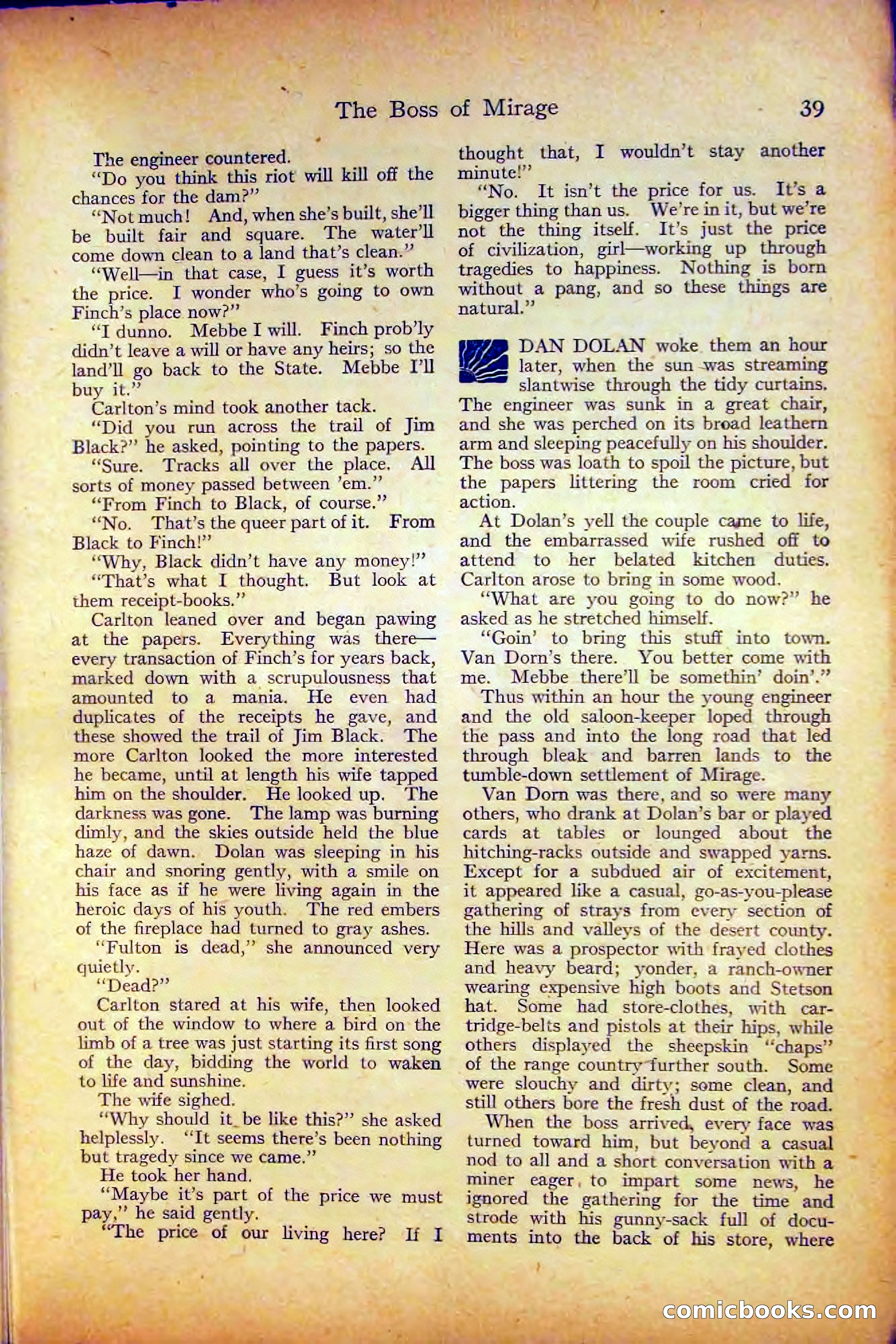
A restored page from Pulp Fiction, 1919. Page through the whole issue in the reader above.
📄 Transcribed text from this page (OCR, searchable)
Machine-transcribed from the original scan — historical spelling and the odd misread are preserved.
The engin eer countered. ‘Do you think this riot will kill off the chances for the dam?” ‘Not much! And, when she’s built, she’ll be built fair and square. The water’ll come down clean to a land that’s clean.” “Well—in that case, I guess it’s worth the price. I wonder who’s going to own Finch’s place now?” . “T dunno. Mebbe I will. Finch prob’ly didn’t leave a will or have any heirs; so the land’ll go back to the State. Mebbe I'll buy it.” Carlton’s mind took another tack. : “Did you run across the trail of Jim Black?” he asked, pointing to the papers. “Sure. Tracks all over the place, All sorts of money passed between ’em.”’ “From Finch to Black, of course.” “No. That’s the queer part of it. From Black to Finch!” “Why, Black didn’t have any money!” “That’s what I thought. But look at them receipt-books.” Carlton leaned over and began pawing at the papers. Everything was there— every transaction of Finch’s for years back, marked down with a scrupulousness that amounted to a mania. He even had _ duplicates of the receipts he gave, and these showed the trail of Jim Black. The more Carlton looked the more interested he became, until at length his wife tapped him on the shoulder. He looked up. The darkness was gone. The lamp was burning dimly, and the skies outside held the blue haze of dawn. Dolan was sleeping in his chair and snoring gently, with a smile on his face as if he were living again in the heroic days of his youth. The red embers of the fireplace had turned to gray ashes. “Fulton is dead,” she announced very quietly. “Dead?” Carlton stared at his wife, then looked out of the window to where a bird on the limb of a tree was just starting its first song * f of the day, bidding the world to waken - to life and sunshine. ~ The wife sighed. “Why should it_be like this?” she asked Ps helplessly. “‘It seems there’s been nothing ’ but tragedy since we came.” io He took her hand. “Maybe it’s part of the price we must pay,” he said gently. ai "The price “of our living here? If I ad el _ ~ « - — . - } . ie Pal a Past A, *y 39 thought that, I wouldn’t stay another minute!” “No. It isn’t the price for us. It’s a bigger thing than us. We're init, but we’re not the thing itself. It’s just the price of civilization, girl—working up through tragedies to happiness. Nothing is born without a pang, and so these things are natural.” ww DAN DOLAN woke. them an ho later, when the sun was streaming slantwise through the tidy curtains, The engineer was sunk in a great chair, and she was perched on its bread leathern arm and sleeping peacefully on his shoulder. The boss was loath to spoil the picture, but the papers littering the room cried for action. At Dolan’s yell the couple came to life, and the embarrassed wife rushed off to attend to her belated kitchen duties. Carlton arose to bring in some wood. “What are you going to do now?” he asked as he stretched himself. “Goin’ to bring this stuff into town. Van Dorn’s there. You better come with me. Mebbe there'll be somethin’ doin’.” Thus within an hour the young engineer and the old saloon-keeper loped through the pass and into the long road that led through bleak and barren lands to the tumble-down settlement of Mirage. Van Dorn was there, and so were many others, who drank at Dolan’s bar or played cards at tables or lounged about the hitching-racks outside and swapped yarns. Except for a subdued air of excitement, it appeared like a casual, go-as-you-please gathering of strays from every section of “ the hills and valleys of the desert county. r Here was a prospector with frayed clothes and heavy beard; yonder, a ranch-owner wearing expensive high boots and Stetson __ hat. Some had store-clothes, with car- tridge-belts and pistols at their hips, while others displayed the sheepskin ‘chaps’ of the range country ‘further south. Some were slouchy and dirty; some clean, and ~ still others bore the fresh dust of the road. — When the boss arrived, every face was turned toward him, but beyond a casual nod to all and a short conversation with a ~_ miner eager, to impart some news, he ignored the gathering for the time and strode with his gunny-sack full of docu- _ ments into the back of his store, where a eee ‘ a it ; . books.com