
Pulp Fiction, 1919 · page 45 of 204
Adventure, August 3, 1919 — page 45: what you’re looking at
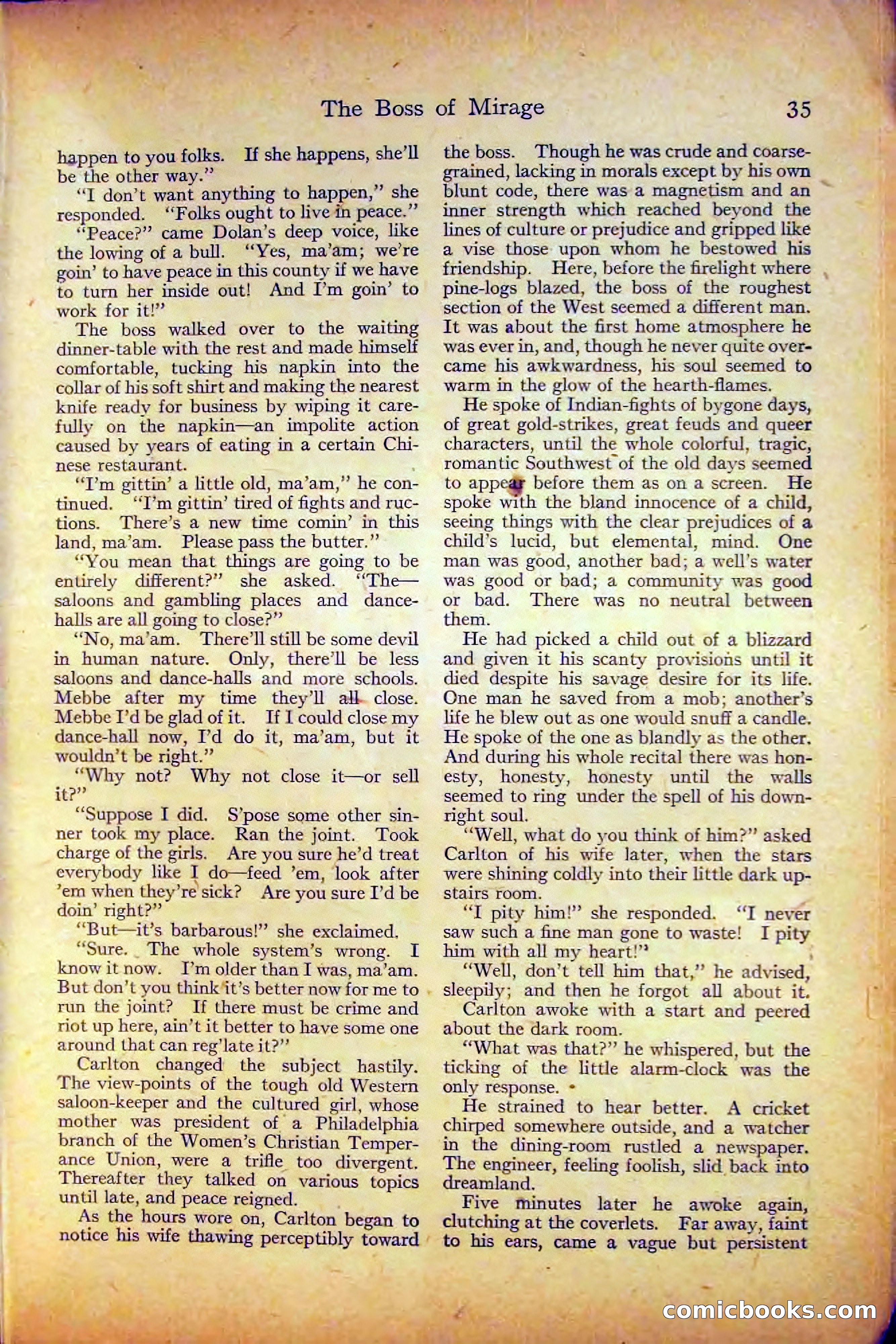
A restored page from Pulp Fiction, 1919. Page through the whole issue in the reader above.
📄 Transcribed text from this page (OCR, searchable)
Machine-transcribed from the original scan — historical spelling and the odd misread are preserved.
happen to you folks. If she happens, she’ I be the other way.” ; “T don’t want anything to aaa she “Folks ought to live responded. peace.” “Peace?” came Dolan’s deep voice, like the lowing of a bull. “Yes, ma’am; we’re goin’ to have peace in this county if we have to turn her inside out! And I’m goin’ to work for it!” The boss walked over to the waiting dinner-table with the rest and made himself comfortable, tucking his napkin into the collar of his soft shirt and making the nearest knife ready for business by wiping it care- fully on the napkin—an impolite action caused by years of eating in a certain Chi- nese restaurant. “I’m gittin’ a little old, ma’am,” he con- tinued. “I’m gittin’ tired of fights and ruc- tions. There’s a new time comin’ in this land, ma’am. Please pass the butter.” “You mean that things are going to be entirely different?” she asked. ‘“‘The— saloons and gambling places and dance- halls are all going to close?” “No, ma’am. ‘There’ll still be some devil in human nature. Only, there'll be less saloons and dance-halls and more schools. Mebbe after my time they’ll all. close. Mebbe I'd be glad of it. If I could close my _ dance-hall now, I’d do it, ma’am, but it wouldn’t be right.” - «Why not? Why not close it—or sell ste” “Suppose I did. S’pose some other sin- ner took my place. Ran the joint. Took charge of the girls. Are you sure he’d treat everybody like I do—feed ’em, look after ’em when they’re sick? Are you sure I’d be doin’ right?” “But—it’s barbarous!” she exclaimed, “Sure. The whole system’s wrong. I know itnow. I’m older than I was, ma’am. But don’t you think it’s better now for me to run the joint? If there must be crime and riot up here, ain’t it better to have some one around that can reg’late it?”’ Carlton changed the subject hastily. The view-points of the tough old Western saloon-keeper and the cultured girl, whose mother was president of a Philadelphia branch of the Women’s Christian Temper- ance Union, were a trifle too divergent. Thereafter they talked on various topics until late, and peace reigned. : As the hours wore on, Carlton began to i o. ‘ . : —, * - si the boss. Though he was crude and coarse- grained, lacking in morals except by his own — blunt code, there was a magnetism and an Inner strength which reached beyond the lines of culture or prejudice and gripped like a vise those upon whom he bestowed his friendship. Here, before the firelight where pine-logs blazed, the boss of the roughest section of the West seemed a different man. It was about the first home atmosphere he was ever in, and, though he never quite over- came his awkwardness, his soul seemed to warm in the glow of the hearth-flames. He spoke of Indian-fights of bygone days, of great gold-strikes, great feuds and queer characters, until the whole colorful, tragic, romantic Southwest of the old days seemed to apped@¥ before them as on a screen. He spoke with the bland innocence of a child, seeing things with the clear prejudices of a child’s lucid, but elemental, mind. One man was good, another bad; a well’s water was good or bad; a community was good or bad. There was no neutral between them. He had picked a child out of a blizzard and given it his scanty provisions until it died despite his savage desire for its life. One man he saved from a mob; another’s life he blew out as one would snuff a candle. He spoke of the one as blandly as the other, And during his whole recital there was hon- esty, honesty, honesty until the walls seemed to ring under the spell of his down- right soul. “Well, what do you think of him?” asked Carlton of his wife later, when the stars were shining coldly into their little dark up- stairs room. a “T pity him!” she responded. “I never saw such a fine man gone to waste! I pity him with all my heart!” ; “Well, don’t tell him that,”’ he advised, . sleepily; and then he forgot all about it. Carlton awoke with a start and peered about the dark room. “What was that?” he whispered, but the ticking of the little alarm-clock was the only response. * He strained to hear better. A cricket chirped somewhere outside, and a watcher in the dining-room rustled a newspaper. The engineer, feeling foolish, slid back into dreamland. ; he ~*~ 4 ; -. “ - ae: -o * an oS Sa P “a. > “comicbooks. Five minutes later he awoke agai a ° foe Hie voife thong oi Cariton began to clutching at the coverlets. Far away, faint notice his wife thawing perceptibly toward to his ears, came a vague but persistent — = — ~-@- 2.4, com