
Pulp Fiction, 1919 · page 26 of 204
Adventure, August 3, 1919 — page 26: what you’re looking at
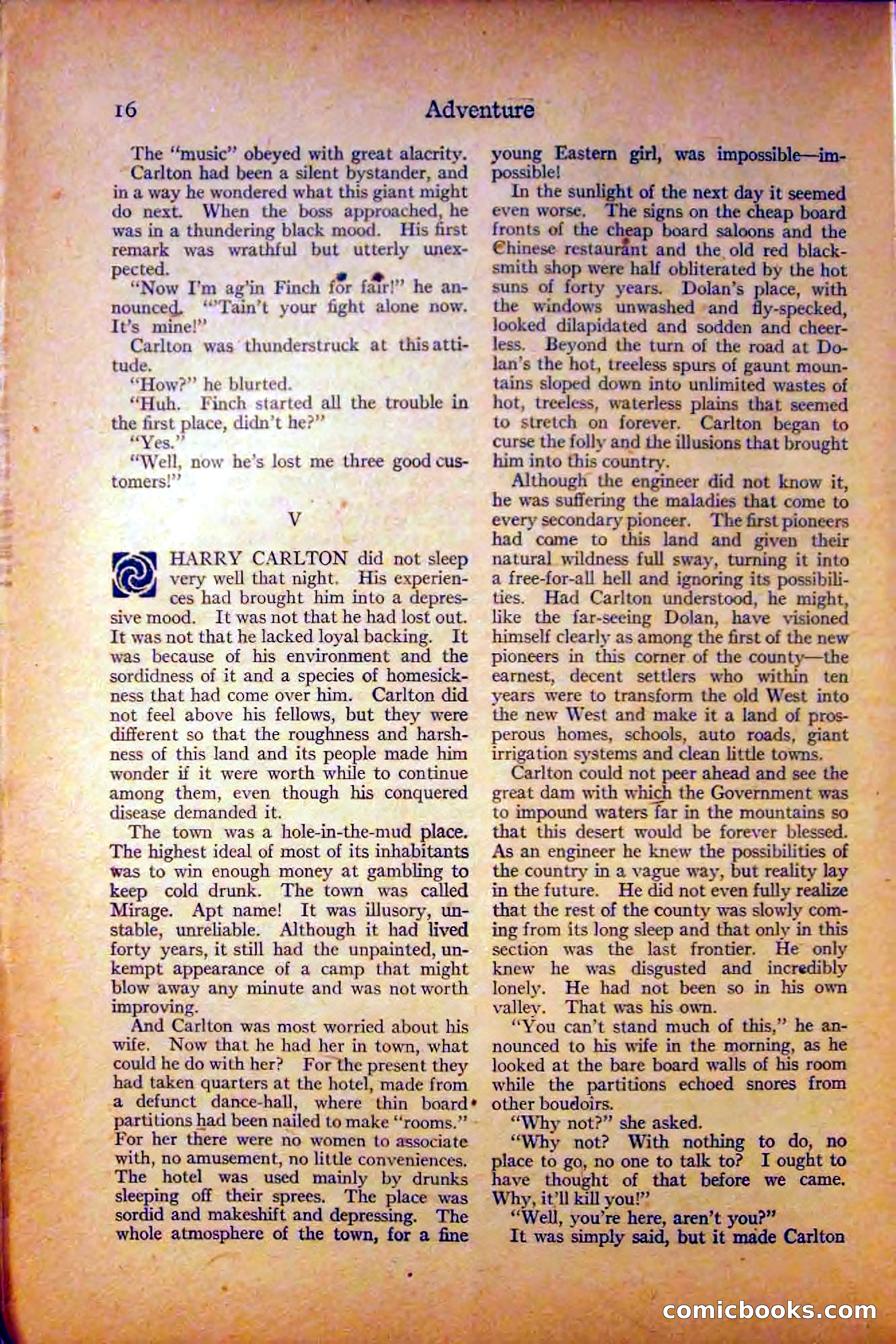
A restored page from Pulp Fiction, 1919. Page through the whole issue in the reader above.
📄 Transcribed text from this page (OCR, searchable)
Machine-transcribed from the original scan — historical spelling and the odd misread are preserved.
ey . 7 ~ ‘ , +o ‘ pees 2, i sd oe! at , ’ es sth a A Gi. ® P ad LA * The “music” obeyed with great alacrity. ~ Carlton had been a silent bystander, and in a way he wondered what this giant might do next. When the boss approached, he was in a thundering black mood. His first remark was wrathful but utterly unex- pected. eo - “Now I'm ag’in Finch for fair!’ he an- nounced, ‘“*Tain’t your fight alone now. It’s mine!” : ‘ Carlton was thunderstruck at this atti- tude, “How?” he blurted. “Huh. Finch started all the trouble in the first place, didn’t he?” “Ves.” “Well, now he’s lost me three good cus- tomers!” V HARRY CARLTON did not sleep © very well that night, His experien- ces had brought him into a depres- sive mood. It was not that he had lost out. It was not that he lacked loyal backing. It was because of his environment and the sordidness of it and a species of homesick- ness that had come over him. Carlton did not feel above his fellows, but they were different so that the roughness and harsh- ness of this land and its people made him wonder if it were worth while to continue among them, even though his conquered disease demanded it. The town was a hole-in-the-mud place. The highest ideal of most of its inhabitants was to win enough money at gambling to keep cold drunk. The town was called Mirage. Apt name! It was illusory, un- stable, unreliable. Although it had lived forty years, it still had the unpainted, un- kempt appearance of a camp that might blow away any minute and was not worth improving. And Carlton was most worried about his wife, Now that he had her in town, what could he do with her? For the present they had taken quarters at the hotel, made from a defunct dance-hall, where thin board? partitions had been nailed to make “rooms.” - For her there were no women to associate with, no amusement, no little conveniences, The hotel was used mainly by drunks sleeping off their sprees. The place was d and makeshift and depressing. The whole atmosphere of the town, for a fine heap board saloons and the @hinese res t and the old red black- smith shop were half obliterated by the hot the windows unwashed «and fh ip looked dilapidated and sodden 4 cheer less, Beyond the turn of the road at Do- lan’s the hot, treeless spurs of gaunt moun- tains sloped down into unlimited wastes of hot, treeless, waterless plains that seemed to stretch on forever. Carlton began to curse the folly and the illusions that brought him into this country. Although the engineer did not know it, he was suffering the maladies that come to every secondary pioneer. The first pioneers had came to this land and given their natural wildness full sway, turning it into a free-for-all hell and ignoring its possibili- ties. Had Carlton understood, he might, like the far-seeing Dolan, have visioned himself clearly as among the first of the new pioneers in this corner of the county—the earnest, decent settlers who within ten years were to transform the old West into the new West and make it a land of pros- perous homes, schools, auto roads, giant irrigation systems and clean little towns. Carlton could not — ahead and see the great dam with which the Government was to impound waters far in the mountains so that this desert would be forever blessed. As an engineer he knew the ibilities of the country in a vague way, pat reality lay in the future. He did not even fully realize that the rest of the county was slowly com- ing from its long sleep and that only in this section was the last frontier. He only knew he was disgusted and incredibly lonely. He had not been so in his own valley. That was his own. “You can’t stand much of this,” he an- nounced to his wife in the morning, as he looked at the bare board walls of his room while the partitions echoed snores from other boudoirs. “Why not?” she asked. “Why not? With nothing to do, no lace to go, no one to talk to? T ought to ve ht of that before we came. Why, it'll kill you!” “Well, you're here, aren’t you?” _ suns of forty years. ee rey with 1 ae books.com