
Pulp Fiction, 1919 · page 166 of 204
Adventure, August 3, 1919 — page 166: what you’re looking at
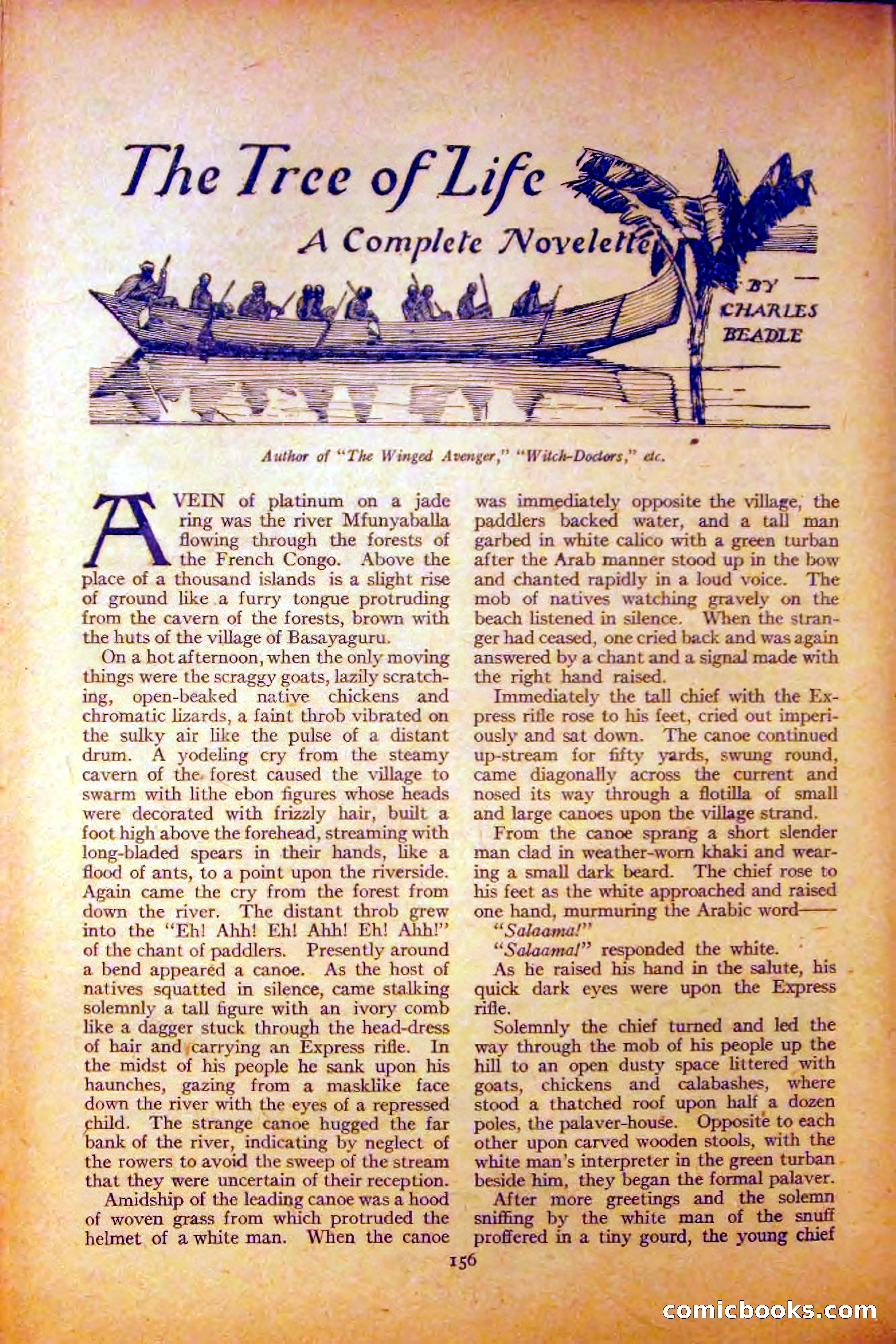
A restored page from Pulp Fiction, 1919. Page through the whole issue in the reader above.
📄 Transcribed text from this page (OCR, searchable)
Machine-transcribed from the original scan — historical spelling and the odd misread are preserved.
A Complete Noveletté \ Author of “The Winged Avenger,” “Witch-Dodors,” ec. VEIN of platinum on a jade ring was the river Mfunyaballa flowing through the forests of the French Congo. Above the place of a thousand islands is a slight rise of ground hke a furry tongue protruding from the cavern of the forests, brown with the huts of the village of Basayaguru. On a hot afternoon, when the only moving things were the scraggy goats, lazily scratch- ing, open-beaked native chickens and chromatic lizards, a faint throb vibrated on the sulky air like the pulse of a distant drum. A yodeling cry from the steamy cavern of the. forest caused the village to swarm with lithe ebon figures whose heads were decorated with frzzly hair, built a foot high above the forehead, streaming with long-bladed spears in their hands, like a flood of ants, to a point upon the riverside. Again came the cry from the forest from down the river. The distant throb grew into the “Eh! Ahh! Eh! Ahh! Eh! Ahh!” of the chant of paddlers. Presently around a bend appeared a canoe. As the host of natives squatted in silence, came stalking solemnly a tall figure with an ivory comb like a dagger stuck through the head-dress of hair andycarrying an Express rifle. In the midst of his people he sank upon his haunches, gazing from a masklike face down the river with the eyes of a repressed child. The strange canoe hugged the far bank of the river, indicating by neglect of the rowers to avoid the sweep of the stream that they were uncertain of their reception. Amidship of the leading canoe was a hood of woven grass from which protruded the helmet of a white man. When the canoe 156 was immediately opposite the village; the paddlers backed water, and a tall man garbed in white calico with a green turban after the Arab manner stood up in the bow and chanted rapidly in a loud voice. The mob of natives watching gravely on the beach listened in silence. When the stran- ger had ceased, one cried back and was again answered by a chant and a signal made with the right hand raised. Immediately the tall chief with the Ex- press rifle rose to his feet, cried out imperi- ously and sat down. The canoe continued up-stream for fifty yards, swung round, came diagonally across the current and nosed its way through a flotilla of small and large canoes upon the village strand. From the canoe sprang a short slender man clad in weather-worn khaki and wear- ing a small dark beard. The chief rose to his feet as the white approached and raised one hand, murmuring the Arabic word—— “Salaama!”’ ‘ “Salaama!” responded the white. As le raised his hand in the salute, his - quick dark eyes were upon the Express rifle. Solemnly the chief turned and led the way through the mob of his people up the hill to an open dusty space littered with goats, chickens and calabashes, where stood a thatched roof upon half a dozen poles, the palaver-house. Opposite to each other upon carved wooden stools, with the white man’s interpreter in the green turban . beside him, they the formal palaver. After more greetings and the solemn snifing by the white man of the snuff proffered in a tiny gourd, the young chief