
Pulp Fiction, 1919 · page 155 of 204
Adventure, August 3, 1919 — page 155: what you’re looking at
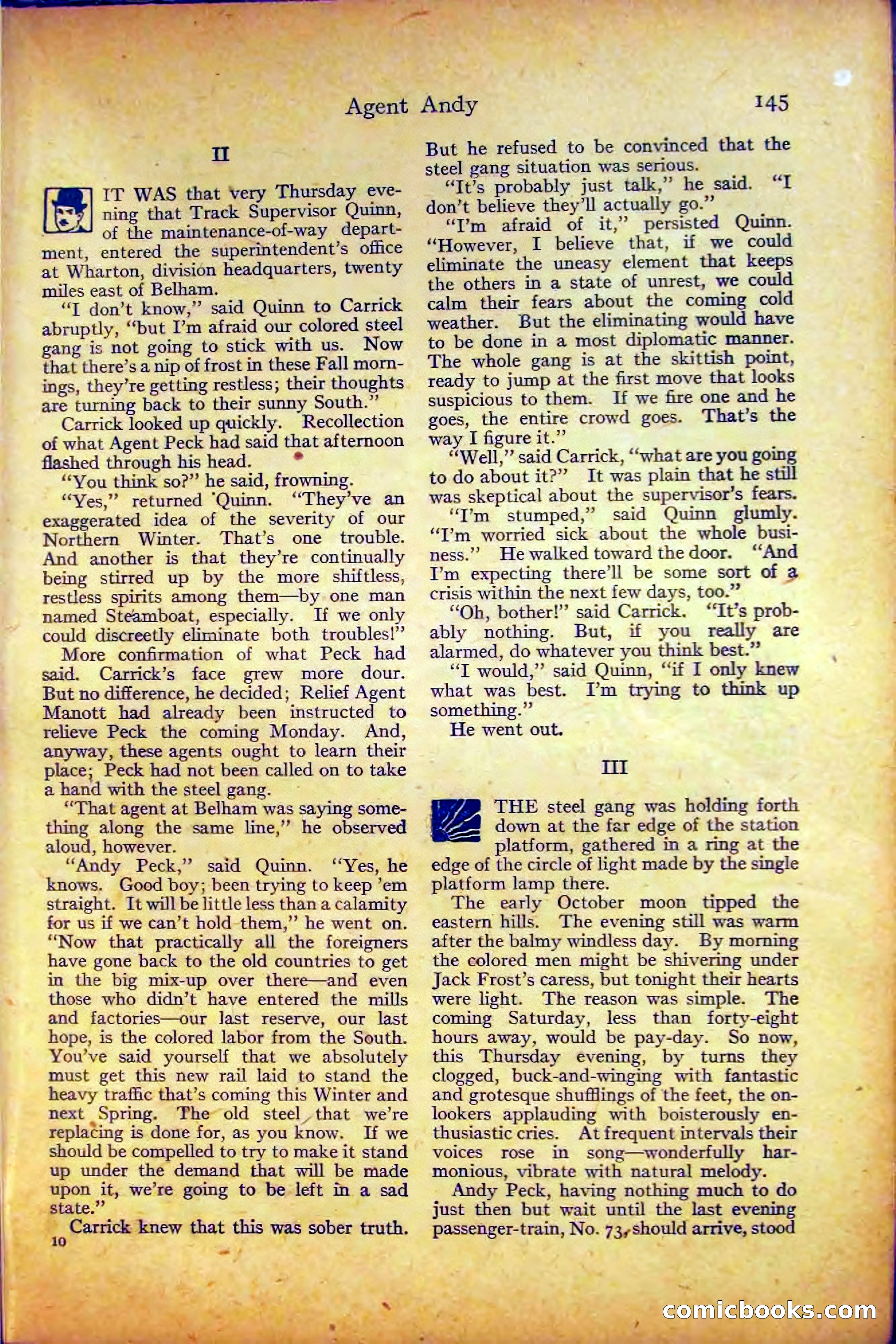
A restored page from Pulp Fiction, 1919. Page through the whole issue in the reader above.
📄 Transcribed text from this page (OCR, searchable)
Machine-transcribed from the original scan — historical spelling and the odd misread are preserved.
_ * IT WAS that very Thursday eve- a ning that Track Supervisor Quinn, (— of the maintenance-of-way depart- ment, entered the superintendent’s office at Wharton, division headquarters, twenty miles east of Belham. “T don’t know,’ said Quinn to Carrick abruptly, “but I’m afraid our colored steel gang is not going to stick with us. Now that there’s a nip of frost in these Fall morn- ings, they’re getting restless; their thoughts. are turning back to their sunny South.” Carrick looked up quickly. Recollection of what Agent Peck had said that afternoon flashed through his head. ad “Vou think so?” he said, frowning. “Yes,” returned ‘Quinn. “They’ve an exaggerated idea of the severity of our Northern Winter. That’s one trouble. And another is that they’re continually being stirred up by the more shiftless, restless spirits among them—by one man named Steamboat, especially. If we only could discreetly eliminate both troubles!’ More confirmation of what Peck had said. Carrick’s face grew more dour. But no difference, he decided; Relief Agent -Manott had already been instructed to relieve Peck the coming Monday. And, anyway, these agents ought to learn their place; Peck had not been called on to take a hand with the steel gang. ~ : “That agent at Belham was saying some- thing along the same line,”’ he observed aloud, however. 7 _ “Andy Peck,” said Quinn. “Yes, he knows. Good boy; been trying to keep ’em straight. It will be little less than a calamity for us if we can’t hold -them,”’ he went on. “Now that practically all the foreigners have gone back to the old countries to get in the big mix-up over there—and even those who didn’t have entered the mills and factories—our last reserve, our last hope, is the colored labor from the South. You’ve said yourself that we absolutely must get this new rail laid to stand the _ heavy traffic that’s coming this Winter and _ next Spring. The old steel, that we’re replacing is done for, as you know. If we should be co on it, we’re going to be left in a sad <_g . ial -_ , Apa Andy -.. elled to try to make it stand | up under the demand that will be made 145 But he refused to be convinced that the steel gang situation was serious. “Tt’s probably just talk,” he said. <P don’t believe they'll actually go.” “Pm afraid of it,” persisted Quinn. “However, I believe that, if we could eliminate the uneasy element that keeps the others in a state of unrest, we could calm their fears about the coming cold weather. But the eliminating would have to be done in a most diplomatic manner. The whole gang is at the skittish point, ready to jump at the first move that looks suspicious to them. If we fire one and he goes, the entire crowd goes. That’s the way I figure it.”’ “Well,” said Carrick, “what are you going to do about it?” It was plain that he still was skeptical about the supervisor’s fears. “T’m stumped,” said Quinn glumly. “T’m worried sick about the whole busi- ness.”” He walked toward the door. “And I’m expecting there’ll be some sort of a crisis within the next few days, too.” “Oh, bother!” said Carrick. “It’s prob- ably nothing. But, if you really are alarmed, do whatever you think best.” “T would,” said Quinn, “if I only knew what was best. I’m trying to think up something.” He went out. iit ‘BZ = down at the far edge of the station THE steel gang was holding forth platform, gathered in a ring at the edge of the circle of light made by the single platform lamp there. The early October moon tipped the eastern hills. The evening still was warm after the balmy windless day. By morning the colored men might be shivering under Jack Frost’s caress, but tonight their hearts were light. The reason was simple. The coming Saturday, less than forty-eight hours away, would be pay-day. So now, this Thursday evening, by turns they clogged, buck-and-winging with fantastic and grotesque shuffiings of the feet, the on- lookers applauding with boisterously en- _ thusiastic cries. At frequent intervals their voices rose in song—wonderfully har- monious, vibrate with natural melody. _ Andy Peck, having nothing | just then but wait until the la passenger-train, No. 73¢Should arri as . eed a > , . ‘ —