
Pulp Fiction, 1919 · page 151 of 204
Adventure, August 3, 1919 — page 151: what you’re looking at
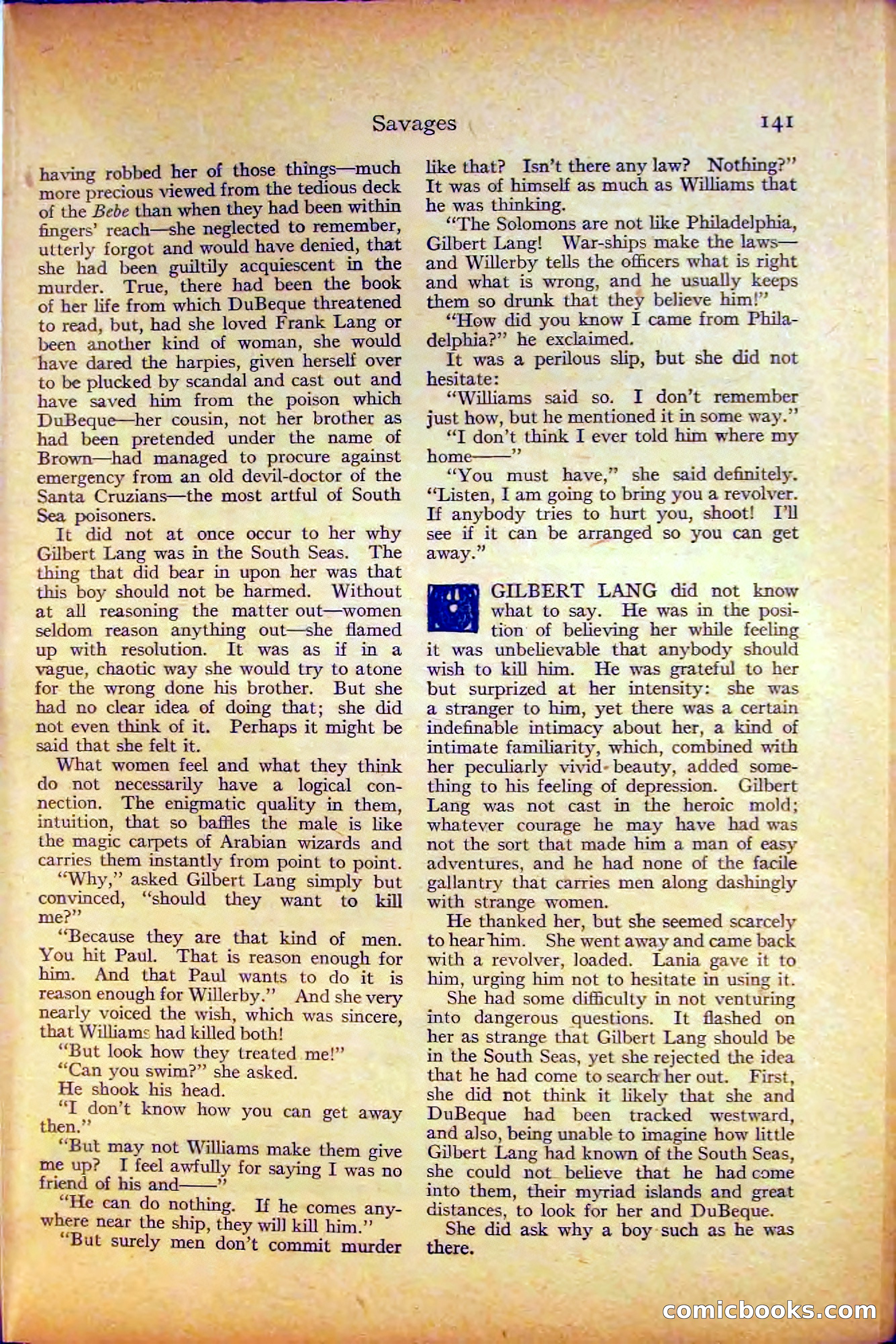
A restored page from Pulp Fiction, 1919. Page through the whole issue in the reader above.
📄 Transcribed text from this page (OCR, searchable)
Machine-transcribed from the original scan — historical spelling and the odd misread are preserved.
having robbed her of those things—much : : more S eciadl viewed from the tedious deck of the Bebe than when they had been within fingers’ reach—she neglected to remember, utterly forgot and would have denied, that she had been guiltily acquiescent in the murder. True, there had been the book of her life from which DuBeque threatened to read, but, had she loved Frank Lang or been another kind of woman, she would have dared the harpies, given herself over to be plucked by scandal and cast out and have saved him from the poison which DuBeque—her cousin, not her brother as had been pretended under the name of Brown—had managed to procure against emergency from an old devil-doctor of the Santa Cruzians—the most artful of South Sea poisoners. It did not at once occur to her why Gilbert Lang was in the South Seas. The thing that did bear in upon her was that this boy should not be harmed. Without at all reasoning the matter out—women seldom reason anything out—she flamed up with resolution. It was as if in a vague, chaotic way she would try to atone for the wrong done his brother. But she had no clear idea of doing that; she did not even think of it. Perhaps it might be said that she felt it. What women feel and what they think do not necessarily have a logical con- nection, The enigmatic quality in them, intuition, that so baffles the male is like the magic carpets of Arabian wizards and carries them instantly from point to point. “Why,” asked Gilbert Lang simply but sie “should they want to kill me?” “Because they are that kind of men. You hit Paul. That is reason enough for him. And that Paul wants to do it is reason enough for Willerby.”’ And she very nearly voiced the wish, which was sincere, that Williams had killed both! “But look how they treated me!” “Can you swim?” she asked. He shook his head. “I don’t know how you can get away hen.” — ay cm Williams make them give me up awfully for saying I Seles eaiegees ying I was no “He can do nothing. If he comes any- ___ where near the ship, they will kill him.” . : ‘But surely men don’t commit murder ‘er ai 7 -~ Pied “a ~~ : - ua _ es like that? Isn’t there any law? Nothing?” Tt was of himself as much as Williams that he was thinking. ‘The Solomons are not like Philadelphia, Gilbert Lang! War-ships make the laws— and Willerby tells the officers what is right and what is wrong, and he usually keeps them so drunk that they believe him!” ‘“‘How did you know I came from Phila- delphia?”’ he exclaimed. It was a perilous slip, but she did not hesitate: ‘Williams said so. I don’t remember just how, but he mentioned it in some way.”’ “T don’t think I ever told him where my home——” “You must have,” she said definitely. “Listen, | am going to bring you a revolver. If anybody tries to hurt you, shoot! I'll see if it can be arranged so you can get away.” mim) GILBERT LANG did not know wae what to say. He was in the posi- “eS tion of believing her while feeling it was unbelievable that anybody should wish to kill him. He was grateful to her but surprized at her intensity: she was a stranger to him, yet there was a certain indefinable intimacy about her, a kind of intimate familiarity, which, combined with her peculiarly vivid- beauty, added some- thing to his feeling of depression. Gilbert Lang was not cast in the heroic mold; whatever courage he may have had was not the sort that made him a man of easy adventures, and he had none of the facile gallantry that carries men along dashingly with strange women. He thanked her, but she seemed scarcely tohearhim. She went away and came back with a revolver, loaded. Lania gave it to him, urging him not to hesitate in using it. She had some difficulty in not venturing into dangerous questions. It flashed on her as strange that Gilbert Lang should be in the South Seas, yet she rejected the idea that he had come tosearchrher out. First, she did not think it likely that she and DuBeque had been tracked westward, and also, being unable to imagine how little Gilbert Lang had known of the South Seas, she could not believe that he had come into them, their myriad islands and great distances, to look for her and DuBeque. Bess did ask why a boy-such as he was ere.