
Pulp Fiction, 1919 · page 140 of 204
Adventure, August 3, 1919 — page 140: what you’re looking at
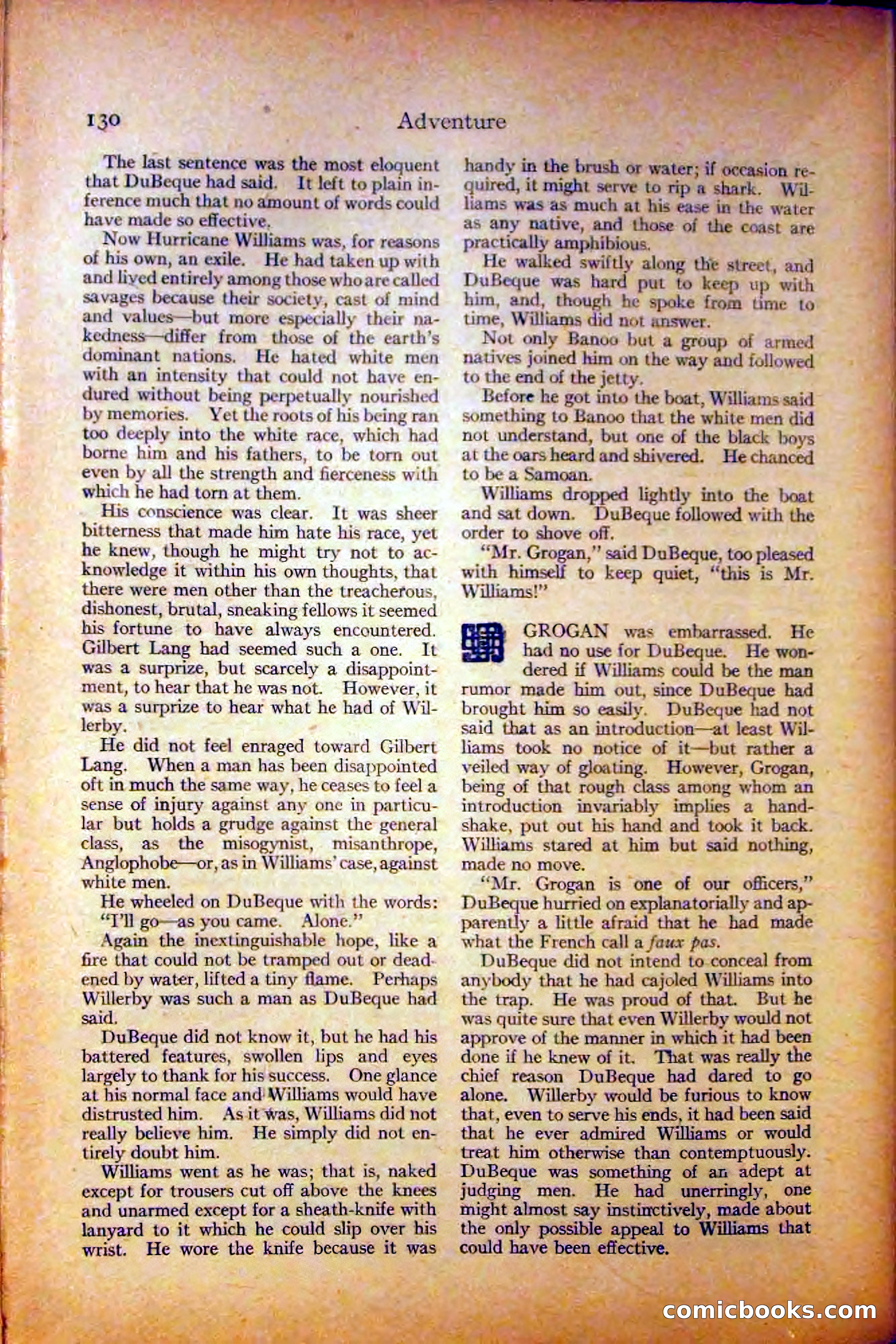
A restored page from Pulp Fiction, 1919. Page through the whole issue in the reader above.
📄 Transcribed text from this page (OCR, searchable)
Machine-transcribed from the original scan — historical spelling and the odd misread are preserved.
130 The last sentence was the most eloquent that DuBeque had said. It left to plain in- ference much that no amount of words could have made so effective. Now Hurricane Williams was, for reasons of his own, an exile. He had taken up with and lived entirely among those whoare called savages because their society, cast of mind and values—but more especially their na- kedness—differ from those of the earth's dominant nations. He hated white men with an intensity that could not have en- dured without being perpetually nourished by memories. Yet the roots of his being ran too deeply into the white race, which had borne him and his fathers, to be torn out even by all the strength and fierceness with which he had torn at them. His conscience was clear. It was sheer bitterness that made him hate his race, yet he knew, though he might try not to ac- knowledge it within his own thoughts, that there were men other than the treacherous, dishonest, brutal, sneaking fellows it seemed his fortune to have always encountered. Gilbert Lang had seemed such a one. It was a surprize, but scarcely a disappoint- ment, to hear that he was not. However, it was a surprize to hear what he had of Wil- erby. He did not feel enraged toward Gilbert Lang. When a man has been disappointed oft in much the same way, he ceases to feel a sense of injury against any one in particu- lar but holds a grudge against the general class, as the misogynist, misanthrope, Anglophobe—or, as in Williams’ case, against white men. He wheeled on DuBeque with the words: “T'll go—as you came. Alone.” Again the inextinguishable hope, like a fire that could not be tramped out or dead. ened by water, lifted a tiny flame. Perhaps Willerby was such a man as DuBeque had said. DuBeque did not know it, but he had his battered features, swollen lips and eyes largely to thank for his success. One glance at his normal face and Williams would have distrusted him. As it Was, Williams did not really believe him. He simply did not en- tirely doubt him. Williams went as he was; that is, naked except for trousers cut off above the knees and unarmed except for a sheath-knife with lanyard to it which he could slip over his wrist. He wore the knife because it was Adventure handy in the brush or water; if occasion re- quired, it might serve to rip a shark. Wil- liams was as much at his ease in the water as any native, and those of the coast are practically amphibious, He walked swiftly along the street, and DuBeque was hard put to keep up with him, and, though he spoke from time to ume, Williams did not answer. Not only Banoo but a group of armed natives joined him on the way and followed to the end of the jetty. Before he got into the boat, Williams said something to Banoo that the white men did not understand, but one of the black boys at the oars heard and shivered. He chanced to be a Samoan. Williams dropped lightly into the boat and sat down. DuBeque followed with the order to shove off. “Mr. Grogan,” said DuBeque, too pleased with himself to keep quiet, “this is Mr. Williams!” GROGAN was embarrassed. He had no use for DuBeque. He won- dered if Williams could be the man rumor made him out, since DuBeque had brought him so easily. DuBeque had not said that as an introduction—at least Wil- hams took no notice of it—but rather a veiled way of gloating. However, Grogan, being of that rough class among whom an introduction invariably implies a hand- shake, put out his hand and took it back. Willams stared at him but said nothing, made no move. “Mr. Grogan is one of our officers,” DuBeque hurried on explanatorially and ap- parently a little afraid that he had made what the French call a faux pas. DuBeque did not intend to-conceal from anybody that he had cajoled Williams into the trap. He was proud of that. But he was quite sure that even Willerby would not approve of the manner in which it had been done if he knew of it. That was really the chief reason DuBeque had dared to go alone. Willerby would be furious to know that, even to serve his ends, it had been said that he ever admired Williams or would treat him otherwise than contemptuously. DuBeque was something of an adept at judging men. He had unerringly, one might almost say instinctively, made about the only possible appeal to Williams that could have been effective. comicbooks.com : |