
Pulp Fiction, 1919 · page 138 of 204
Adventure, August 3, 1919 — page 138: what you’re looking at
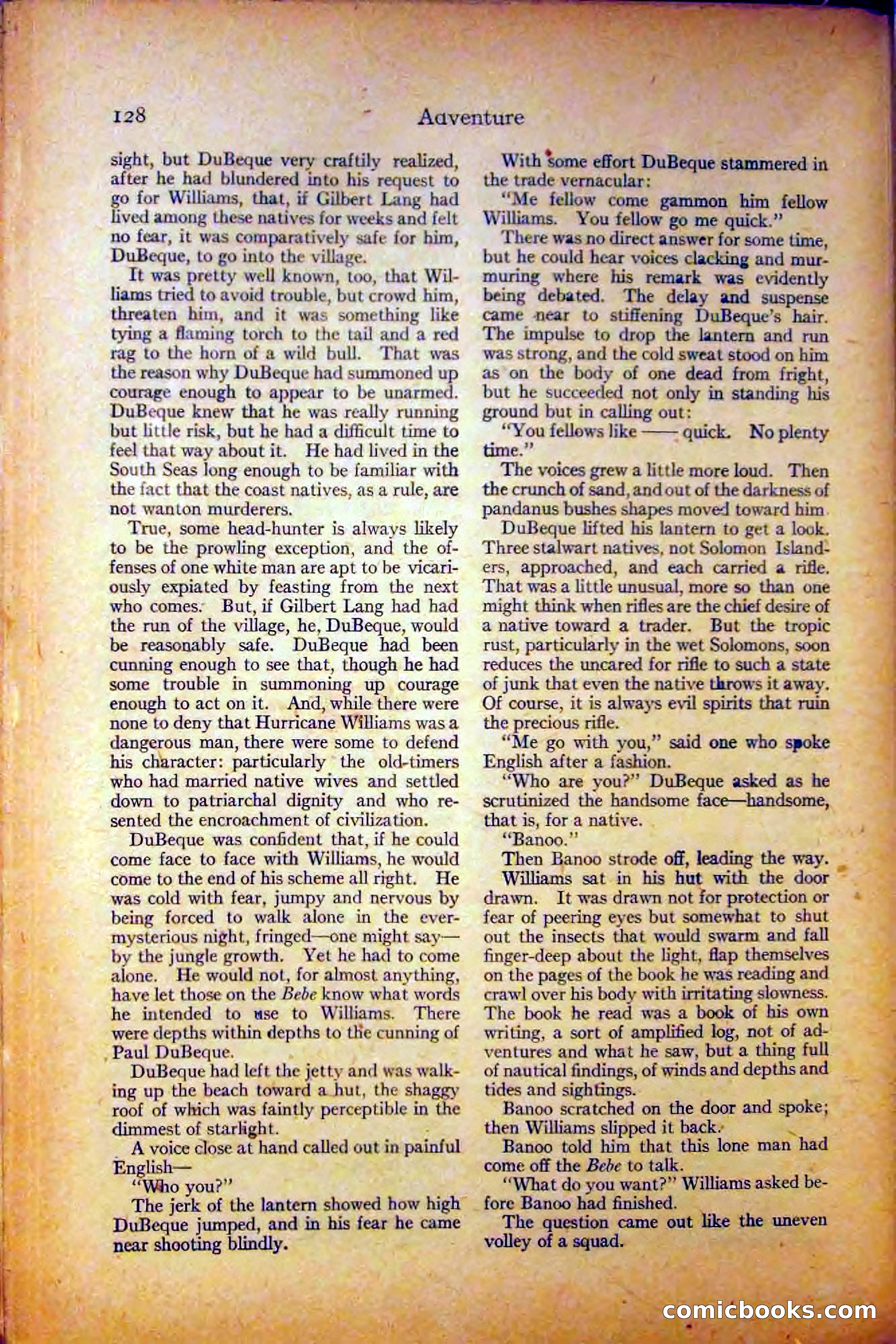
A restored page from Pulp Fiction, 1919. Page through the whole issue in the reader above.
📄 Transcribed text from this page (OCR, searchable)
Machine-transcribed from the original scan — historical spelling and the odd misread are preserved.
: Aaventure sight, but DuBeque very craftily realized, after he had blundered into his request to go for Williams, that, if Gilbert Lang had lived among these natives for weeks and felt no fear, it was comparatively safe for him, DuBeque, to go into the village. It was pretty well known, too, that Wil- liams tried to avoid trouble, but crowd him, threaten him, and it was something like tying a flaming torch to the tail and a red rag to the horn of a wild bull. That was the reason why DuBeque had summoned up courage enough to appear to be unarmed. DuBeque knew that he was really running but little risk, but he had a difficult time to feel that way about it. He had lived in the South Seas long enough to be familiar with the fact that the coast natives, as a rule, are not wanton murderers. True, some head-hunter is always likely to be the prowling exception, and the of- fenses of one white man are apt to be vicari- ously expiated by feasting from the next who comes. But, if Gilbert Lang had had the run of the village, he, DuBeque, would be reasonably safe. DuBeque had been cunning enough to see that, though he had some trouble in summoning up courage enough to act on it. And, while there were none to deny that Hurricane Williams was a dangerous man, there were some to defend his character: particularly the old-timers who had married native wives and settled down to patriarchal dignity and who re- sented the encroachment of civilization. DuBeque was confident that, if he could come face to face with Williams, he would come to the end of his scheme all right. He was cold with fear, jumpy and nervous by being forced to walk alone in the ever- mysterious night, fringed—one might say— by the jungle growth. Yet he had to come alone. He would not, for almost anything, have let those on the Bebe know what words he intended to use to Williams. There were depths within depths to the cunning of Paul DuBeque. DuBeque had left the jetty and was walk- ing up the beach toward a hut, the shaggy roof of which was faintly perceptible in the dimmest of starlight. _ A voice close at hand called out in painful English— “Wiho you?” The jerk of the lantern showed how high DuBeque jumped, and in his fear he cam near shooting blindly. With Some effort DuBeque stammered in the trade vernacular: “Me fellow come gammon him fellow Williams. You fellow go me quick.” There was no direct answer for some time, but he could hear voices clacking and mur- muring where his remark was evidently being debated. The delay and suspense came néar to stiffening DuBeque’s hair. The impulse to drop the lantern and run was strong, and the cold sweat stood on him as on the body of one dead from fright, but he succeeded not only in standing his ground but in calling out: “You fellows like —— quick. No plenty time.” The voices grew a little more loud. Then the crunch of sand, and out of the darkness of pandanus bushes shapes moved toward him. DuBeque lifted his lantern to get a look. Three stalwart natives, not Solomon Island- ers, approached, and each carried a rifle. That was a little unusual, more so than one might think when rifles are the chief desire of a native toward a trader. But the tropic rust, particularly in the wet Solomons, soon reduces the uncared for rifle to such a state of junk that even the native throws it away. Of course, it is always evil spirits that ruin the precious rifle. “Me go with you,” said one who spoke English after a fashion. “Who are you?”” DuBeque asked as he scrutinized the handsome face—handsome, that is, for a native. “Banoo.” Then Banoo strode off, leading the way. Williams sat in his hut with the door ~ drawn. It was drawn not for protection or fear of peering eyes but somewhat to shut out the insects that would swarm and fall finger-deep about the light, flap themselves on the pages of the book he was reading and crawl over his body with irritating slowness. The book he read acuinediee of een writing, a sort of I , not of a ventunes and what he saw, but a thing full of nautical findings, of winds and depths and tides and sightings. Banoo scratched on the door and spoke; then Williams slipped it backs e Banoo told him that this lone man had come off the Bebe to talk. ‘ “What do you want?” Williams asked be- fore Banoo had finished. _ The question came out like the uneven 4