
Pulp Fiction, 1919 · page 127 of 204
Adventure, August 3, 1919 — page 127: what you’re looking at
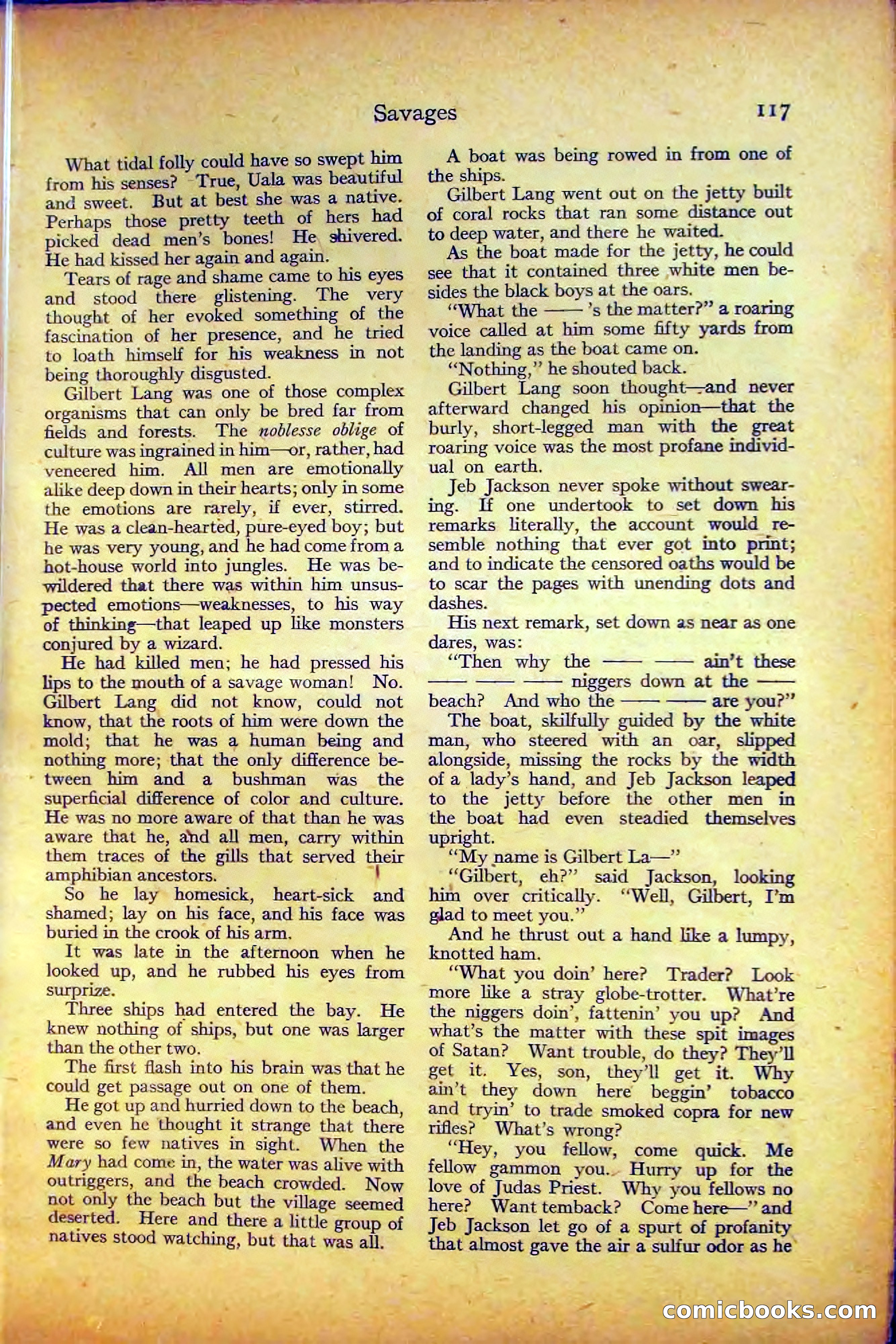
A restored page from Pulp Fiction, 1919. Page through the whole issue in the reader above.
📄 Transcribed text from this page (OCR, searchable)
Machine-transcribed from the original scan — historical spelling and the odd misread are preserved.
Me ee a What tidal folly could have so swept him from his senses? True, Uala was beautiful and sweet. But at best she was a native. Perhaps those pretty teeth of hers had picked dead men’s bones! He. shivered. He had kissed her againandagain. Tears of rage and shame came to his eyes and stood there glistening. The very thought of her evoked something of the fascination of her presence, and he tried to loath himself for his weakness in not being thoroughly disgusted. Gilbert Lang was one of those complex organisms that can only be bred far from fields and forests. The woblesse oblige of culture was ingrained in him—r, rather, had veneered him. All men are emotionally alike deep down in their hearts; only in some the emotions are rarely, if ever, stirred. He was a clean-hearted, pure-eyed boy; but he was very young, and he had come from a hot-house world into jungles. He was be- wildered that there was within him unsus- pected emotions—weaknesses, to his way of thinking—that leaped up like monsters conjured by a wizard. He had killed men; he had pressed his lips to the mouth of a savage woman! No. Gilbert Lang did not know, could not know, that the roots of him were down the mold; that he was a human being and nothing more; that the only difference be- * tween him and a bushman was the superficial difference of color and culture. He was no more aware of that than he was aware that he, and all men, carry within them traces of the gills that served their amphibian ancestors. oe So he lay homesick, heart-sick and shamed; lay on his face, and his face was buried in the crook of his arm. It was late in the afternoon when he looked up, and he rubbed his eyes from surprize. Three ships had entered the bay. He knew nothing of ships, but one was larger than the other two. The first flash into his brain was that he could get passage out on one of them. He got up and hurried down to the beach, _ and even he thought it strange that there were so few natives in sight. When the Mary had come in, the water was alive with outriggers, and the beach crowded. Now not only the beach but the village seemed deserted. Here and there a little group of ; €. a an 4 be 4 ha | YE - , sh “ Pd ‘. .* Pa a 117 A boat was being rowed in from one of the ships. Gilbert Lang went out on the jetty built of coral rocks that ran some distance out to deep water, and there he waited. As the boat made for the jetty, he could see that it contained three white men be- sides the black boys at the oars. “What the ’s the matter?” a roaring voice called at him some fifty yards from the landing as the boat came on. “Nothing,” he shouted back. Gilbert Lang soon thought—and never afterward changed his opinion—that the burly, short-legged man with the great roaring voice was the most profane individ- ual on earth. Jeb Jackson never spoke without swear- ing. If one undertook to set down his remarks literally, the account would re- semble nothing that ever got into print; and to indicate the censored oaths would be to scar the pages with unending dots and dashes. His next remark, set down as near as one dares, was: “Then why the —— ain’t these —— niggers down at the —— beach? And who the —— are you?” The boat, skilfully guided by the white man, who steered with an oar, sli alongside, missing the rocks by the width of a lady’s hand, and Jeb Jackson leaped to the jetty before the other men in the boat had even steadied themselves upright. “My name is Gilbert La—” “Gilbert, eh?” said Jackson, looking him over critically. ‘Well, Gilbert, I’m glad to meet you.” And he thrust out a hand like a lumpy, knotted ham, _ “What you doin’ here? Trader? Look more like a stray globe-trotter. What’re the niggers doin’, fattenin’ you up? And what’s the matter with these spit images of Satan? Want trouble, do they? They’ll get it. Yes, son, they’ll get it. Why ain't they down here beggin’ tobacco and tryin’ to trade smoked copra for new rifles? What’s wrong? “Hey, you fellow, come quick. Me fellow gammon you... Hurry up for the love of Judas Priest. Why you fellows no here? Want temback? Come here—” an that almost gave the air a sulfur odo a ; ‘a ty? Jeb Jackson let go of a spurt of profanity by t go of a sp fei ne - + oe eae icbooks.com