
Pulp Fiction, 1919 · page 105 of 204
Adventure, August 3, 1919 — page 105: what you’re looking at
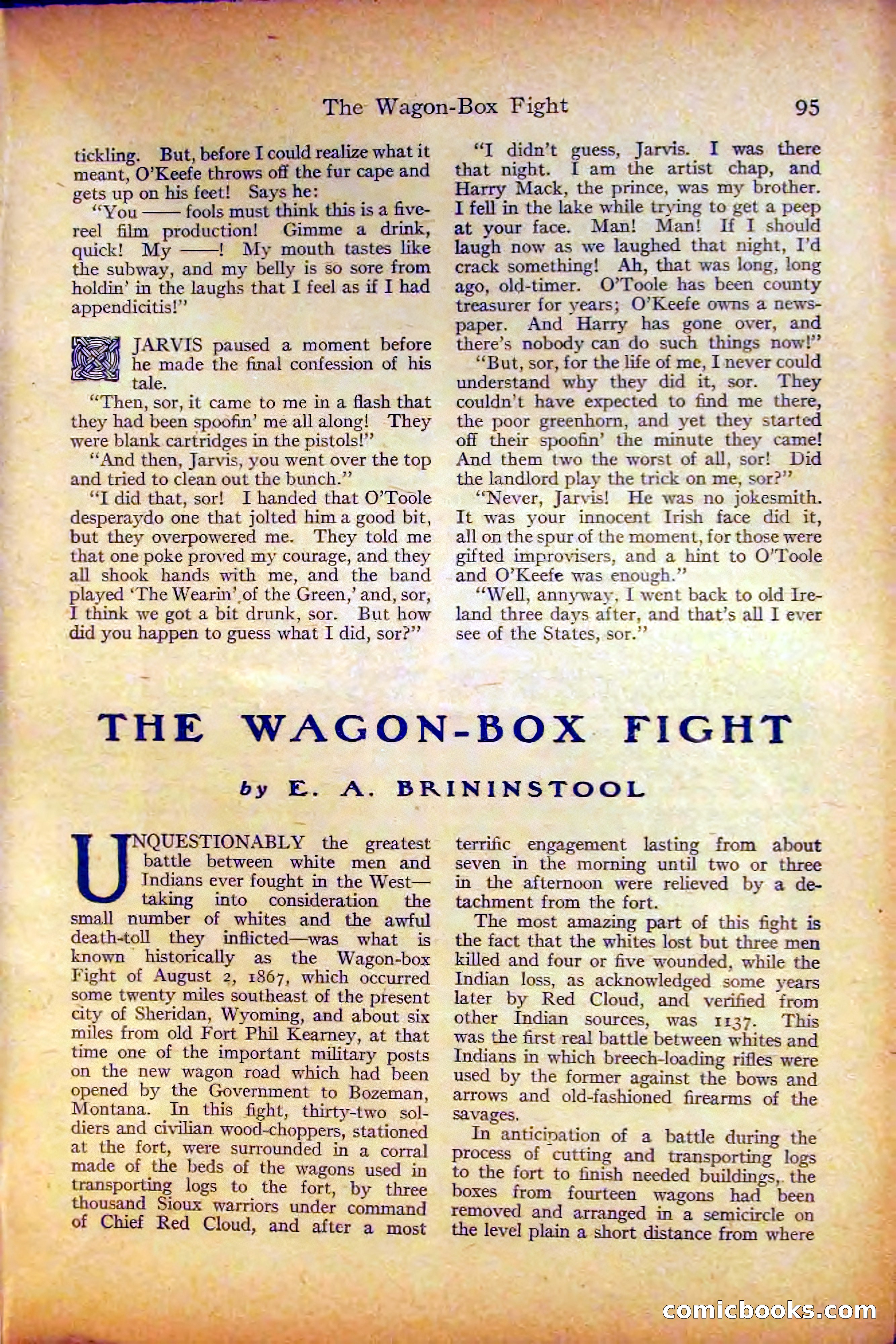
A restored page from Pulp Fiction, 1919. Page through the whole issue in the reader above.
📄 Transcribed text from this page (OCR, searchable)
Machine-transcribed from the original scan — historical spelling and the odd misread are preserved.
to SS, th ee “Te = _ meant, O off the fur cape and | gets up on his feet! Sayshe: “You fools must think this is a five- reel film production! Gimme a drink, quick! My ——! My mouth tastes like the subway, and my belly is so sore from holdin’ in the laughs that I feel as if I had appendicitis!” <q JARVIS paused a moment before ey re made the final confession of his e. “Then, sor, it came to me in a flash that -_-* they had been spoofin’ me all along! They : were blank cartridges in the pistols!” | *‘And then, Jarvis, you went over the top and tried to clean out the bunch.” ; “T did that, sor! I handed that O’Toole desperaydo one that jolted him a good bit, but they overpowered me. They told me that one poke proved my courage, and they all shook hands with me, and the band | played ‘The Wearin’ of the Green,’ and, sor, q I think we got a bit drunk, sor. But how did you happen to guess what I did, sor?” o , 4 i” - yi ll ~~ oe s Wagon-Box Fight Se al re ly t: 95 “J didn’t guess, Jarvis. I was there that night. I am the artist chap, and Harry Mack, the prince, was my brother. I fell in the lake while trying to get a peep at your face. Man! Man! If I should laugh now as we laughed that night, I’d % crack something! Ah, that was long, long . ago, old-timer. O’Toole has been county treasurer for years; O’Keefe owns a news- paper. And Harry has gone over, and there’s nobody can do such things now!” . “But, sor, for the life of me, I never could understand why they did it, sor. They “< couldn't have expected to find me there, the poor greenhorn, and yet they started off their spoofin’ the minute they came! And them two the worst of all, sor! Did the landlord play the trick on me, sor?” “Never, Jarvis! He was no jokesmith. It was your innocent Irish face did it, all on the spur of the moment, for those were gifted improvisers, and a hint to O’Toole and O’Keefe was enough.” ‘Well, annyway, I went back to old Ire- land three days after, and that’s all I ever see of the States, sor.” s y iil errs | THE WAGON-BOX FIGHT by E. A. BRININSTOOL a el Dre 8) Oe te QUESTIONABLY the greatest battle between white men and Indians ever fought in the West— taking into consideration the small number of whites and the awful death-toll they inflicted—was what is . known historically as the Wagon-box 4 Fight of August 2, 1867, which occurred . some twenty miles southeast of the present city of Sheridan, Wyoming, and about six miles from old Fort Phil Kearney, at that time one of the important military posts on the new wagon road which had been opened by the Government to Bozeman, Montana. In this fight, thirty-two sol- _ diers and civilian wood-choppers, stationed at the fort, were surrounded in a corral _ ‘made of the beds of the wagons used in _+ transporting logs to the fort, by three thousand Sioux warriors under command of Chic Cloud, and after a most é %. «= = s > * cal terrific engagement lasting from about seven in the morning until two or three in the afternoon were relieved by a de- y tachment from the fort. by The most amazing part of this fight is © the fact that the whites lost but three men ‘ killed and four or five wounded, while the 3 Indian loss, as acknowledged some years later by Red Cloud, and verified from other Indian sources, was 1137. This was the first real battle between whites and Indians in which breech-loading rifles were used by the former against the bows and arrows and old-fashioned firearms of the savages. In anticipation of a battle during the . process of cutting and transporting logs — ‘ to the fort to finish needed buildings,. the boxes from fourteen wagons had been removed and arranged in a semicircle on ie level plain a short distance from where > mee: o45 i iy LY ; mio he K e “Ss F - ; ‘“s ida of’ — books.com