
Pulp Fiction, 1958 · page 5 of 100
Action-Packed Western, May 1958 — page 5: what you’re looking at
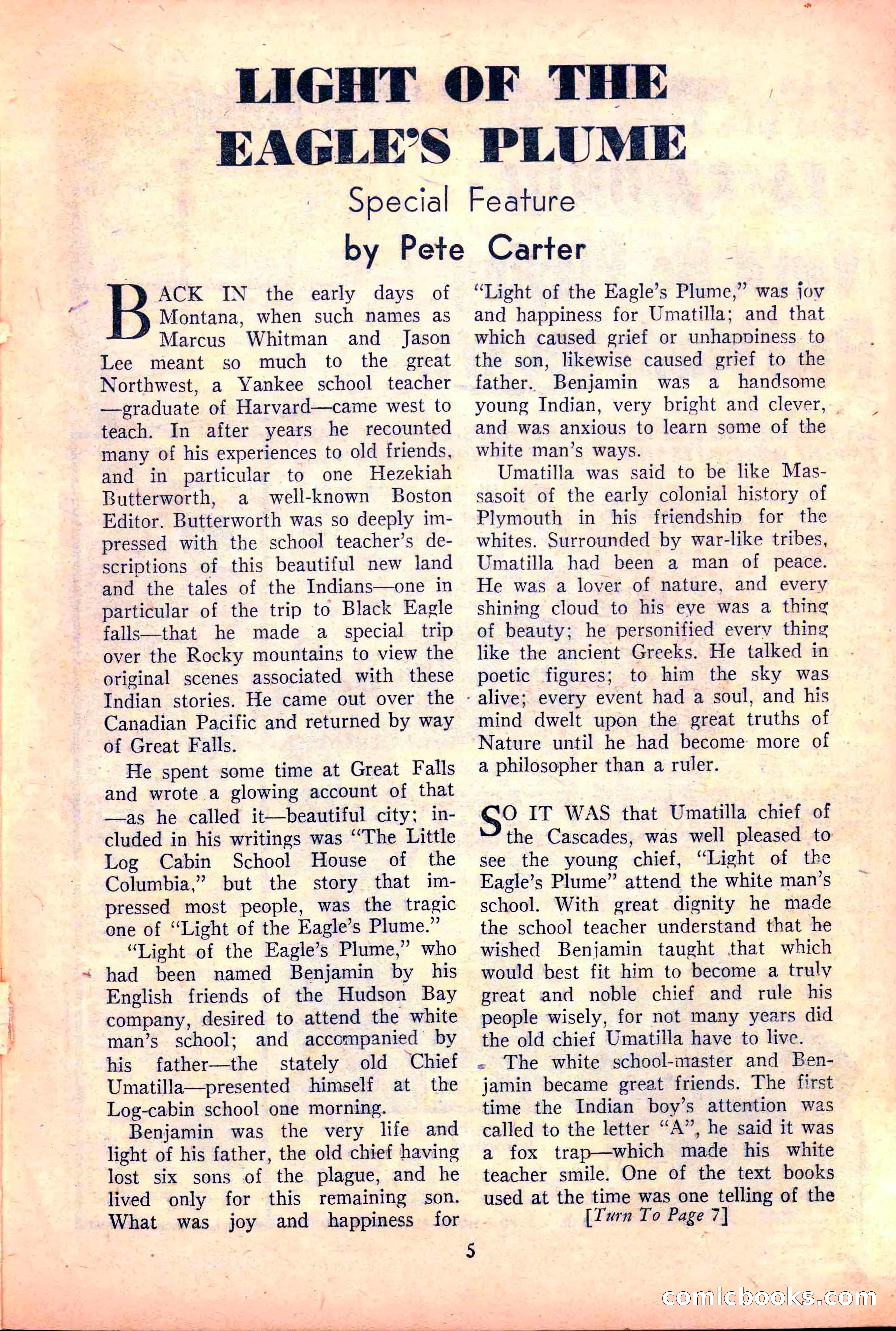
A restored page from Pulp Fiction, 1958. Page through the whole issue in the reader above.
📄 Transcribed text from this page (OCR, searchable)
Machine-transcribed from the original scan — historical spelling and the odd misread are preserved.
LIGHT OF THE EAGLE’S PLUME Special by Pete Carter ; ACK IN the early days of : Montana, when such names as Marcus Whitman and_ Jason Lee meant so much to the great Northwest, a Yankee school teacher —graduate of Harvard—came west to teach. In after years he recounted many of his experiences to old friends, and in particular to one Hezekiah Butterworth, a well-known Boston Editor. Butterworth was so deeply im- pressed with the school teacher’s de- scriptions of this beautiful new land and the tales of the Indians—one in particular of the trip to Black Eagle falls—that he made a special trip over the Rocky mountains to view the original scenes associated with these Indian stories. He came out over the Canadian Pacific and returned by way of Great Falls. He spent some time at Great Falls and wrote a glowing account of that —as he called it—beautiful city; in- cluded in his writings was ‘The Little Log Cabin School House of the Columbia,” but the story that im- pressed most people, was the tragic one of “Light of the Eagle’s Plume.” “Light of the Eagle’s Plume,” who - had been named Benjamin by his English friends of the Hudson Bay company, desired to attend the white man’s school; and accompanied by his father—the stately old Chief Umatilla—presented himself at the Log-cabin school one morning. Benjamin was the very life and light of his father, the old chief having lost six sons of the plague, and he lived only for this remaining son. What was joy and happiness for Feature ‘Light of the Eagle’s Plume,” was jov and happiness for Umatilla; and that which caused grief or unhapviness to the son, likewise caused grief to the father. Benjamin was a handsome young Indian, very bright and clever, . and was anxious to learn some of the white man’s ways. Umatilla was said to be like Mas- sasoit of the early colonial history of Plymouth in his friendship for the whites. Surrounded by war-like tribes, Umatilla had been a man of peace. He was a lover of nature, and every shining cloud to his eye was a thing of beauty; he personified everv thing like the ancient Greeks. He talked in poetic figures; to him the sky was - alive; every event had a soul, and his mind dwelt upon the great truths of Nature until he had become more of a philosopher than a ruler. CoO IT WAS that Umatilla chief of the Cascades, was well pleased to see the young chief, “Light of the Eagle’s Plume” attend the white man’s school. With great dignity he made the school teacher understand that he wished Benjamin taught that which would best fit him to become a truly great and noble chief and rule his people wisely, for not many years did the old chief Umatilla have to live. - The white school-master and Ben- jamin became great friends. The first time the Indian boy’s attention was called to the letter “A”, he said it was a fox trap—which made his white teacher smile. One of the text books used at the time was one telling of the , [Turn To Page 7] Comicbooksicom:.