
Pulp Fiction, 1958 · page 13 of 100
Action-Packed Western, May 1958 — page 13: what you’re looking at
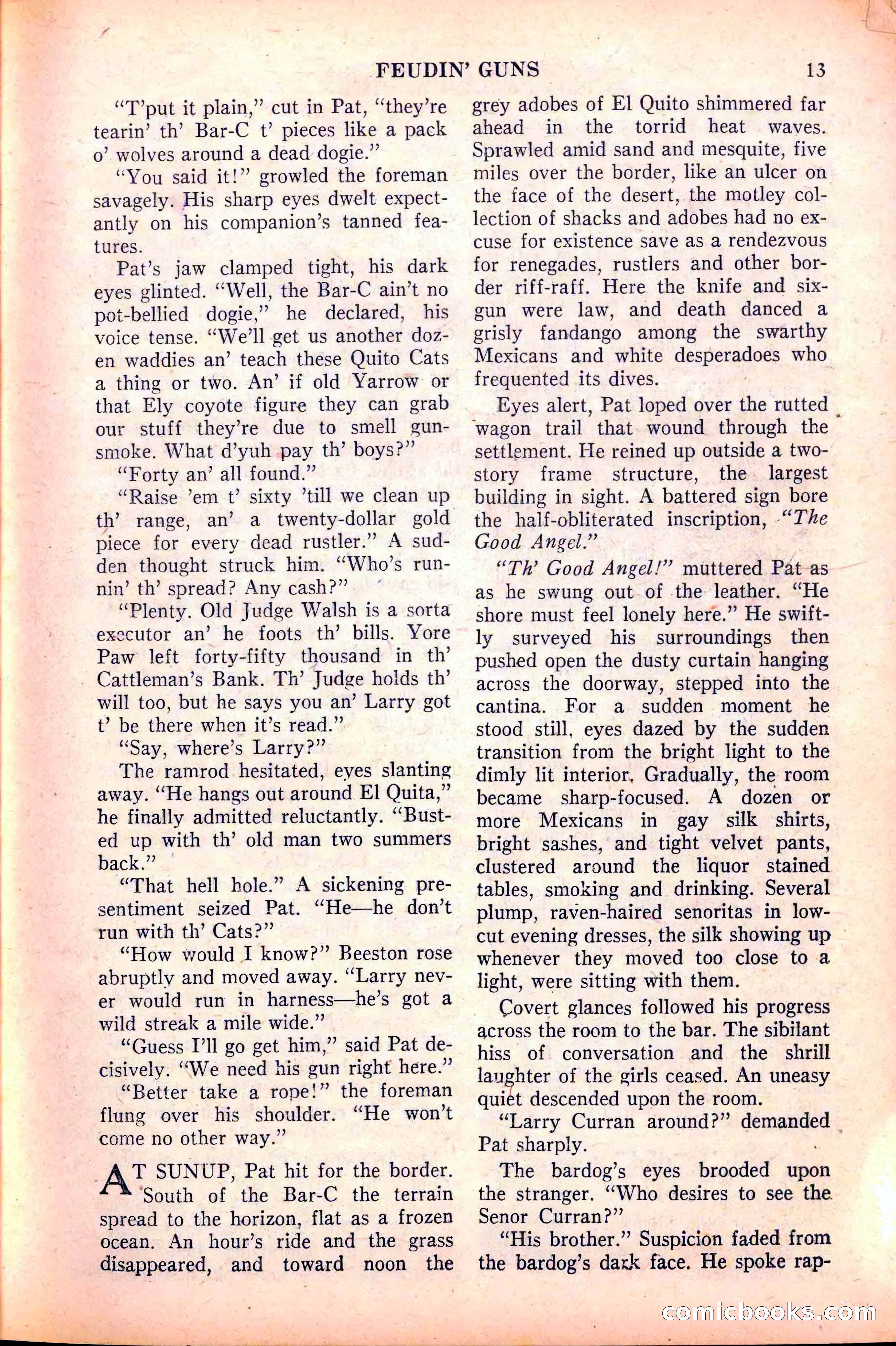
A restored page from Pulp Fiction, 1958. Page through the whole issue in the reader above.
📄 Transcribed text from this page (OCR, searchable)
Machine-transcribed from the original scan — historical spelling and the odd misread are preserved.
FEUDIN’ GUNS 13 “T’put it plain,” cut in Pat, “they’re tearin’ th’ Bar-C t’ pieces like a pack o’ wolves around a dead dogie.”’ “Vou said it!” growled the foreman savagely. His sharp eyes dwelt expect- antly on his companion’s tanned fea- tures. . Pat’s jaw clamped tight, his dark eyes glinted. “Well, the Bar-C ain’t no pot-bellied dogie,” he declared, his voice tense. “We'll get us another doz- en waddies an’ teach these Quito Cats a thing or two. An’ if old Yarrow or that Ely coyote figure they can grab our stuff they’re due to smell gun- smoke. What d’yuh pay th’ boys?” “Forty an’ all found.” “Raise ’em t’ sixty ’till we clean up th’ range, an’ a twenty-dollar gold piece for every dead rustler.” A sud- den thought struck him. ‘“Who’s run- nin’ th’ spread? Any cash?” “Plenty. Old Judge Walsh is a sorta executor an’ he foots th’ bills. Yore Paw left forty-fifty thousand in th’ _ Cattleman’s Bank. Th’ Judge holds th’ will too, but he says you an’ Larry got t’? be there when it’s read.” “Say, where’s Larry?” The ramrod hesitated, eyes slanting away. “He hangs out around EI] Quita,” he finally admitted reluctantly. “Bust- ed up with th’ old man two summers back.” “That hell hole.” A sickening pre- sentiment seized Pat. “He—he don’t run with th’ Cats?” “How would I know?” Beeston rose abruptly and moved away. “Larry nev- er would run in harness—he’s got a wild streak a mile wide.” “Guess I'll go get him,” said Pat de- cisively. “We need his gun right here.” “Better take a rope!” the foreman flung over his shoulder. “He won't come no other way.” T SUNUP, Pat hit for the border. ‘South of the Bar-C the terrain spread to the horizon, flat as a frozen ocean. An hour’s ride and the grass disappeared, and toward noon the grey adobes of El Quito shimmered far ahead in the torrid heat waves. Sprawled amid sand and mesquite, five miles over the border, like an ulcer on the face of the desert, the motley col- lection of shacks and adobes had no ex- cuse for existence save as a rendezvous for renegades, rustlers and other bor- der riff-raff. Here the knife and six- gun were law, and death danced a grisly fandango among the swarthy Mexicans and white desperadoes who frequented its dives. Eyes alert, Pat loped over the rutted _ wagon trail that wound through the settlement. He reined up outside a two- story frame structure, the largest building in sight. A battered sign bore the half-obliterated inscription, “Te Good Angel.” “Th” Good Angel!”’ muttered Pat as as he swung out of .the leather. “He shore must feel lonely here.” He swift- ly surveyed his surroundings then pushed open the dusty curtain hanging across the doorway, stepped into the cantina. For a sudden moment he stood still, eyes dazed by the sudden transition from the bright light to the dimly lit interior, Gradually, the room became sharp-focused. A dozen or more Mexicans in gay silk shirts, bright sashes, and tight velvet pants, clustered around the liquor stained tables, smoking and drinking. Several plump, raven-haired senoritas in low- cut evening dresses, the silk showing up whenever they moved too close to a light, were sitting with them. Covert glances followed his progress across the room to the bar. The sibilant hiss of conversation and the shrill laughter of the girls ceased. An uneasy quiet descended upon the room. “Larry Curran around?” demanded | Pat sharply. The bardog’s eyes brooded upo the stranger. “Who desires to see the. Senor Curran?” “His brother.” Suspicion faded from the bardog’s dark face. He spoke rap- i at. 7 COMMCEWOOkKS.CO