
Pulp Fiction, 1957 · page 74 of 100
Action-Packed Western, May 1957 — page 74: what you’re looking at
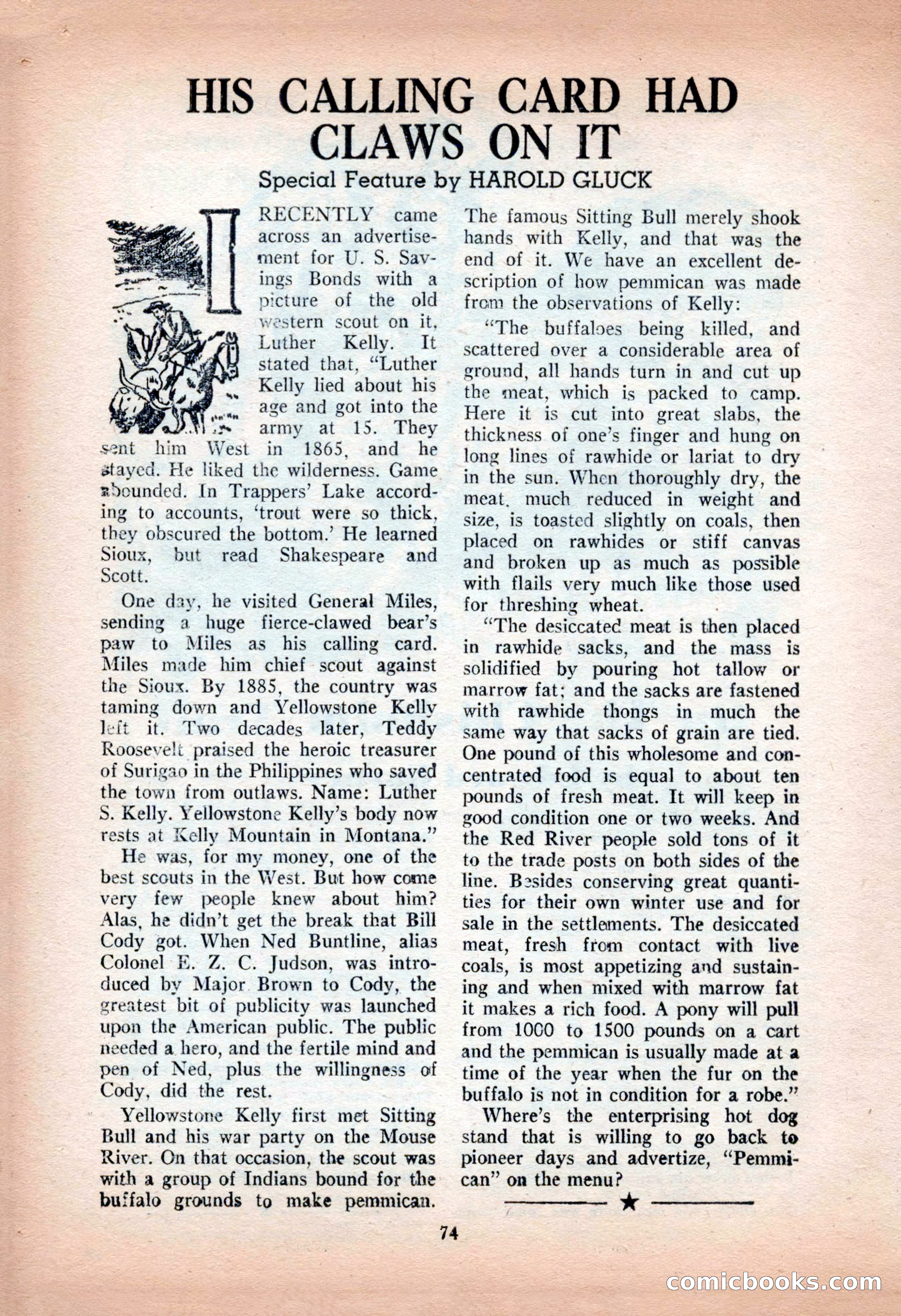
A restored page from Pulp Fiction, 1957. Page through the whole issue in the reader above.
📄 Transcribed text from this page (OCR, searchable)
Machine-transcribed from the original scan — historical spelling and the odd misread are preserved.
> HIS CALLING CARD HAD CLAWS ON IT Special Feature by HAROLD GLUCK RECENTLY came across an advertise- ment for U. S. Sav- ings Bonds with a picture of the old western scout on it, Luther Kelly. It stated that, “Luther Kelly lied about his age and got into the army at 15. They West in 1865, and he him stayed. He liked the wilderness. Game nQounded. In Trappers’ Lake accord- sent ing to accounts, ‘trout were so thick, they obscured the bottom.’ He learned Sioux, but read Shakespeare and Scott. One day, he visited General Miles, sending a huge fierce-clawed bear’s paw to Miles as his calling card. Miles made him chief scout against the Sioux. By 1885, the country was taming down and Yellowstone Kelly left it. Two decades later, Teddy Rooseveli praised the heroic treasurer of Surigao in the Philippines who saved the town from outlaws. Name: Luther 5S. Kelly. Yellowstone Kelly’ s body now rests at Kelly Mountain in Montana.” He was, for my money, one of the best scouts in the West. But how come very few people knew about him? Alas, he didn’t get the break that Bill Cody got. When Ned Buntline, alias Colonel KE. Z. C. Judson, was intro- duced by Major Brown to Cody, the greatest bit of publicity was launched upon the American public. The public needed a hero, and the fertile mind and pen of Ned, plus the willingness of Cody, did the rest. Yellowstone Kelly first met Sitting Bull and his war party on the Mouse River. On that occasion, the scout was with a group of Indians bound for the buffalo grounds to make pemmican. 74 The famous Sitting Bull merely shook hands with Kelly, and that was the end of it. We have an excellent de- scription of how pemmican was made from the observations of Kelly: “The buffaloes being killed, and scattered over a considerable area of ground, all hands turn in and cut up the meat, which is packed to camp. Here it is cut into great slabs, the thickness of one’s finger and hung on long lines of rawhide or lariat to dry in the sun. When thoroughly dry, the meat, much reduced in weight and size, is toasted slightly on coals, then placed on rawhides or stiff canvas and broken up as much as possible with flails very much like those used for threshing wheat. “The desiccated meat is then placed in rawhide sacks, and the mass is solidified by pouring hot tallow or marrow fat; and the sacks are fastened with rawhide thongs in much the same way that sacks of grain are tied. One pound of this wholesome and con- centrated food is equal to about ten pounds of fresh meat. It will keep in good condition one or two weeks. And the Red River people sold tons of it to the trade posts on both sides of the line. Besides conserving great quanti- ties for their own winter use and for sale in the settlements. The desiccated meat, fresh from contact with live coals, is most appetizing and sustain- ing and when mixed with marrow fat it makes a rich food. A pony will pull from 1000 to 1500 pounds on a cart and the pemmican is usually made at a time of the year when the fur on the buffalo is not in condition for a ro Where’s the enterprising hot dog stand that is willing to go back to pioneer days and advertize, “Pemmi- can” on the menu? * comichook (E(0) ~~ S-