
Pulp Fiction, 1957 · page 72 of 100
Action-Packed Western, May 1957 — page 72: what you’re looking at
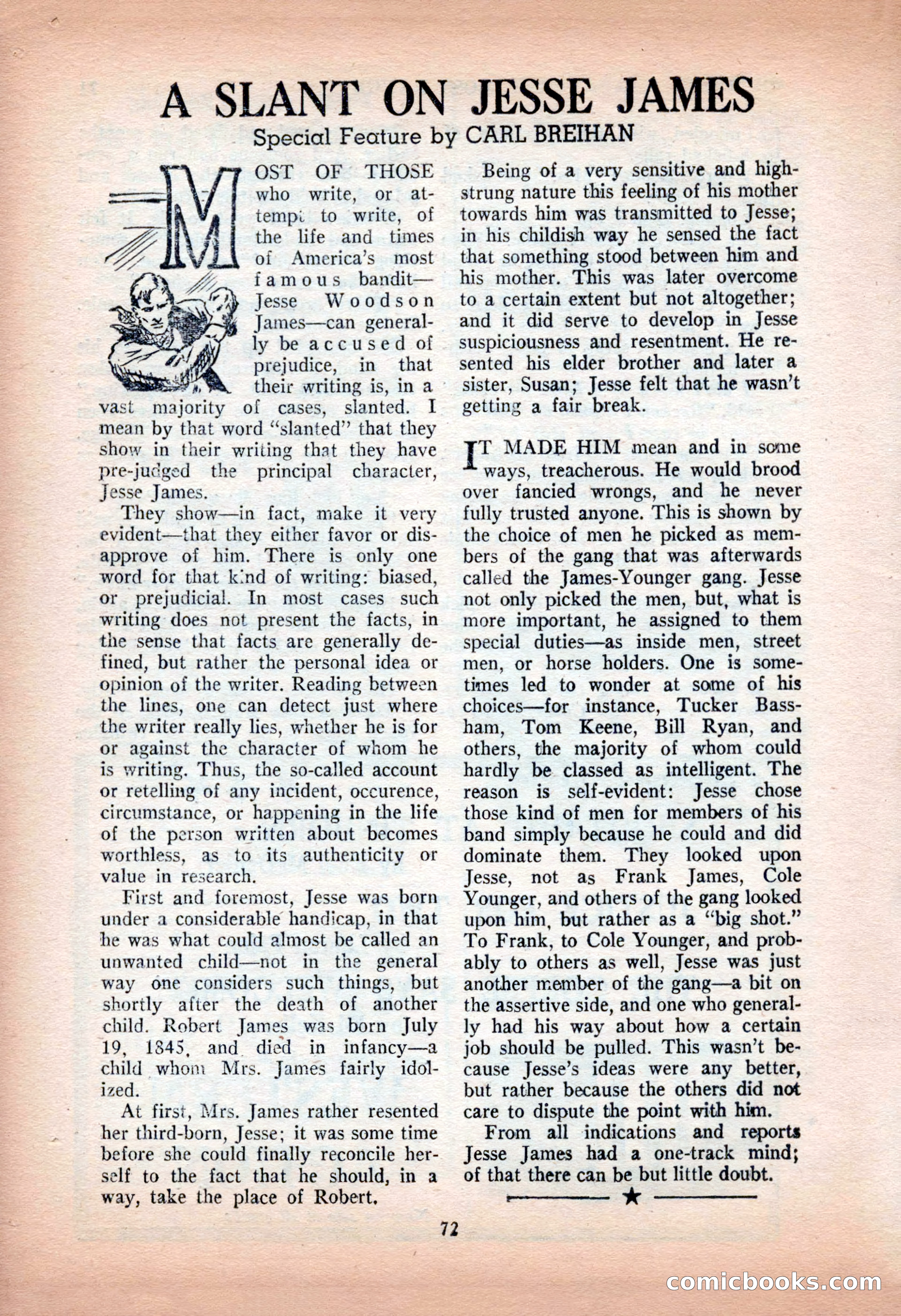
A restored page from Pulp Fiction, 1957. Page through the whole issue in the reader above.
📄 Transcribed text from this page (OCR, searchable)
Machine-transcribed from the original scan — historical spelling and the odd misread are preserved.
Wh y J A SLANT ON JESSE JAMES Special Feature by CARL BREIHAN OST OF THOSE who write, or at- tempi to write, of the life and times oi America’s most famous. bandit— Jesse Woodson James—can general- ly be accused of prejudice, in that 7» their writing is, in a vast sa iocity of cases, slanted. I mean by that word “slant ed” that they show in their writing that they have pre-judged the principal character, Jesse James. They show—in fact, make it very 1 that they either favor or dis- approve of him. There is only one word for that kind of writing: biased, or prejudicial. In most cases such writing does not present the facts, in the sense that facts are generally de- fined, but rather the personal idea or opinion of the writer. Reading between the lines, one can detect just where the writer really lies, whether he is for or against the character of whom he is writing. Thus, the so-called account or retelling of any incident, occurence, circumstance, or happening in the life of the person written about becomes worthless, as to its authenticity or value in research. First and foremost, Jesse was born under a considerable handicap, in that he was what could almost be called an unwanted child—not in the general way one considers such things, but shortly after the death of another child. Robert James was born July 19, 1845, and. died in infancy—a child whom Mrs. James fairly idol- ized. At first, Mrs. James rather resented her third-born, Jesse; it was some time before she could finally reconcile her- elf to the fact that he should, in a way, take the place of Robert, 72 Being of a very sensitive and high- strung nature this feeling of his mother towards him was transmitted to Jesse; in his childish way he sensed the fact that something stood between him and his mother. This was later overcome to a certain extent but not altogether; and it did serve to develop in Jesse suspiciousness and resentment. He re- sented his elder brother and later a sister, Susan; Jesse felt that he wasn’t getting a fair break. T MADE HIM mean and in some ways, treacherous. He would brood over fancied wrongs, and he never fully trusted anyone. This is shown by the choice of men he picked as mem- bers of the gang that was afterwards called the James-Younger gang. Jesse not only picked the men, but, what is more important, he assigned to them special duties—as inside men, street men, or horse holders. One is some- times led to wonder at some of his choices—for instance, Tucker Bass- ham, Tom Keene, Bill Ryan, and others, the majority of whom could hardly be classed as intelligent. The reason is self-evident: Jesse chose those kind of men for members of his band simply because he could and did dominate them. They looked upon Jesse, not as Frank James, Cole Younger, and others of the gang looked upon him, but rather as a “big shot.” To Frank, to Cole Younger, and prob- ably to others as well, Jesse was just another member of the gang—a bit on the assertive side, and one who general- ly had his way about how a certain job should be pulled. This wasn’t be- cause Jesse’s ideas were any better, but rather because the others did not care to dispute the point with him. From all indications and reports Jesse James had a one-track mind; of that there can be but little doubt. comichbook > sa Hig SY :cO