
Pulp Fiction, 1960 · page 64 of 68
Action for Men, May 1960 — page 64: what you’re looking at
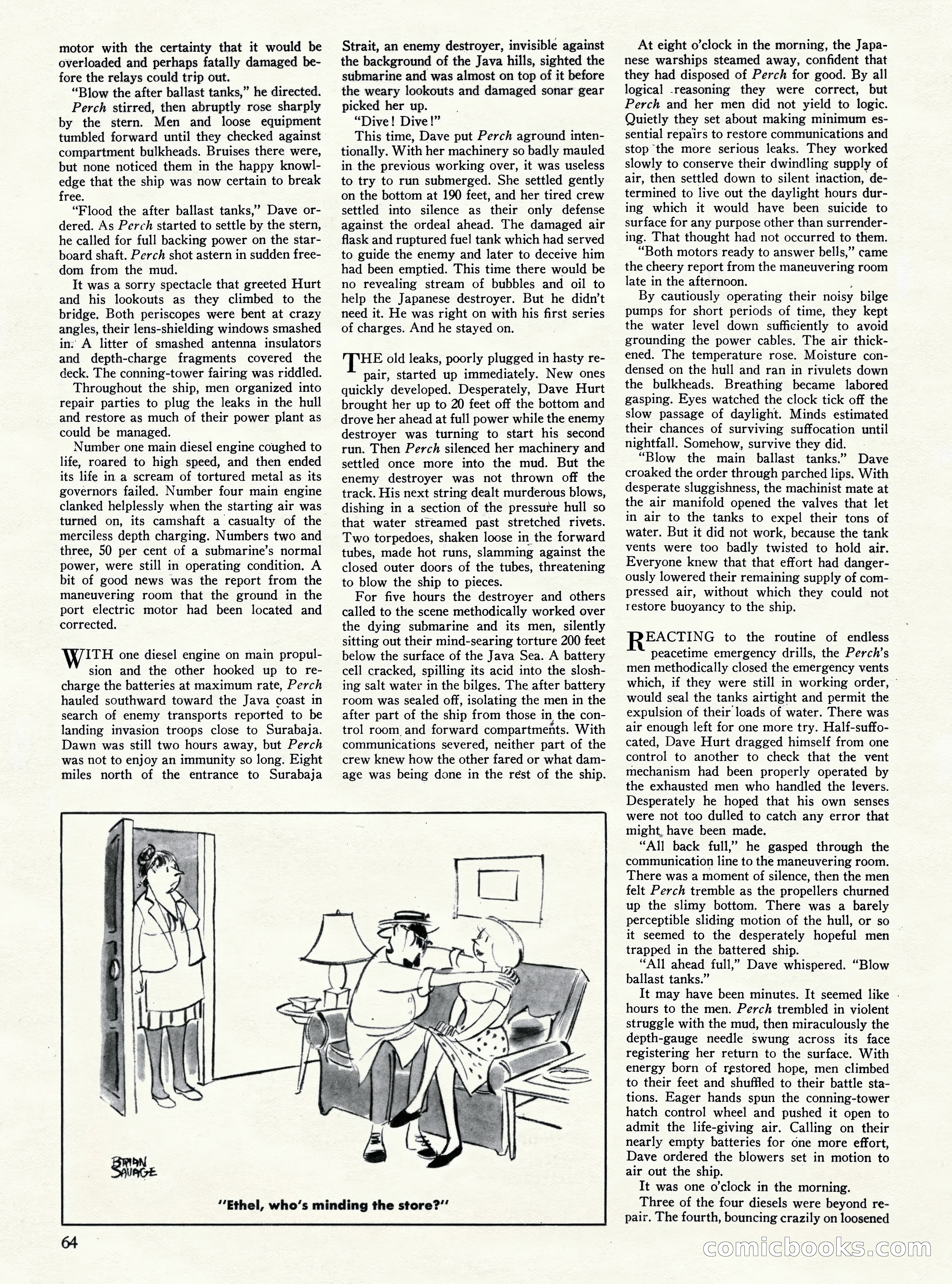
A restored page from Pulp Fiction, 1960. Page through the whole issue in the reader above.
📄 Transcribed text from this page (OCR, searchable)
Machine-transcribed from the original scan — historical spelling and the odd misread are preserved.
motor with the certainty that it would be overloaded and perhaps fatally damaged be- fore the relays could trip out. “Blow the after ballast tanks,” he directed. Perch stirred, then abruptly rose sharply by the stern. Men and loose equipment tumbled forward until they checked against compartment bulkheads. Bruises there were, but none noticed them in the happy knowl- edge that the ship was now certain to break free. “Flood the after ballast tanks,’ Dave or- dered. As Perch started to settle by the stern, he called for full backing power on the star- board shaft. Perch shot astern in sudden free- dom from the mud. It was a sorry spectacle that greeted Hurt and his lookouts as they climbed to the bridge. Both periscopes were bent at crazy angles, their lens-shielding windows smashed in: A litter of smashed antenna insulators and depth-charge fragments covered the deck. The conning-tower fairing was riddled. Throughout the ship, men organized into repair parties to plug the leaks in the hull and restore as much of their power plant as could be managed. Number one main diesel engine coughed to life, roared to high speed, and then ended its life in a scream of tortured metal as its governors failed. Number four main engine clanked helplessly when the starting air was turned on, its camshaft a casualty of the merciless depth charging. Numbers two and three, 50 per cent of a submarine’s normal power, were still in operating condition. A bit of good news was the report from the maneuvering room that the ground in the port electric motor had been located and corrected. Wirth one diesel engine on main propul- sion and the other hooked up to re- charge the batteries at maximum rate, Perch hauled southward toward the Java coast in search of enemy transports reported to be landing invasion troops close to Surabaja. Dawn was still two hours away, but Perch was not to enjoy an immunity so long. Eight miles north of the entrance to Surabaja Strait, an enemy destroyer, invisible against the background of the Java hills, sighted the submarine and was almost on top of it before the weary lookouts and damaged sonar gear picked her up. “Dive! Dive!” This time, Dave put Perch aground inten- tionally. With her machinery so badly mauled in the previous working over, it was useless to try to run submerged. She settled gently on the bottom at 190 feet, and her tired crew settled into silence as their only defense against the ordeal ahead. The damaged air flask and ruptured fuel tank which had served to guide the enemy and later to deceive him had been emptied. This time there would be no revealing stream of bubbles and oil to help the Japanese destroyer. But he didn’t need it. He was right on with his first series of charges. And he stayed on. THE old leaks, poorly plugged in hasty re- pair, started up immediately. New ones quickly developed. Desperately, Dave Hurt brought her up to 20 feet off the bottom and drove her ahead at full power while the enemy destroyer was turning to start his second run. Then Perch silenced her machinery and settled once more into the mud. But the enemy destroyer was not thrown off the track. His next string dealt murderous blows, dishing in a section of the pressure hull so that water streamed past stretched rivets. Two torpedoes, shaken loose in the forward tubes, made hot runs, slamming against the closed outer doors of the tubes, threatening to blow the ship to pieces. For five hours the destroyer and others called to the scene methodically worked over the dying submarine and its men, silently sitting out their mind-searing torture 200 feet below the surface of the Java Sea. A battery cell cracked, spilling its acid into the slosh- ing salt water in the bilges. The after battery room was sealed off, isolating the men in the after part of the ship from those in, the con- trol room.and forward compartments. With communications severed, neither part of the crew knew how the other fared or what dam- age was being done in the rest of the ship. “Ethel, who’s minding the store?”’ At eight o’clock in the morning, the Japa- nese warships steamed away, confident that they had disposed of Perch for good. By all logical .reasoning they were correct, but Perch and her men did not yield to logic. Quietly they set about making minimum es- sential repairs to restore communications and stop the more serious leaks. They worked slowly to conserve their dwindling supply of air, then settled down to silent inaction, de- termined to live out the daylight hours dur- ing which it would have been suicide to surface for any purpose other than surrender- ing. That thought had not occurred to them. “Both motors ready to answer bells,” came the cheery report from the maneuvering room late in the afternoon. : By cautiously operating their noisy bilge pumps for short periods of time, they kept the water level down sufficiently to avoid grounding the power cables. The air thick- ened. The temperature rose. Moisture con- densed on the hull and ran in rivulets down the bulkheads. Breathing became labored gasping. Eyes watched the clock tick off the slow passage of daylight. Minds estimated their chances of surviving suffocation until nightfall. Somehow, survive they did. “Blow the main ballast tanks.” Dave croaked the order through parched lips. With desperate sluggishness, the machinist mate at the air manifold opened the valves that let in air to the tanks to expel their tons of water. But it did not work, because the tank vents were too badly twisted to hold air. Everyone knew that that effort had danger- ously lowered their remaining supply of com- pressed air, without which they could not restore buoyancy to the ship. EACTING to the routine of endless peacetime emergency drills, the Perch’s men methodically closed the emergency vents which, if they were still in working order, © would seal the tanks airtight and permit the expulsion of their loads of water. There was air enough left for one more try. Half-suffo- cated, Dave Hurt dragged himself from one control to another to check that the vent mechanism had been properly operated by the exhausted men who handled the levers. Desperately he hoped that his own senses were not too dulled to catch any error that might, have been made. “All back full,’ he gasped through the communication line to the maneuvering room. There was a moment of silence, then the men felt Perch tremble as the propellers churned up the slimy bottom. There was a barely perceptible sliding motion of the hull, or so | it seemed to the desperately hopeful men — trapped in the battered ship. “All ahead full,” Dave whispered. “Blow ballast tanks.” It may have been minutes. It seemed like - hours to the men. Perch trembled in violent struggle with the mud, then miraculously the depth-gauge needle swung across its face registering her return to the surface. With energy born of restored hope, men climbed to their feet and shuffled to their battle sta- tions. Eager hands spun the conning-tower hatch control wheel and pushed it open to admit the life-giving air. Calling on their nearly empty batteries for one more effort, Dave ordered the blowers set in motion to air out the ship. : It was one o'clock in the morning. Three of the four diesels were beyond re- pair. The fourth, bouncing crazily on loosened (COUN ClooolkKS. com