
Pulp Fiction, 1960 · page 62 of 68
Action for Men, May 1960 — page 62: what you’re looking at
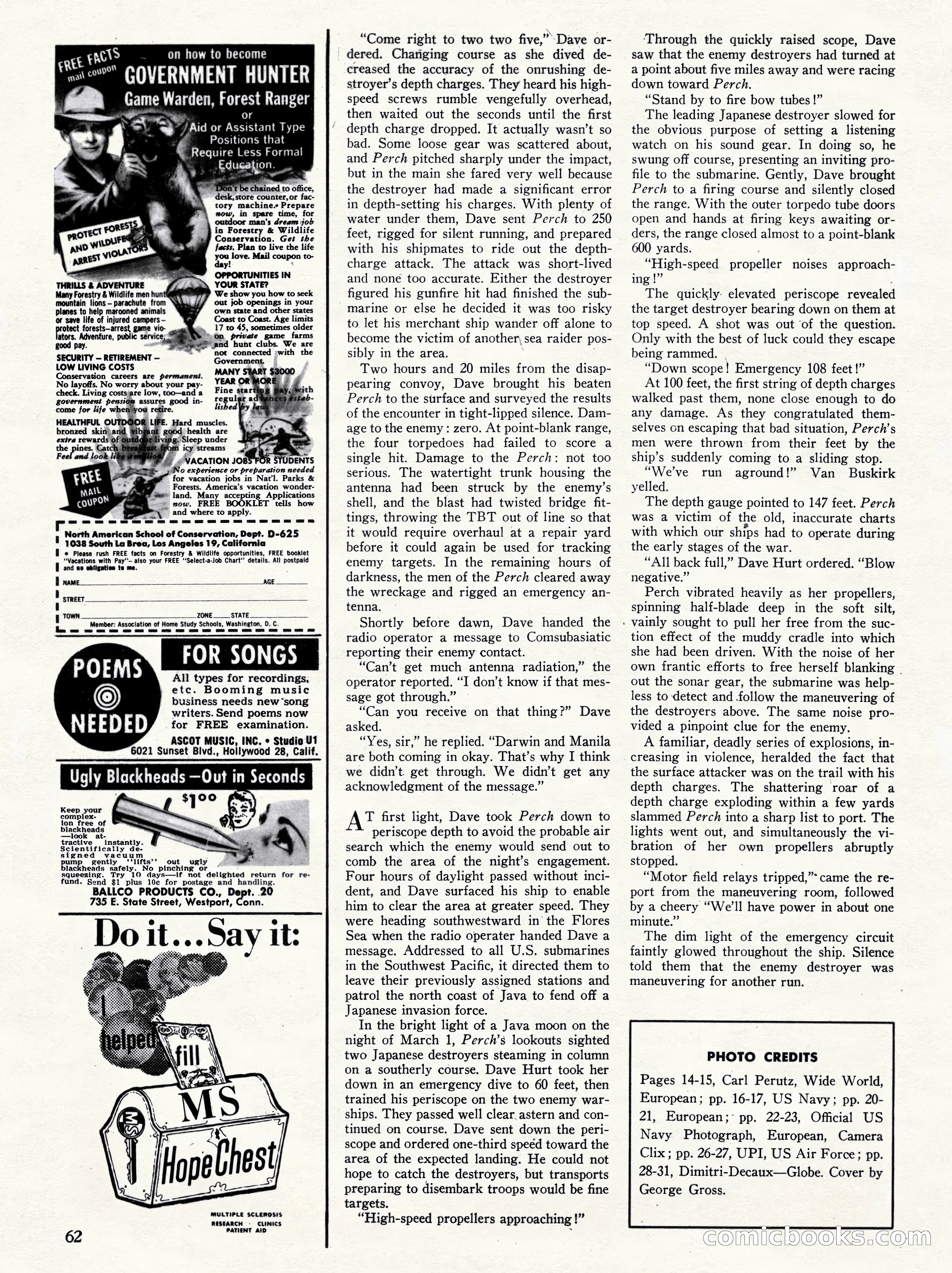
A restored page from Pulp Fiction, 1960. Page through the whole issue in the reader above.
📄 Transcribed text from this page (OCR, searchable)
Machine-transcribed from the original scan — historical spelling and the odd misread are preserved.
ERTS on how to become rae" GOVERNMENT HUNTER fame Warden, Forest Ranger ex a / Aid or Assistant Type “ Positions that € Require Less Formal Rduaaion. - ' Sn" b Pelained to office, g Gel ates counter, or fac- tory machine. Prepare now, in spare time, for outdoor man’s dream job Zin Forestry & Wildlife # Conservation. Get the fects. Plan to live the life you love. Mail coupon to- day! OPPORTUNITIES IN YOUR STATE? We show you how to seek out job openings in your own state and other states Many Forestry & Wildlife men hunt mountain lions — parachute from ‘S planes to help marooned animals or save life of injured campers ~ otect forests—arrest game vio- | ators. neat public service oa SECURITY — RETIREMENT — LOW LIVING COSTS Conservation careers are permanent. No layoffs. No worry about your pay- check. Living costsjare low, too—and a government pensi assures mone in- come for life wh On private game farms ‘and hunt clubs. We are not connected pwith the ” le ’NACATION JOBS FOR 81 > No experience or preparation needed for vacation jobs in Nat'l. Parks & ° A Forests, America’s vacation Souler ee Se land. Many accepting Applications « now. FREE KLET tells how “and where to apply. i North American School of Conservation, Dept. D-625 1038 South La Brea, Los Angeles 19, California B © Please rush FREE facts on Forestry & Wildlife opportunities, FREE booklet “Vacations with ype —— your FREE 'Select-a-Job Chart’’ details. All postpaid [and no cbtigation te : I name. _AGE STREET | TOW ne TOE STANE Member: Association of Home Study Schools, Washington, D. C. he om mene ee eee eee eee eee ee ee eee All types for recordings, , etc. Booming music business needs new ‘song writers. Send poems now for FREE examination. ASCOT MUSIC, INC. Studio U1 Keep your complex- on free of blackheads tractive instantly. Seientifical ly de- m y ‘‘lifts’’ out — a oe Ag safely. No pinching o squeezing. Try 10 days—if not "delighted return for re- fund. Send $1 plus Woe for postage and handling. BALLCO PRODUCTS CO., Dept. 20 735 E. State Street, Westport, Conn. Do it. . say it: MULTIPLE SCLEROSIS RESEARCH - CLINICS 62 ° PATIENT AID “Come right to two two five,” Dave or- ' dered. Changing course as she dived de- creased the accuracy of the onrushing de- stroyer’s depth charges. They heard his high- speed screws rumble vengefully overhead, then waited out the seconds until the first depth charge dropped. It actually wasn’t so bad. Some loose gear was scattered about, and Perch pitched sharply under the impact, but in the main she fared very well because the destroyer had made a significant error in depth-setting his charges. With plenty of water under them, Dave sent Perch to 250 feet, rigged for silent running, and prepared with his shipmates to ride out the depth- charge attack. The attack was short-lived and none too accurate. Either the destroyer figured his gunfire hit had finished the sub- marine or else he decided it was too risky to let his merchant ship wander off alone to become the victim of another, sea raider pos- sibly in the area. Two hours and 20 miles from the disap- pearing convoy, Dave brought his beaten Perch to the surface and surveyed the results of the encounter in tight-lipped silence. Dam- age to the enemy : zero. At point-blank range, the four torpedoes had failed to score a single hit. Damage to the Perch: not too serious. The watertight trunk housing the antenna had been struck by the enemy’s shell, and the blast had twisted bridge fit- tings, throwing the TBT out of line so that it would require overhaul at a repair yard before it could again be used for tracking enemy targets. In the remaining hours of darkness, the men of the Perch cleared away the wreckage and rigged an emergency an- tenna. Shortly before dawn, Dave handed the radio operator a message to Comsubasiatic reporting their enemy contact. “Can’t get much antenna radiation,” the operator reported. “I don’t know if that mes- sage got through.” “Can you receive on that thing?” Dave asked. “Yes, sir,” he replied. “Darwin and Manila are both coming in okay. That’s why I think we didn’t. get through. We didn’t get any acknowledgment of the message.” T first light, Dave took Perch down to periscope depth to avoid the probable air search which the enemy would send out to comb the area of the night’s engagement. Four hours of daylight passed without inci- dent, and Dave surfaced his ship to enable him to clear the area at greater speed. They were heading southwestward in the Flores Sea when the radio operater handed Dave a message. Addressed to all U.S. submarines in the Southwest Pacific, it directed them to leave their previously assigned stations and patrol the north coast of Java to fend off a Japanese invasion force. In the bright light of a Java moon on the night of March 1, Perch’s lookouts sighted two Japanese destroyers steaming in column on a southerly course. Dave Hurt took her down in an emergency dive to 60 feet, then trained his periscope on the two enemy war- ships. They passed well clear.astern and con- tinued on course. Dave sent down the peri- scope and ordered one-third speed toward the area of the expected landing. He could not hope to catch the destroyers, but transports preparing to disembark troops would be fine targets. “High-speed propellers approaching !” Through the quickly raised scope, Dave saw that the enemy destroyers had turned at a point about five miles away and were racing down toward Perch. “Stand by to fire bow tubes!” The leading Japanese destroyer slowed for the obvious purpose of setting a listening watch on his sound gear. In doing so, he swung off course, presenting an inviting pro- file to the submarine. Gently, Dave brought Perch to a firing course and silently closed the range. With the outer torpedo tube doors open and hands at firing keys awaiting or- ders, the range closed almost to a point-blank 600 yards. “High-speed propeller noises approach- ing!” The quickly: elevated periscope revealed the target destroyer bearing down on them at top speed. A shot was out ‘of the question. Only with the best of luck could they escape being rammed. | “Down scope! Emergency 108 feet!” At 100 feet, the first string of depth charges walked past them, none close enough to do any damage. As they congratulated them- selves cn escaping that bad situation, Perch’s men were thrown from their feet by the ship’s suddenly coming to a sliding stop. “We’ve run aground!” Van Buskirk yelled. The depth gauge pointed to 147 feet. Perch was a victim of the old, inaccurate charts with which our ships had to operate during the early stages of the war. “All back full,” Dave Hurt ordered. “Blow negative.” Perch vibrated heavily as her propellers, spinning half-blade deep in the soft silt, . vainly sought to pull her free from the suc- tion effect of the muddy cradle into which she had been driven. With the noise of her own frantic efforts to free herself blanking - out the sonar gear, the submarine was help- less to detect and follow the maneuvering of the destroyers above. The same noise pro- vided a pinpoint clue for the enemy. A familiar, deadly series of explosions, in- creasing in violence, heralded the fact that the surface attacker was on the trail with his depth charges. The shattering roar of a depth charge exploding within a few yards slammed Perch into a sharp list to port. The lights went out, and simultaneously the vi- bration of her own propellers abruptly stopped. “Motor field neiage tripped, ”* came the re- port from the maneuvering room, followed by a cheery “We'll have power in about one minute.” The dim light of the emergency circuit faintly glowed throughout the ship. Silence told them that the enemy destroyer was maneuvering for another run. PHOTO CREDITS Pages 14-15, Carl Perutz, Wide World, European; pp. 16-17, US Navy; pp. 20- 21, European; pp. 22-23, Official US Navy Photograph, European, Camera Clix ; pp. 26-27, UPI, US Air Force; pp. 28-31, Dimitri-Decaux—Globe. Cover by George Gross.