
Pulp Fiction, 1960 · page 52 of 68
Action for Men, May 1960 — page 52: what you’re looking at
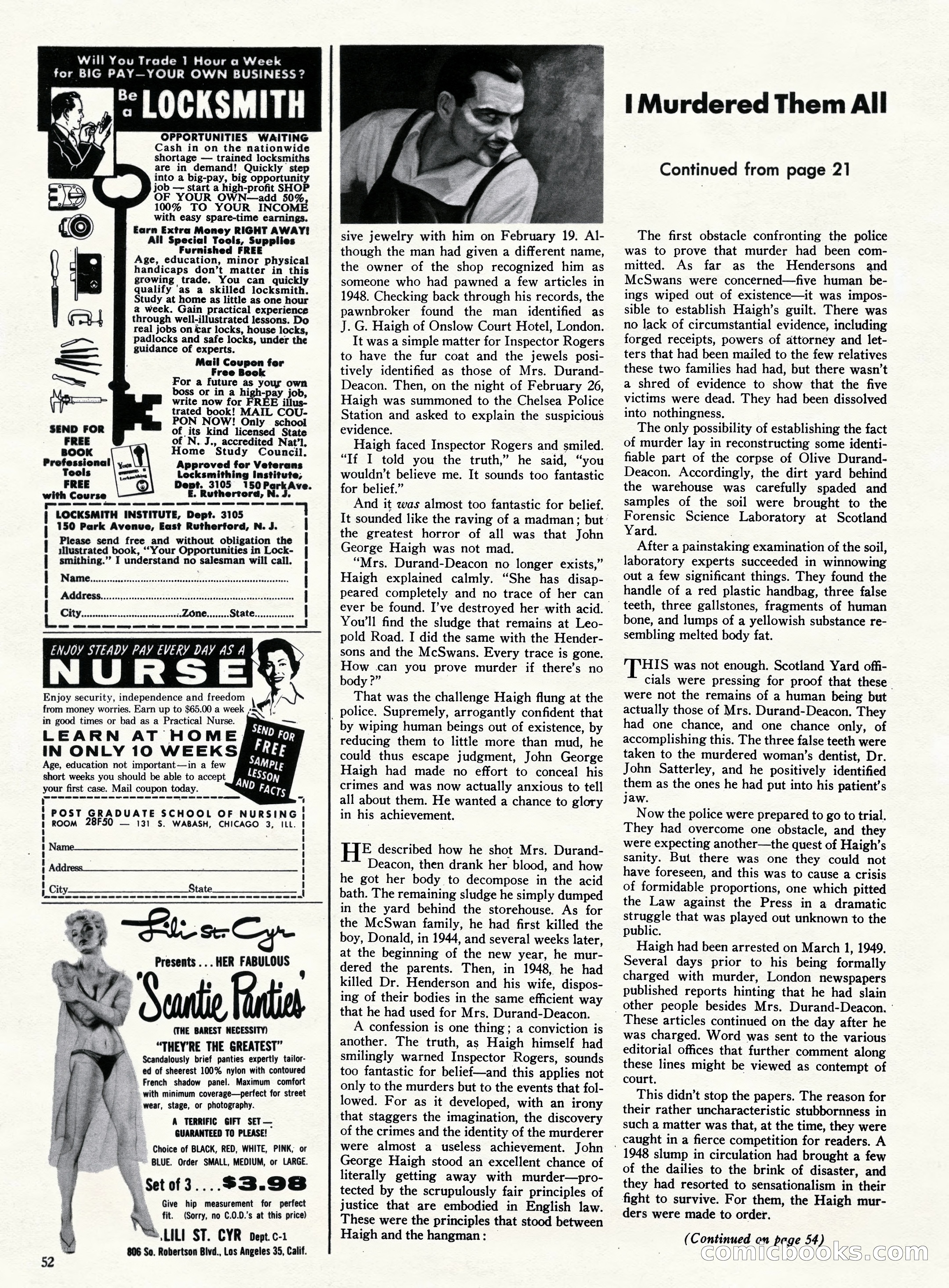
A restored page from Pulp Fiction, 1960. Page through the whole issue in the reader above.
📄 Transcribed text from this page (OCR, searchable)
Machine-transcribed from the original scan — historical spelling and the odd misread are preserved.
Will You Trade 1 Hour a Week for BIG PAY—-YOUR OWN BUSINESS? OPPORTUNITIES WAITING Cash in on the nationwide shortage — trained locksmiths are in demand! Quickly step into a big-pay, big opportunity job — start a high-profit SHOP OF YOUR OWN—add 50% 100% TO YOUR INCOME with easy spare-time earnings. Earn Extra Money RIGHT AWAY! All Special Tools, Supplies Furnished FREE Age, education, minor physical handicaps don’t matter in this growing trade. You can quickly qualify ‘as a skilled locksmith. Study at home as little as one hour a week. Gain practical experience through well-illustrated lessons. Do real jobs on «ar locks, house locks, padlocks and safe locks, under the guidance of experts. Mail Coupen for Free Book For a future as your own boss or in a high-pay job, write now for FREE iilus- trated book! MAIL COU- PON NOW! Only school SEND FOR of its kind licensed State FREE of N. J., accredited Nat’l, BOOK \¢| Home Study Council. Professional | y.\¥- Approved for Veterans Tools —on Locksmithing Institute, FREE . Dept. 3105 150 ParkAve. with Course E. Ruthertord, N. J. fe ee cee ee Gee ee ce cee ee ee ee ee ee ee oe j LOCKSMITH INSTITUTE, Dept. 3105 1 150 Park Avenue, East Rutherford, N. J. { Please send free and without obligation the i illustrated book, ‘“Your Opportunities in Lock- | f smithing.” I understand no salesman will call. j Enjoy security, independence and freedom from money worries. Earn up to $65.00 a week , in good times or bad as a Practical Nurse. LEARN AT HOME IN ONLY 10 WEEKS Age, education not important—in a few short weeks you should be able to accept ; POST GRADUATE SCHOOL OF NURSING room 28F50 — 131 S. WABASH, CHICAGO 3, ILL. Nam Presents ...HER FABULOUS (THE BAREST NECESSITY) “THEY'RE THE GREATEST” Scandalously brief panties expertly tailor- _. ed of sheerest 100% nylon with contoured French shadow panel. Maximum comfort with minimum coverage—perfect for street ____wear, stage, or photography. A TERRIFIC GIFT SET— GUARANTEED TO PLEASE! Choice of BLACK, RED, WHITE, PINK, or BLUE. Order SMALL, MEDIUM, or LARGE. _ Setof3... 53.98 Give hip measurement for perfect fit. (Sorry, no C.0.D.’s at this price) S.LILI ST. CYR. bept.c-1 ; bi. 806 So. Robertson Bivd., Los Angeles 35, Calif. 2 sive jewelry with him on February 19. Al- though the man had given a different name, the owner of the shop recognized him as someone who had pawned a few articles in 1948. Checking back through his records, the pawnbroker found the man identified as J. G. Haigh of Onslow Court Hotel, London. It was a simple matter for Inspector Rogers to have the fur coat and the jewels posi- tively identified as those of Mrs. Durand- Deacon. Then, on the night of February 26, Haigh was summoned to the Chelsea Police Station and asked to explain the suspicious evidence. Haigh faced Inspector Rogers and smiled. “If I told you the truth,” he said, “you wouldn’t believe me. It sounds too fantastic for belief.” And it was almost too fantastic for belief. It sounded like the raving of a madman; but’ the greatest horror of all was that John George Haigh was not mad. “Mrs. Durand-Deacon no longer exists,” Haigh explained calmly. “She has disap- peared completely and no trace of her can_ ever be found. I’ve destroyed her with acid. You'll find the sludge that remains at Leo- pold Road. I did the same with the Hender- sons and the McSwans. Every trace is gone. How can you prove murder if there’s no body ?” That was the challenge Haigh flung at the _ police. Supremely, arrogantly confident that by wiping human beings out of existence, by reducing them to little more than mud, he could thus escape judgment, John George Haigh had made no effort to conceal his crimes and was now actually anxious to tell all about them. He wanted a chance to glory in his achievement. E described how he shot Mrs. Durand- Deacon, then drank her blood, and how he got her body to decompose in the acid bath. The remaining sludge he simply dumped in the yard behind the storehouse. As for the McSwan family, he had first killed the boy, Donald, in 1944, and several weeks later, at the beginning of the new year, he mur- dered the parents. Then, in 1948 he had killed Dr. Henderson and his wife, dispos- ing of their bodies in the same efficient way that he had used for Mrs. Durand-Deacon. A confession is one thing; a conviction is another. The truth, as Haigh himself had smilingly warned Inspector Rogers, sounds too fantastic for belief—and this applies not only to the murders but to the events that fol- lowed. For as it developed, with an irony that staggers the imagination, the discovery of the crimes and the identity of the murderer were almost a useless achievement. John George Haigh stood an excellent chance of literally getting away with murder—pro- tected by the scrupulously fair principles of justice that are embodied in English law. These were the principles that stood between Haigh and the hangman: © | Murdered Them All Continued from page 21 The first obstacle confronting the police was to prove that murder had been com- mitted. As far as the Hendersons and McSwans were concerned—five human be- ings wiped out of existence—it was impos- sible to establish Haigh’s guilt. There was no lack of circumstantial evidence, including forged receipts, powers of attorney and let- ters that had been mailed to the few relatives these two families had had, but there wasn’t a shred of evidence to show that the five victims were dead. They had been dissolved into nothingness. The only possibility of establishing the fact of murder lay in reconstructing some identi- fiable part of the corpse of Olive Durand- Deacon. Accordingly, the dirt yard behind the warehouse was carefully spaded and samples of the soil were brought to the Forensic Science Laboratory at Scotland Yard. After a painstaking examination of the soil, laboratory experts succeeded in winnowing out a few significant things. They found the handle of a red plastic handbag, three false teeth, three gallstones, fragments of human bone, and lumps of a yellowish substance re- sembling melted body fat. THIS was not enough. Scotland Yard offi- cials were pressing for proof that these were not the remains of a human being but actually those of Mrs. Durand-Deacon. They had one chance, and one chance only, of accomplishing this. The three false teeth were taken to the murdered woman’s dentist, Dr. John Satterley, and he positively identified them as the ones he had put into his patient’s jaw. Now the police were prepared to go to trial. They had overcome one obstacle, and they were expecting another—the quest of Haigh’s sanity. But there was one they could not have foreseen, and this was to cause a crisis of formidable proportions, one which pitted the Law against the Press in a dramatic struggle that was played out unknown to the public. Haigh had been arrested on March 1, 1949, Several days prior to his being formally charged with murder, London newspapers published reports hinting that he had slain Other people besides Mrs. Durand-Deacon. : These articles continued on the day after he was charged. Word was sent to the various editorial offices that further comment along these lines might be viewed as contempt of court. This didn’t stop the papers. The reason for their rather uncharacteristic stubbornness in such a matter was that, at the time, they were _ caught in a fierce competition for readers. A 1948 slump in circulation had brought a few of the dailies to the brink of disaster, and they had resorted to sensationalism in their fight to survive. For them, the Haigh mur- ders were made to order. (Continued on e 54 Gom GIG cS (C(@) 5}