
Pulp Fiction, 1960 · page 39 of 68
Action for Men, May 1960 — page 39: what you’re looking at
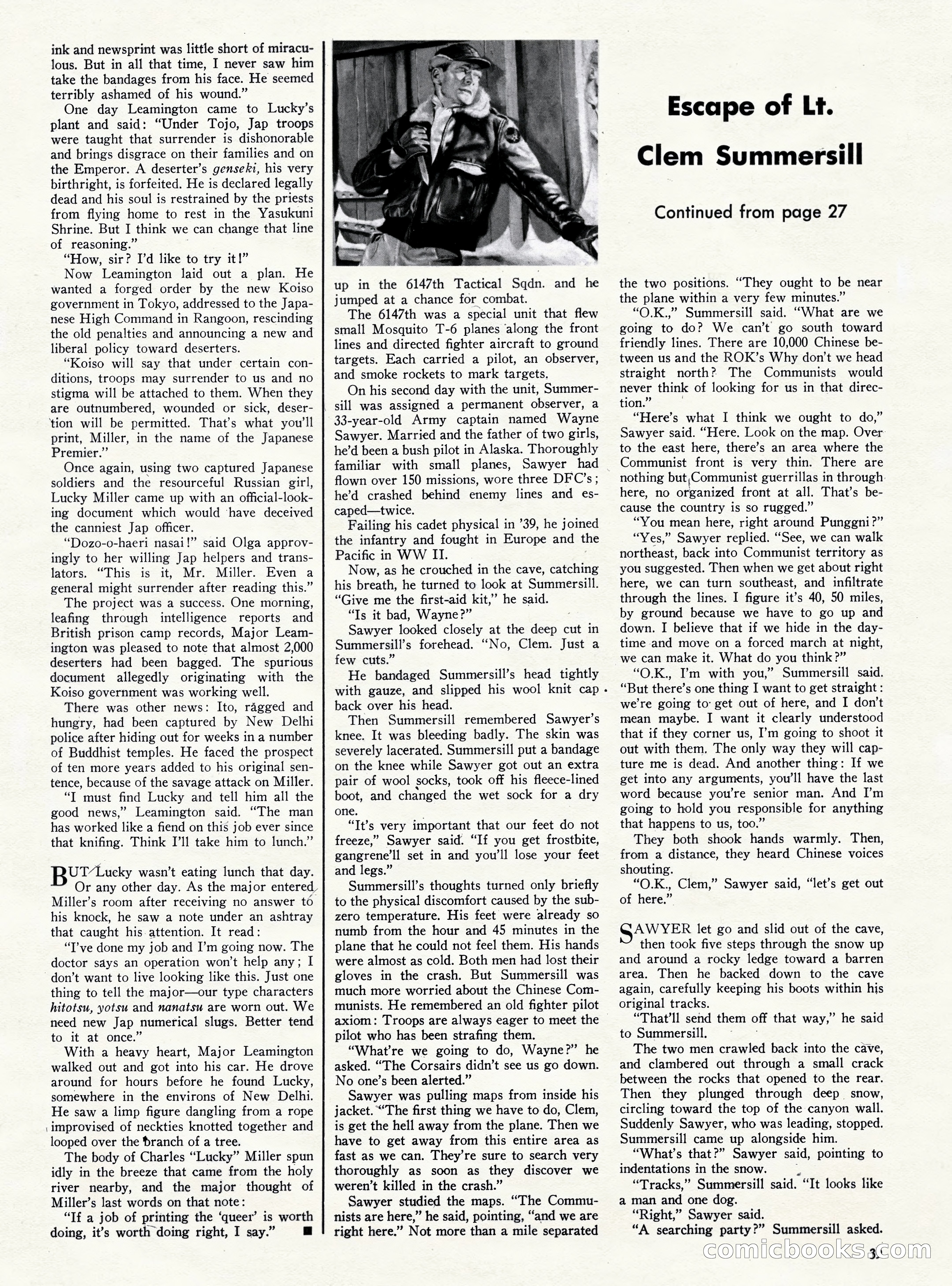
A restored page from Pulp Fiction, 1960. Page through the whole issue in the reader above.
📄 Transcribed text from this page (OCR, searchable)
Machine-transcribed from the original scan — historical spelling and the odd misread are preserved.
ink and newsprint was little short of miracu- lous. But in all that time, I never saw him take the bandages from his face. He seemed terribly ashamed of his wound.” One day Leamington came to Lucky’s plant and said: “Under Tojo, Jap troops were taught that surrender is dishonorable and brings disgrace on their families and on the Emperor. A deserter’s genseki, his very birthright, is forfeited. He is declared legally dead and his soul is restrained by the priests from flying home to rest in the Yasukuni Shrine. But I think we can change that line of reasoning.” “How, sir? I’d like to try it!” Now Leamington laid out a plan. He wanted a forged order by the new Koiso government in Tokyo, addressed to the Japa- nese High Command in Rangoon, rescinding the old penalties and announcing a new and liberal policy toward deserters. “Koiso will say that under certain con- ditions, troops may surrender to us and no stigma will be attached to them. When they are outnumbered, wounded or sick, deser- ‘tion will be permitted. That’s what you'll print, Miller, in the name of the Japanese Premier.” Once again, using two captured Japanese soldiers and the resourceful Russian girl, Lucky Miller came up with an official-look- ing document which would have deceived the canniest Jap officer. “Dozo-o-haeri nasai!” said Olga approv- ingly to her willing Jap helpers and trans- lators. “This is it, Mr. Miller. Even a general might surrender after reading this.” The project was a success. One morning, leafing through intelligence reports and British prison camp records, Major Leam- ington was pleased to note that almost 2,000 deserters had been bagged. The spurious document allegedly originating with the Koiso government was working well. There was other news: Ito, ragged and hungry, had been captured by New Delhi police after hiding out for weeks in a number of Buddhist temples. He faced the prospect of ten more years added to his original sen- tence, because of the savage attack on Miller. “IT must find Lucky and tell him all the good news,” Leamington said. “The man has worked like a fiend on this job ever since that knifing. Think I’ll take him to lunch.” BUP Lucky wasn’t eating lunch that day. Or any other day. As the major entered, Miller’s room after receiving no answer to his knock, he saw a note under an ashtray that caught his.attention. It read: “T’ve done my job and I’m going now. The doctor says an operation won't help any; I don’t want to live looking like this. Just one thing to tell the major—our type characters hitotsu, yotsu and nanatsu are worn out. We need new Jap numerical slugs. Better tend to it at once.” With a heavy heart, Major Leamington walked out and got into his car. He drove around for hours before he found Lucky, somewhere in the environs of New Delhi. He saw a limp figure dangling from a rope improvised of neckties knotted together and looped over the branch of a tree. The body of Charles “Lucky” Miller spun idly in the breeze that came from the holy river nearby, and the major thought of Miller’s last words on that note: “If a job of printing the ‘queer’ is worth doing, it’s worth doing right, I say.” | up in the 6147th Tactical Sqdn. and he jumped at a chance for combat. The 6147th was a special unit that flew small Mosquito T-6 planes along the front lines and directed fighter aircraft to ground targets. Each carried a pilot, an observer, and smoke rockets to mark targets. On his second day with the unit, Summer- sill was assigned a permanent observer, a 33-year-old Army captain named Wayne Sawyer. Married and the father of two girls, he’d been a bush pilot in Alaska. Thoroughly familiar with small planes, Sawyer had flown over 150 missions, wore three DFC’s ; he’d crashed behind enemy lines and es- caped—twice. Failing his cadet physical in ’39, he joined the infantry and fought in Europe and the Pacific in WW II. Now, as he crouched in the cave, catching his breath, he turned to look at Summersill. “Give me the first-aid kit,” he said. “Is it bad, Wayne?” Sawyer looked closely at the sie ae cut in Summersill’s forehead. ‘““No, Clem. Just a few cuts.” He bandaged Summersill’s head tightly with gauze, and slipped his wool knit cap. back over his head. Then Summersill remembered Sawyer’s knee. It was bleeding badly. The skin was severely lacerated. Summersill put a bandage on the knee while Sawyer got out an extra pair of wool socks, took off his fleece-lined boot, and changed the wet sock for a dry one. “It’s very important that our feet do not freeze,’ Sawyer said. “If you get frostbite, gangrene’ll set in and you'll lose your feet and legs.” Summersill’s thoughts turned only briefly to the physical discomfort caused by the sub- zero temperature. His feet were already so numb from the hour and 45 minutes in the plane that he could not feel them. His hands were almost as cold. Both men had lost their gloves in the crash. But Summersill was much more worried about the Chinese Com- munists. He remembered an old fighter pilot axiom: Troops are always eager to meet the pilot who has been strafing them. “What're we going to do, Wayne?” he asked. “The Corsairs didn’t see us go down. No one’s been alerted.” Sawyer was pulling maps from inside his jacket. “‘The first thing we have to do, Clem, is get the hell away from the plane. Then we have to get away from this entire area as fast as we can. They’re sure to search very thoroughly as soon as they discover we weren’t killed in the crash.” Sawyer studied the maps. “The Commu- nists are here,” he said, pointing, “and we are right here.” Not more than a mile separated Escape of Lt. Clem Summersill Continued from page 27 the two positions. “They ought to be near the plane within a very few minutes.” “O.K.,” Summersill said. “What are we going to do? We can’t go south toward friendly lines. There are 10,000 Chinese be- tween us and the ROK’s Why don’t we head straight north? The Communists would never think of looking for us in that direc- tion.” 3 “Here’s what I think we ought to do,” Sawyer said. “Here. Look on the map. Over: to the east here, there’s an area where the Communist front is very thin. There are nothing but,\Communist guerrillas in through here, no organized front at all. That’s be- cause the country is so rugged.” “You mean here, right around Punggni?” “Yes,” Sawyer replied. “See, we can walk northeast, back into Communist territory as you suggested. Then when we get about right here, we can turn southeast, and infiltrate through the lines. I figure it’s 40, 50 miles, by ground because we have to go up and down. I believe that if we hide in the day- time and move on a forced march at night, we can make it. What do you think?” “O.K., I’m with you,” Summersill said. “But there’s one thing I want to get straight: we're going to: get out of here, and I don't mean maybe. I want it clearly understood that if they corner us, I’m going to shoot it out with them. The only way they will cap- ture me is dead. And another thing: If we get into any arguments, you'll have the last word because you're senior man. And I’m going to hold you responsible for anything that happens to us, too.” They both shook hands warmly. Then, from a distance, they heard Chinese voices shouting. “O.K., Clem,” Sawyer said, “let’s get out of here.” AWYER let go and slid out of the cave, then took five steps through the snow up and around a rocky ledge toward a barren area. Then he backed down to the cave again, carefully keeping his boots within his original tracks. “That'll send them off that way,’ to Summersill. The two men crawled back into the cave, and clambered out through a small crack between the rocks that opened to the rear. Then they plunged through deep. snow, circling toward the top of the canyon wall. Suddenly Sawyer, who was leading, stopped. Summersill came up alongside him. “What’s that?” Sawyer said, pointing to indentations in the snow. “Tracks,” Summersill said. “It looks like a man and one dog. “Right,” Sawyer said. “A searching party?” Summersill asked. ’ he said GOMIGHoOo SS 3xCO 5}