
Pulp Fiction, 1960 · page 26 of 68
Action for Men, May 1960 — page 26: what you’re looking at
A restored page from Pulp Fiction, 1960. Page through the whole issue in the reader above.
📄 Transcribed text from this page (OCR, searchable)
Machine-transcribed from the original scan — historical spelling and the odd misread are preserved.
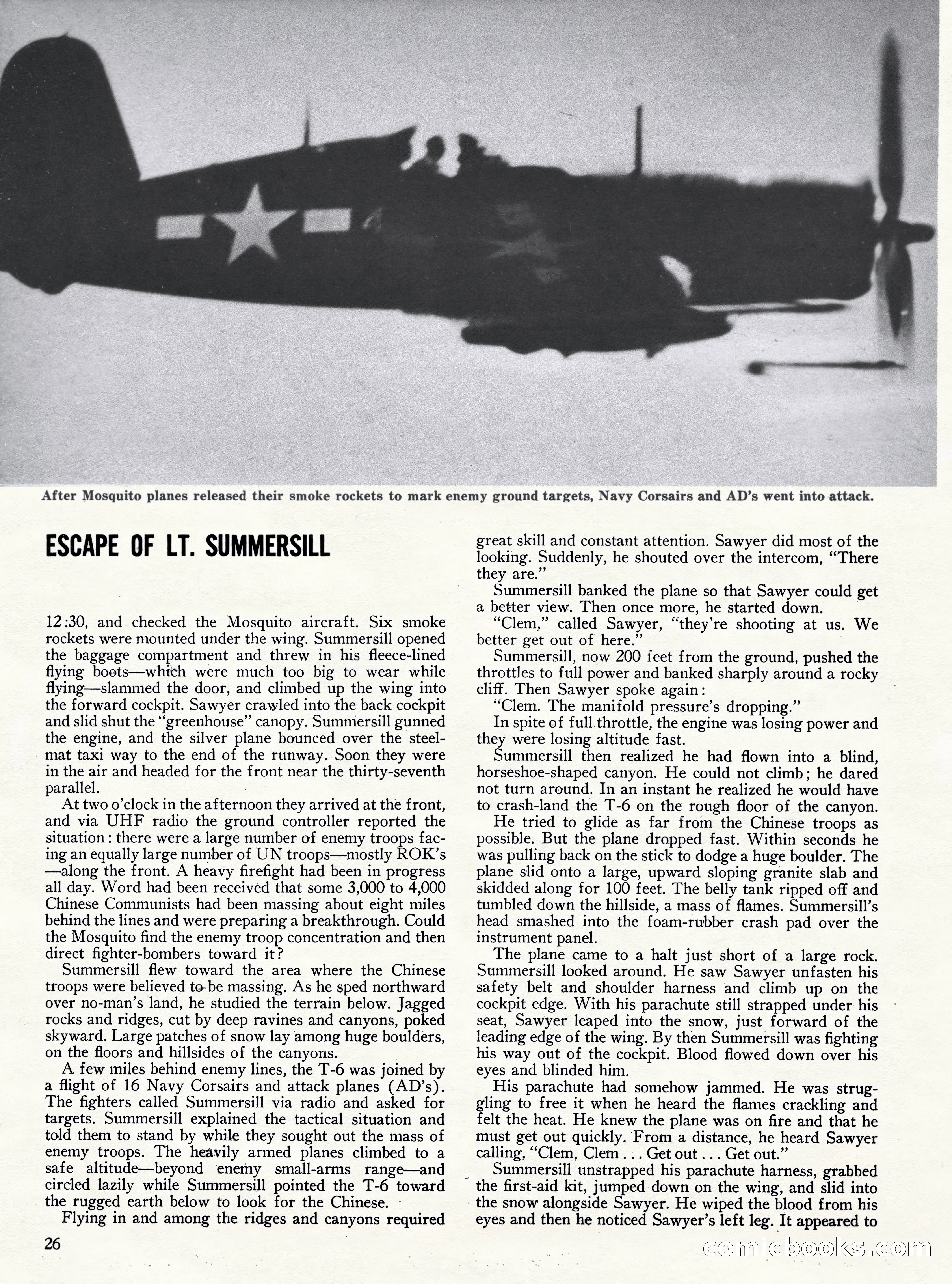
After Mosquito planes released their smoke rockets to mark enemy ground targets, Navy Corsairs and AD’s went into attack. ESCAPE OF LT. SUMMERSILL 12:30, and checked the Mosquito aircraft. Six smoke rockets were mounted under the wing. Summersill opened the baggage compartment and threw in his fleece-lined flying boets—which were much too big to wear while flying—slammed the door, and climbed up the wing into the forward cockpit. Sawyer crawled into the back cockpit and slid shut the ‘‘greenhouse” canopy. Summersill gunned the engine, and the silver plane bounced over the steel- _ mat taxi way to the end of the runway. Soon they were in the air and headed for the front near the thirty-seventh parallel. . At two o’clock in the afternoon they arrived at the front, and via UHF radio the ground controller reported the situation : there were a large number of enemy troops fac- ing an equally large number of UN troops—mostly ROK’s —along the front. A heavy firefight had been in progress all day. Word had been receivéd that some 3,000 to 4,000 Chinese Communists had been massing about eight miles behind the lines and were preparing a breakthrough. Could the Mosquito find the enemy troop concentration and then direct fighter-bombers toward it? Summersill flew toward the area where the Chinese troops were believed to-be massing. As he sped northward over no-man’s land, he studied the terrain below. Jagged rocks and ridges, cut by deep ravines and canyons, poked skyward. Large patches of snow lay among huge boulders, on the floors and hillsides of the canyons. A few miles behind enemy lines, the T-6 was joined by a flight of 16 Navy Corsairs and attack planes (AD’s). The fighters called Summersill via radio and asked for targets. Summersill explained the tactical situation and told them to stand by while they sought out the mass of enemy troops. The heavily armed planes climbed to a safe altitude—beyond enemy small-arms range—and circled lazily while Summersill pointed the T-6 toward _ the rugged earth below to look for the Chinese. — Flying in and among the ridges and canyons required 26 great skill and constant attention. Sawyer did most of the looking. Suddenly, he shouted over the intercom, “There they are.” Summersill banked the plane so that Sawyer could get a better view. Then once more, he started down. : “Clem,” called Sawyer, “they’re shooting at us. We better get out of here.” Summersill, now 200 feet from the ground, pushed the throttles to full power and banked sharply around a rocky cliff. Then Sawyer spoke again: “Clem. The manifold pressure’s dropping.” In spite of full. throttle, the engine was losing power and they were losing altitude fast. Summersill then realized he had flown into a blind, horseshoe-shaped canyon. He could not climb; he dared not turn around. In an instant he realized he would have to crash-land the T-6 on the rough floor of the canyon. He tried to glide as far from the Chinese troops as possible. But the plane dropped fast. Within seconds he was pulling back on the stick to dodge a huge boulder. The plane slid onto a large, upward sloping granite slab and skidded along for 100 feet. The belly tank ripped off and tumbled down the hillside, a mass of flames. Summersill’s head smashed into the foam-rubber crash pad over the instrument panel. The plane came to a halt just short of a large rock. Summersill looked around. He saw Sawyer unfasten his safety belt and shoulder harness and climb up on the cockpit edge. With his parachute still strapped under his seat, Sawyer leaped into the snow, just forward of the leading edge of the wing. By then Summersill was fighting his way out of the cockpit. Blood flowed down over his eyes and blinded him. His parachute had somehow jammed. He was strug- gling to free it when he heard the flames crackling and - felt the heat. He knew the plane was on fire and that he must get out quickly. From a distance, he heard Sawyer calling, “Clem, Clem... Get out... Get out.” Summersill unstrapped his parachute harness, grabbed _ the first-aid kit, jumped down on the wing, and slid into - the snow alongside Sawyer. He wiped the blood from his eyes and then he noticed Sawyer’s left leg. It appeared to © IOOKSHEO conn