
Pulp Fiction, 1960 · page 15 of 68
Action for Men, May 1960 — page 15: what you’re looking at
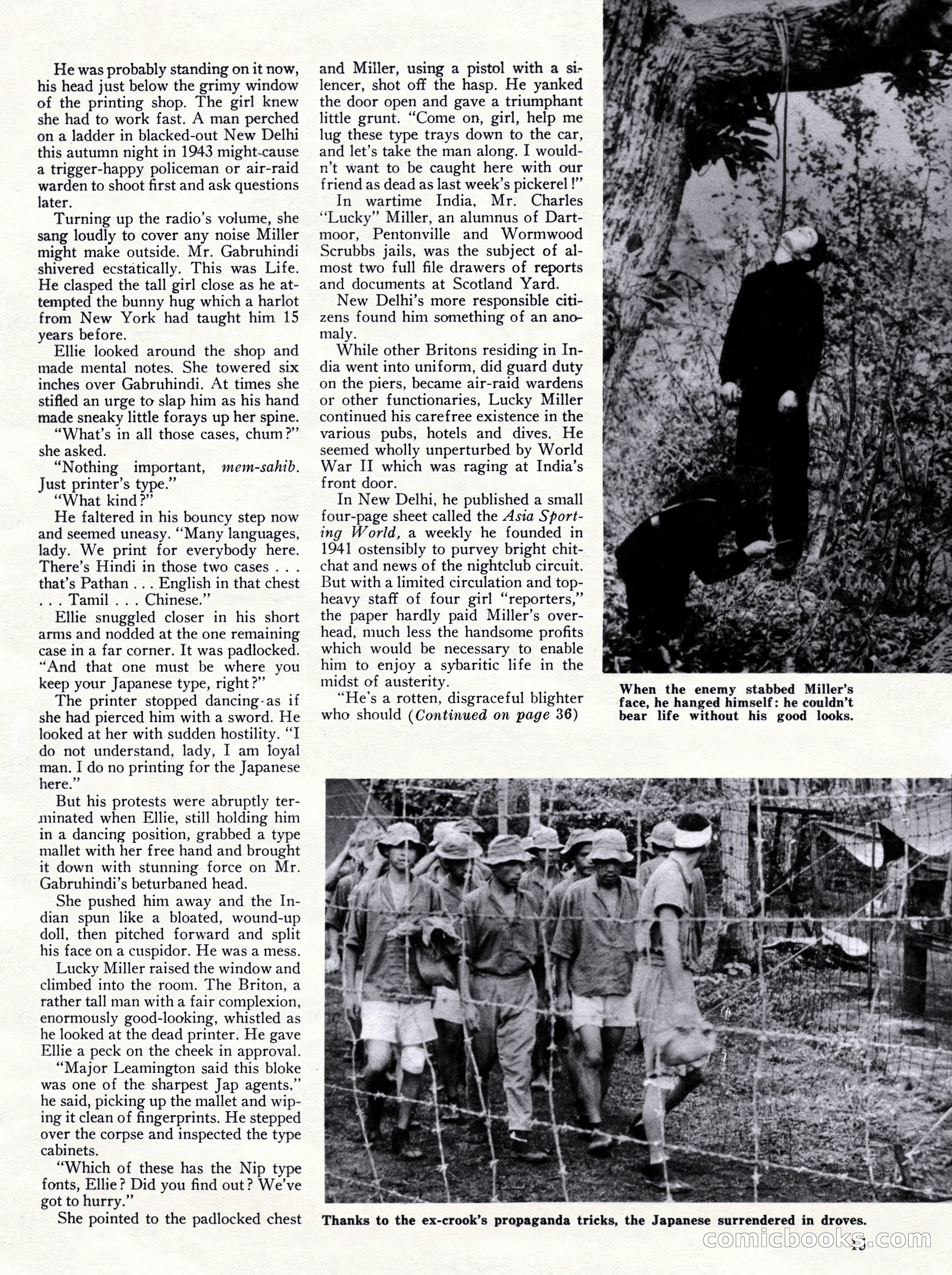
A restored page from Pulp Fiction, 1960. Page through the whole issue in the reader above.
📄 Transcribed text from this page (OCR, searchable)
Machine-transcribed from the original scan — historical spelling and the odd misread are preserved.
He was probably standing on it now, his head just below the grimy window of the printing shop. The girl knew she had to work fast. A man perched on a ladder in blacked-out New Delhi this autumn night in 1943 might-cause a trigger-happy policeman or air-raid warden to shoot first and ask questions later. Turning up the radio’s volume, she sang loudly to cover any noise Miller might make outside. Mr. Gabruhindi shivered ecstatically. This was Life. He clasped the tall girl close as he at- tempted the bunny hug which a harlot from New York had taught him 15 years before. Ellie looked around the shop and made mental notes. She towered six inches over Gabruhindi. At times she stifled an urge to slap him as his hand made sneaky little forays up her spine. “What’s in all those cases, chum ?”’ she asked. “Nothing important, Just printer’s type.” “What kind ?” He faltered in his bouncy step now and seemed uneasy. “Many languages, lady. We print for everybody here. There’s Hindi in those two cases... that’s Pathan... English in that chest <aal .., Chinese: Ellie snuggled closer in his short arms and nodded at the one remaining case in a far corner. It was padlocked. “And that one must be where you keep your Japanese type, right?” The printer stopped dancing-as if she had pierced him with a sword. He looked at her with sudden hostility. “I do not understand, lady, I am loyal man. I do no printing for the Japanese here.” But his protests were abruptly ter- minated when Ellie, still holding him in a dancing position, grabbed a type mallet with her free hand and brought it down with stunning force on Mr. Gabruhindi’s beturbaned head. She pushed him away and the In- dian spun like a bloated, wound-up doll, then pitched forward and split his face on a cuspidor. He was a mess. Lucky Miller raised the window and climbed into the room. The Briton, a rather tall man witha fair complexion, enormously good-looking, whistled as he looked at the dead printer. He gave Ellie a peck on the cheek in approval. “Major Leamington said this bloke was one of the sharpest Jap agents,” he said, picking up the mallet and wip- ing it clean of fingerprints. He stepped over the corpse and inspected the type cabinets. “Which of these has the Nip type fonts, Ellie? Did you find out ? We’ve got to hurry.” She pointed to the padlocked chest mem-sahib. and Miller, using a pistol with a si- lencer, shot off the hasp. He yanked the door open and gave a triumphant little grunt. “Come on, girl, help me lug these type trays down to the car, and let’s take the man along. I would- n’t want to be caught here with our friend as dead as last week’s pickerel !” In wartime India, Mr. Charles “Lucky” Miller, an alumnus of Dart- moor, Pentonville and Wormwood Scrubbs jails, was the subject of al- most two full file drawers of reports and documents at Scotland Yard. New Delhi’s more responsible citi- zens found him something of an ano- maly. While other Britons residing in In- dia went into uniform, did guard duty on the piers, became air-raid wardens or other functionaries, Lucky Miller continued his carefree existence in the various pubs, hotels and dives. He seemed wholly unperturbed by World War II which was raging at India’s front door. In New Delhi, he published a small four-page sheet called the Asia Sport- ing World, a weekly he founded in 1941 ostensibly to purvey bright chit- chat and news of the nightclub circuit. But with a limited circulation and top- heavy staff of four girl “reporters,” the paper hardly paid Muiller’s over- head, much less the handsome profits which would be necessary to enable him to enjoy a sybaritic life in the midst of austerity. “He's a rotten, disgraceful blighter who should (Continued on page 36) Thanks to the ex-crook’s propaganda tricks, the Japanese surrendered in droves. * When the enemy stabbed Miller’s face, he hanged himself: he couldn’t bear life without his good looks. (C(O) im (C OO) J